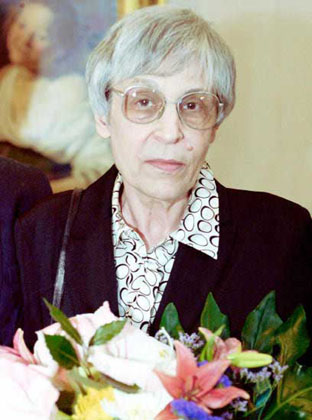
4-8-2004

Юнна Петровна Мориц

Yunna Morits

(b. 1937)


Yunna Morits was born in Kiev. Her first collection of poetry, Talk of Happiness, was published in 1957. in 1964 she published a collection of translations of the Jewish poet M. Toif. With Joseph Brodsky, she was a particular favourite of Akhmatova’s. She has had a hard life: she suffered from tuberculosis, and her husband, a literary critic,  committed suicide at the time of the Soviet invasion of Czechoslovakia. Though regarded by many writers as one of the finest women poets in Russia today, Morits is very little published now, and is scarcely known abroad. She has been much influenced by Pasternak and, like him and Zabolotsky, has an animistic vision of nature. Her powerful, atmospheric poems about the Far North or the South, severe, utterly serious, with intimations of pain, of loss, of separation, are darkly moving. Her verses stir with the slow rhythm of nature. She is a poet of rooted attachments, measuring her love against the forces of nature. She is drawn to those men – hunters, settlers, fishermen – whose business it is to live and contend with these forces. The intensity of her work, its concrete, weighted depiction of the drama of the spiritual life as it is reflected or as it unfolds in nature, places her in the forefront of contemporary Russian poetry.

from Post-War Russian Poetry, Edited by Daniel Weissbort,Penguin Books, London, 1974, ISBN 0-14042-183-1


Yunna Morits


LINKS:

Poems in English

O O O O O

Biographies in Russian

O O O O O

Poems in Russian

O O O O O
  O O O O O


Ты - моя девочка,
ты - моя нежная,
ты - моя сладкая.


Лежит она горкой
в пахнущей хлоркой палате,
думает кожицей на голове:
я помираю для здесь,
а для там - неизвестно...


Стряпай, стирай, - она говорит
глазами, - чисти ботинки,
брейся, и галстук...


Вата на палке горит,
делают банки
кому-то.


Пошел покурить.
Доктор работал в Шри-Ланке,
тысячу взял: не волнуйся, мужик,
не будет ей больно, -
сделаю, чтобы во сне.
Палтуса хочешь с капустой,
лишняя порция?..


Палтусом пахнет с капустой,
Господи, он подъедает
в больнице объедки,
не унижай его, Господи,
это - мой мальчик,
дай ему вдовую девочку
в чистой одежде.


Так они жили когда-то
и так умирали,
наши «совки», -
отключали им летом горячую воду,
был еще сахар, и на зиму
вишню варили, малину,
мяту сушили, смородинный лист
и шиповник...
Дурно история пахнет,
а личная жизнь ароматна.


1992


You are my girl
you are my darling,
you are my honey


She lies like a small hill
in a room smelling of chlorine,
thinks with the thin skin of her scalp:
here, I'm dying,
but here – who knows?


Cook, wash, her eyes
say, polish your shoes,
shave, and your tie …


Cotton wadding burns on a stick,
they are cupping
someone.


He went for a smoke.
The doctor had worked in Sri Lanka,
made a mint: "don't upset yourself, man,
she won't suffer, –
I'll manage so she's asleep.
Do you want some halibut and cabbage,
there's some left …"


He smells of halibut and cabbage,
Dear Lord, he's finishing off
hospital leftovers,
don't humiliate him, Dear Lord,
he is my own boy,
find him a young widow
in a clean dress


So they once lived
and so died,
our "sovki",*
in summer their hot water was cut off,
though there was still sugar. And in winter
they cooked cherries, raspberries;
they dried mint, current leaf
and dogrose …
History stinks,
but a life is aromatic.


*"Soviet folk"   

                      
1992 (trans.
Daniel Weissbort and Leona Medlin)


  Приходить домой, а там - казино или пицца-хат.
На каждом газоне - свой президент и вице.
При вате приватизации - кавалерист-девицы.
Мэристо и префектно запахивая халат,
пьет охраняемый член голландское пиво из банки,
в это время по факсу ему сообщает фирма,
что пипифаксу четыре вагона меняет Бирма
на подводную лодку. Кровавый понос в Госбанке,
деньги кончились, бобик сдох, казначею дурно.
- Дерьмократы проклятые, мать их через губу! -
выражается очередь, не умеющая культурно
свое место занять в гробу...
Клио, лично меня никакая помощь не унижает,
но учти, что она не доходит, - полно ворья,
все красавцы, все гении, все мозги уезжают,
остаются такие бездари и дураки, как я.

1991


You get home, there's a casino or a Pizza Hut.
Each yard has its President and Vice-.
Muffled in the cotton-wool of privatisation, that
           mounted soldier-woman.
The guarded Member drinks Dutch beer from a can,
wrapping his bathrobe round him in Mayoral and
           Prefectly fashion,
At this time, the firm's fax informs him,
Burma is trading four trainloads of toilet paper
for a submarine. Bloody flux in the State Bank,
the money's run out, the puppy has croaked, the
          Treasurer is not feeling so good.
"Damned Demo-Craps, kiss your Mother's ass!"
the line lets rip, not knowing how to take its place
in the grave in a civilised manner.
Clio, personally I find aid does not demean me,
but bear in mind it doesn't reach me, – enough thieving,
all the good-looking guys, geniuses, all the brains are leaving;
only the talentless and fools remain behind, like me.

1991 (trans. Daniel Weissbort and Leona Medlin)


НА ГРАНИ ВЫДОXА И ВЗДОXА


На грани выдоха и вдоха есть волна,

где жизнь от видимости освобождена,

упразднены тела и внешние черты,

и наши сути там свободно разлиты.


Там нет сосудов для скопления пустот,

и знак присутствия иной, чем здесь, и счет

не лицевой, не именной, и только ритм

там раскаляется и звездами горит.


На грани выдоха и вдоха есть волна,

где жизнь, как музыка, слышна, но не видна.

И там поэзия берет свои стихи.

И там посмертно искупаются грехи.


1984


On the Border of the Out-breath and the In


On the border of the out-breath and the in,

is a wave where life is freed from seeming so,

body and external traits are gone,

and our essential natures liberally flow.

There are no vessels there to gather vacuums,

and the sign for presence is different, the account’s

not personal, not nominal, only the rhythm,

burning like the stars, is incandescent.

On the border of the out-breath and the in,

is a wave where life is audible, like music, but not seen,

and it is there that poetry takes its lines,

and there we posthumously atone for sin.


1984

(translated by Daniel Weissbort)


ПОРТРЕТ ЗВУКА

Когда неясный образ мне внушен,
Его рисую я карандашом
И к линии прислушиваюсь гибкой...
Пока не вспыхнет узнаванья свет
И с ним - из тьмы исхищенный портрет
Живого звука с милосердною улыбкой.
Тогда, на горле блузу распахнув,
Я тонкое беру, как стеклодув,
И звук живой вдыхаю в эту пленку -
И вся в нее уходит жизнь моя
В прозрачном виде, как воздушная струя..
А звука ненаглядное лицо
Так переливчато и, Господи, так звонко!

1984


Portrait of a Sound


When the dim outlines are suggested,

I draw them with a pencil, listening intently

To that line’s sinuous meanderings …

Until the light of recognition dawns,

Whereupon the portrait of a living sound,

With a tender smile, is snatched from obscurity.

Then, opening its blouse at the throat,

Like a glass-blower I seize the slender thing,

And breathe a living sound into this membrane.

And the whole of my life goes out into it,

Transparent, like a pure stream of air …

And the sound’s surpassingly lovely face

Is so irridescent, lord, and, oh, so clear!


1984


(translated by Daniel Weissbort)


Если бы я знала в двадцать лет,
Что меня настигнет столько бед,
Что лишусь таких великих благ, -
Белый бы я выбросила флаг.

Я бы круто повернула путь,
Я совсем не к тем бы стала льнуть,
Средства поменяла бы и цель, -
И меня хвалила бы артель.

Даже десять лет тому назад
Все могло пойти еще на лад, -
Трудно ли умеючи? Легко!
Но зашла я слишком далеко.

Не могу я, братцы, дать отбой.
Остается только быть собой.
Если я до смерти доживу,
Белый флаг на саван разорву.

И тогда вы молвите слова,
От которых кругом голова ...
Трудно ли умеючи? Пустяк!
Мертвому поэту все простят -

Даже неприятные черты,
Вроде силы духа в грозный час,
Вроде трех
Отнюдь не кротких глаз,
Вроде правды, сказанной про вас.


If only I’d known at twenty years,

How calamitous would be my lot,

That I’d be deprived of such great blessings,

I should have hoisted a white flag.


I should have abruptly changed my path,

I’d not have stuck to it at all.

I’d have changed both means and ends –

And the guild would have commended me.


As little as ten years ago,

Everything might still have turned out well –

Is it hard if you know how?

It’s not! But I went too far.


Fellows, I cannot stop it now.

All I can do is be myself.

If I should live until I die,

That torn white flag will be my shroud.


And then you will utter such words,

As will make my poor head spin …

It’s not in the least hard if you know how!

A dead poet’s forgiven all her sins –


Even unfortunate traits such as:

A stubborn heart, when the going’s rough,

Three eyes,

By no means meek and mild,

The truth she told about you once.


1985

(translated by Daniel Weissbort)


ЯНВАРЬ


У нас такая синева

В окне - от близости реки,

Что хочется скосить зрачки,

Как на иконе, как при чуде.

У нас такие покрова

Снегов - почти материки,

Что день задень - в ушах звонки,

И всюду голубые люди,

И я да ты - ученики

У чародея. Холодея,

Стоим в просторах мастерской

У стенки с аспидной доской.

Зрачками - вглубь. В гортани - сушь.

Вкачу, вчитаю по слогам

В гордыню, в собственную глушь

Ежеминутной жизни гам,

Битком набитый балаган

Без тряпки жалкой на окне.

И все, что прежде было вне,

Теперь судьбу слагает нам,

Родным составом входит в кровь,

Приставкой к личным именам.

Сообщники! У нас-любовь

Ко всем грядущим временам,

Ко всем - до гибельного рва,

До рваной раны, до строки

Оборванной, где прет трава

Поверх груди, поверх руки!

У нас такая синева

В окне от близости реки.


1967


JANUARY


Such blueness blazes at our window

From the nearness of the river

We want to turn aside our eyes

As on ikons or at miracles.

Such shrouds, such continents of snow,

To touch a day sets our ears ringing

And people everywhere are blue.

- And you and I, apprentices

of the enchanter, stand and freeze

In the spaces of the studio

Beside the blackboard on the wall,

With dry throats and piercing gaze.

I’ll draw and scan, in arrogance,

Each syllable, each minute’s life,

To my remoteness; and the crammed

Fairbooth, no rag to veil its panes –

And all that was irrelevance

Now shapes our fate, enters our veins,

Stands as prefix to our names.

Accomplices! our love’s forever,

For all men, to the ruinous grave,

To the torn wound, and to the line

Unfinished: where grass springs, and stands

Above our breasts, above our hands.

Such blueness blazes at our window

From the nearness of the river.


Translated by J.R.Rowland        


Южный рынок 


Инжир, гранаты, виноград -
Слова бурлят в стихах и прозе.
Кавказа чувственный заряд
Преобладает в их глюкозе.
Корыта, вёдра и тазы
Они коробят и вздувают,
Терзают негой наш язык
И нити мыслей обрывают.

Прекрасны фруктов имена!
Господь назвал их и развесил
В те золотые времена,
Когда он молод был и весел,
И образ плавал в кипятке
Садов Урарту и Тавриды,
Одушевляя в языке
Еще не изданные виды.

А ветры шлепали доской,
Тепло с прохладой чередуя
В его скульптурной мастерской.
Серьезный ангел, в пламя дуя,
Хозяйство вел. Из образцов
Готовил пищу. Пили кофе.
А всякий быт, в конце концов,
Враждебен мыслям о голгофе.

Я это знаю по себе,
По гнету собственных корзинок.
Я это знаю по ходьбе
На рынок, черный от грузинок,
Влачащих овощ на горбе.


   1966


SOUTHERN MARKET


Pomegranates, figs and grapes:

How the words seethe, in verse or prose –

There’s all the feeling, all the smell

Of the Caucasus in their glucose.

Every vessel, bucket, basin

They curve and overflow and swell –

How they torment our tongues with sweetness

And tear the web of our attention!|

Beautiful names – the names of fruit.

The Lord Almighty named and hung them

In his gay youth, that golden age,

When their reflections swam in waters,

Still hot, of the gardens of Urartu

And Tavrida, that inspired

Unheard-of notions into language.

In his workshop blew the winds

Slapping, mixing hot with cold:

A serious angel puffed the fire,

Kept house for him, prepared the food

From samples. Together they drank coffee.

All domesticities impede

Thoughts of Golgotha: that I know

From me own full baskets’ weight

As to the marketplace I go

Back with Georgian women, bent

Under their dragging load of fruit.


Translated by J.R.Rowland                   


The poems "January", and "Southern Market" were found in the book Post-War Russian Poetry, Edited by Daniel Weissbort, Penguin Books, London, 1974, ISBN 0-14042-183-1.


Воспоминание


Из горящего поезда на траву
Выбрасывали детей.
Я плыла по кровавому, скользкому рву
человеческих внутренностей, костей…


Пилот, который летал надо мной, -
Коричневая чума, -
Скалился и хохотал, как больной,
Который сошел с ума.
Он реял в летающем сундуке,
В лобовое влипал стекло.
Я видела свастику на руке
И то, что со лба текло.

А еще я видела красный круг
Паровозного колеса.
И от ужаса мне не хватало рук,
Чтобы закрыть глаза,
Потому что не двигался паровоз,
Но кровавый туман и чад
От на месте вертящихся шел колес
И чугунный стонал рычаг –
Словно в локте согнутая рука,
Оторванная от тела,
Чтобы колеса паровика
Посмертно она вертела!

Так на пятом году мне послал Господь
Спасенье и долгий путь...
Но ужас натек в мою кровь и плоть,
И катается там, как ртуть!
И, когда засыпаю лицом к луне,
Так горько во сне я плачу,
Что слезы мои текут по стене,
В которой я память прячу.


A Memory


They threw the children

from the burning train

out onto the grass.

I slithered and swam

in a bloody trench

of bone, gristle, guts.


The pilot who flew overhead,

this scion of the brownshirt blight

grinned like an invalid,

finally out of his mind.

He hovered in his airborne cage,

pressed to the cockpit glass.

I saw the swastika on his arm,

the sweat on his brow, the rage.


And I saw, too, the red circle

of the locomotive’s wheel.

And fear robbed me

of the strength to exclude

everything I had seen’-

because the engine was motionless,

yet the blood-red fumes

rose from the wheels, turning still,

and the iron lever groaned –

it was like an arm, crooked at the elbow,

torn from the trunk it served,

to keep the locomotive’s wheels

posthumously going round!


This was in the fifth year of my life.

The Good Lord rescued me

for the long way that lay ahead…

But in my blood, like mercury,

is the dread that entered my flesh!

And now, in the moon’s view, as I sleep,

so wildly do I lament

that the very wall where the memory

is stored streams with tears.


Translated by Daniel Weissbort      


Между Сциллой и Харибдой


Быть поэтессой в России – труднее, чем быть поэтом: единица женской силы в русской поэзии – 1 ахмацвет. 


     Ходим в люльке с погремушкой,

     Расцветаем, увядаем.          

     Между Арктикой и  Кушкой,    

     Между Польшей и Китаем.      


     Покидаем с вечным  всхлипом  

     Облак над лицейским  прудом. 

     Между Лиром и Эдипом,        

     Между Цезарем и  Брутом.     


     Сохраняем здравый разум,

     Маслим  свет над фолиантом.

     Строим ясли голым фразам,

     Между Пушкиным и Дантом.


     Поднося фонарь к репризам,

     Связь находим колоссальной

     Между Блоком и Хафизом,

     Между Музой и Кассандрой.


     И дыша гипербореем,

     Проплываем каравеллой

     Между Женей и Андреем,

     Между Беллой и Новеллой.


     Но кровавою корридой

     Угрожает путь старинный

     Между Сциллой и Харибдой,

     Между Анной и Мариной.


     Между Сциллой и Харибдой

     Между Анной и Мариной -

     Кто проглочен был пучиной

     Тот и выплюнут пучиной.


     Стало следствие причиной

     Объясняю образ странный

     Кто проглочен был Мариной

     Тот и выплюнут был Анной.


     Золотою серединой

     Отродясь не обладаем,

     Между Анной и Мариной,

     Между Польшей и Китаем.


     И над бездною родимой  

     Уж не знамо, как летаем, 

     Между Анной и Мариной

     Между Польшей и Китаем.  


Between Scylla and Charybdis


To be a woman poet in Russia is harder than to be a male poet: the unit of female power in Russian poetry is one akhmatsvet


With a rattle we are walking

Round the cradle, flowering, fading.

Between the Arctic and Turkmenia,

Between the Polish lands and China.


With a deep sob we abandon

Clouds above the Lycée puddle –

Between Oedipus and Lear,

Between Julius and Brutus.


We keep our reason healthy,

Dim the light above the folio,

Make a crib for naked phrases,

Between Pushkin and Alighieri.


Highlighting the reprises,

We find a vast connection

Between Blok and Persian Hafiz

Between the Muse and Cassandra.


And breathing, hyperborean,

We sail through, caravel-like,

Between Zhenya and Andrei,

Between Bella and Novella.


But like a gory bullfight,

The ancient path is threatening,

Between Scylla and Charybdis,

Between  Anna and Marina.


Between Scylla and Charybdis,

Between  Anna and Marina,

He whom the gulf has swallowed,

Was spat out by it likewise.


Consequences became a cause.

I'll explain this odd idea:

He whom Marina swallowed,

Was spat out then by Anna.


In all our born days, never

Did we command the Golden Mean –

Between  Anna and Marina.

Between the Polish lands and China.


And above our native chasm -

Who knows how! – look, we are flying

Between  Anna and Marina.

Between the Polish lands and China.


Note: “Akhmatsvet”, a compound, derived from the names of Anna Akhmatova (the sound “akh” recalls the outbreath) (1889-1966) and of Marina Tsvetaeva (1892 – 1941). Zhenya, Andrei, Bella, Novella are Evgeny (Zhenia) Yevtushenko (b. 1933), Andrei Voznesnesky (b.1933), Bella Akhmadulina (b. 1937) and Novella Matveeva (b. 1934), popular public poets of the generation that includes Morits.


Translated by Daniel Weissbort        


  The poems "A Memory" and "Between Scylla and Charybdis" are from Modern Poetry in Translation New Series n.º 20, Edited by Daniel Weissbort, Guest Editor Valentina Polukhina, King's College, London, University of London, 2002 ISBN 0-9533824-8-6  


Я с гениями водку не пила

И близко их к себе не подпускала.
Я молодым поэтом не была,
Слух не лелеяла и взоры не ласкала.

На цыпочках не стоя ни пред кем,
Я не светилась, не дышала мглою
И свежестью не веяла совсем
На тех, кто промышляет похвалою.

И более того! Угрюмый взгляд
На многие пленительные вещи
Выталкивал меня из всех плеяд,
Из ряда - вон, чтоб не сказать подлеще.

И никакие в мире кружева
Не в силах были напустить тумана
И мглой мои окутать жернова
И замыслы бурлящего вулкана.

Так Бог помог мне в свиту не попасть
Ни к одному из патриархов Музы,
Не козырять его любовью всласть,
Не заключать хвалебные союзы,

Не стать добычей тьмы и пустоты
В засиженном поклонниками зале...
Жи