6-12-2000


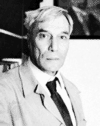
 Boris Leonidovich Pasternak

Борис Леонидович Пастернак


b. Feb. 10 [Jan. 29, Old Style], 1890, Moscow, Russia
d. May 30, 1960, Peredelkino, near Moscow

Russian poet whose novel Doctor Zhivago helped win him the Nobel Prize for Literature in 1958 but aroused so much opposition in the Soviet Union that he declined the honour. An epic of wandering, spiritual isolation, and love amid the harshness of the Russian Revolution and its aftermath, the novel became an international best-seller but circulated only in secrecy and translation in his own land.

Pasternak grew up in a cultured Jewish household. His father, Leonid, was an art professor and a portraitist of novelist Leo Tolstoy, poet Rainer Maria Rilke, and composer Sergey Rachmaninoff, all frequent guests at his home, and of Lenin. His mother was the pianist Rosa Kaufman.

Young Pasternak himself planned a musical career, though he was a precocious poet. He studied musical theory and composition for six years, then abruptly switched to philosophy courses at Moscow University and the University of Marburg (Germany). Physically disqualified for military service, he worked in a chemical factory in the Urals during World War I. After the Revolution he worked in the library of the Soviet commissariat of education.

His first volume of poetry was published in 1913. In 1917 he brought out a striking second volume, Poverkh baryerov ("Over the Barriers"), and with the publication of Sestra moya zhizn (1922; "My Sister Life") he was recognized as a major new lyrical voice. His poems of that period reflected Symbolist influences. Though avant-garde and esoteric by Russian standards, they were successful. From 1933 to 1943, however, the gap between his work and the official modes (such as Socialist Realism) was too wide to permit him to publish, and he feared for his safety during the purges of the late 1930s. One theory is that Stalin spared him because Pasternak had translated poets of Stalin's native Georgia. His translations, which were his main livelihood, included renderings of William Shakespeare, Johann Wolfgang von Goethe, English Romantic poets, Paul Verlaine, and Rainer Maria Rilke.

Although Pasternak hoped for the best when he submitted Doctor Zhivago to a leading Moscow monthly in 1956, it was rejected with the accusation that "it represented in a libelous manner the October Revolution, the people who made it, and social construction in the Soviet Union." The book reached the West in 1957 through an Italian publishing house that had bought rights to it from Pasternak and refused to return it "for revisions." By 1958, the year of its English edition, the book had been translated into 18 languages.

In the Soviet Union, the Nobel Prize brought a campaign of abuse. Pasternak was ejected from the Union of Soviet Writers and thus deprived of his livelihood. Public meetings called for his deportation; he wrote Premier Nikita S. Khrushchev, "Leaving the motherland will equal death for me." Suffering from cancer and heart trouble, he spent his last years in his home at Peredelkino.

Pasternak's works in English translation include short stories, the autobiographical Okhrannaya gramota (1931; Safe Conduct), and the full range of his poetic output, which ended on a note of gravity and quiet inwardness.

In 1987 the Union of Soviet Writers posthumously reinstated Pasternak, a move that gave his works a legitimacy they had lacked in the Soviet Union since his expulsion from the writers' union in 1958 and that finally made possible the publication of Doctor Zhivago in the Soviet Union. In addition to effecting Pasternak's rehabilitation, the review commission, headed by poet Andrey Voznesensky, recommended that Pasternak's home in Peredelkino be made a museum.


Works of mainly biographical interest include Olga Ivinskaya, A Captive of Time (1978; originally published in Russian, 1978); Guy de Mallac, Boris Pasternak: His Life and Work (1981); Ronald Hingley, Pasternak (1983); Christopher Barnes, Boris Pasternak: A Literary Biography (1989- ); and Lazar Fleishman, Boris Pasternak: The Poet and His Politics (1990). Criticism is represented by Olga R. Hughes, The Poetic World of Boris Pasternak (1974); Henry Gifford, Pasternak: A Critical Study (1977); and Victor Erlich (ed.), Pasternak: A Collection of Critical Essays (1978). Munir Sendich, Boris Pasternak: A Reference Guide (1994), an annotated bibliography of works by and about Pasternak, 1913-90, includes an essay on the critical reception Pasternak's writings received.


        Зимняя ночь

Мело, мело по всей земле
Во все пределы.
Свеча горела на столе,
Свеча горела.

Как летом роем мошкора
Летит на пламя,
Слетались хлопья со двора
К оконной раме.

Метель лепила на столе
Кружки и стрелы.
Свеча горела на столе,
Свеча горела.

На озаренный потолок
Ложились тени,
Скрещенья рук, скркщенья ног,
Судьбы скрещенья.

И падали два башмачка
Со стуком на пол,
И воск слезами с ночника
На платье капал.

И все терялось в снежной мгле
Седой и белой.
Свеча горела на столе,
Свеча горела.

На свечку дуло из угла,
И жар соблазна
Вздымал, как ангел, два крыла
Крестообразно.

Мело весь месяц в феврале,
И то и дело
Свеча горела на столе,
Свеча горела.

            1946


Winter's night

Blizzards were blowing everywhere
Throughout the land.
A candle burned upon the table,
A candle burned.

As midgets in the summer fly
Towards a flame,
The snowflakes from the yard swarmed to
The window pane.

And, on the glass, bright snowy rings
And arrows formed.
A candle burned upon the table,
A candle burned.

And on the white illumined ceiling
Shadow were cast,
As arms and legs and destinies
Fatefully crossed.

Two slippers fell on to the floor
With a light sound,
And waxen tears dripped from the candle 
On to a gown.

No object in the misty whiteness
Could be discerned.
A candle burned upon the table,
A candle burned.

A mild draught coming from the corner
Blew on the candle,
Seduction's heat raised two wings crosswise
As might an angel.

It snowed and snowed that February
All through the land.
A candle burned upon the table,
A candle burned.


Никого не будет в доме,
Кроме сумерек. Один
Зимний день в сквозном проеме
Незадернутых гардин.

Только белых мокрых комьев
Быстрый промельк моховой.
Только крыши, снег и, кроме
Крыш и снега, -- никого.

И опять зачертит иней,
И опять завертит мной
Прошлогоднее унынье
И дела зимы иной,

И опять кольнут доныне
Неотпущенной виной,
И окно по крестовине
Сдавит голод дровяной.

Но нежданно по портьере
Пробежит вторженья дрожь.
Тишину шагами меря,
Ты, как будущность, войдешь.

Ты появишься у двери
В чем-то белом, без причуд,
В чем-то впрямь из тех материй,
Из которых хлопья шьют.
 

                      1931
 

There'll be noone in the house
Save for twilight. All alone,
Winter's day seen in the space that's
Made by curtains left undrawn.

Only flash-past of the wet white
Snowflake clusters, glimpsed and gone.
Only roofs and snows, and save for
Roofs and snow -- no one at home.

Once more, frost will trace its patterns,
I'll be haunted once again
By my last-year's melancholy,
By that other wintertime.

Once more I'll be troubled by an
Old, unexpiated shame,
And the icy firewood femine
Will press on the window-pane.

But the quiver of intrusion
Through those curtain folds will run
Measuring silence with your footsteps,
Like the future, in you'll come.

You'll appear there in the doorway
Wearing something white and plain,
Something in the very stuff from
Which the snowflakes too are sewn.


Февраль. Достать чернил и плакать!
Писать о феврале навзрыд,
Пока грохочащая слякоть
Весною черною горит.

Достать пролетку. За шесть гривен
Чрез благовест, чрез клик колес
Перенестись туда, где ливень
Еще шумней чернил и слез.

Где, как обугленные груши,
С деревьев тысячи грачей
Сорвутся в лужи и обрушат
Сухую грусть на дно очей.

Под ней проталины чернеют,
И ветер криками изрыт,
И чем случайней, тем вернее
Слагаются стихи навзрыд.

                          1912
 

February. Get ink, shed tears.
Write of it, sob your heart out, sing,
While torrential slush that roars
Burns in the blackness of the spring.

Go hire a buggy. For six grivnas,
Race through the noice of bells and wheels
To where the ink and all you grieving
Are muffled when the rainshower falls.

To where, like pears burnt black as charcoal,
A myriad rooks, plucked from the trees,
Fall down into the puddles, hurl
Dry sadness deep into the eyes.

Below, the wet black earth shows through,
With sudden cries the wind is pitted,
The more haphazard, the more true
The poetry that sobs its heart out.


ГАМЛЕТ


Гул затих. Я вышел на подмостки.
Прислонясь к дверному косяку,
Я ловлю в далеком отголоске,
Что случится на моем веку.
 

На меня наставлен сумрак ночи
Тысячью биноклей на оси.
Если только можно, авва отче,
Чашу эту мимо пронеси.
 

Я люблю твой замысел упрямый
И играть согласен эту роль.
Но сейчас идет другая драма,
И на этот раз меня уволь.
 

Но продуман распорядок действий,
И неотвратим конец пути.
Я один, все тонет в фарисействе.
Жизнь прожить - не поле перейти.
 

1946
 

(Русская советская поэзия.

Москва, Художественная литература, 1990.)
 

       Hamlet


  The clamor ceased. I walked onto the stage.
  While leaning on a jamb, through cheers,
  I'm grasping in the echo's distant range
  What will occur during my years.
 
 
  The twilight of the night has gathered
  Like thousands of binoculars on me.
  If so you're willing, Father,
  I beg you, take this cup from me.
 
 
  I love your plan, so firm and stubborn
  And I agree to play this role.
  But as of now, there's another drama.
  This time, expel me, I implore.
 
 
  But, the predestined plot proceeds.
  I cannot alter the direction of my path.
  I am alone, all sinks in phariseeism.
  To live a life--is not an easy task.