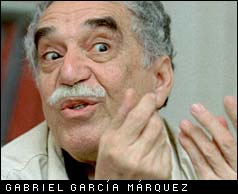
6-12-2002
GABRIEL GARCIA MARQUEZ
(N. 1928 - † 17-4-2014)
Obituarios: Yahoo -- El Pais -- The New York Times
Viernes, 4 de octubre de 2002
García Márquez publica la novela de su vida
Sus
memorias, 'Vivir para contarla', se editan el día 10 con una tirada inicial de
un millón de ejemplares
WINSTON MANRIQUE SABOGAL | Madrid
|
'La vida no es la que uno vivió, sino la que recuerda y cómo la recuerda para contarla'. Así empieza Gabriel García Márquez el primer tomo de sus memorias, Vivir para contarla (Mondadori), cuyo lanzamiento mundial será el 9 de octubre en Barcelona, Bogotá, Buenos Aires y México DF. 'Una vida que se lee como una novela', según Claudio López Lamadrid, su editor en España. Mientras que a Álvaro Mutis, amigo del Nobel colombiano y premio Cervantes, y uno de los pocos que conoce el original, no le queda duda de 'haber leído un clásico'. Unas memorias que García Márquez concluye después de 13 años de trabajo. EL PAÍS publicará este domingo el fragmento del libro dedicado a la escritura de Relato de un náufrago. |
|
Tras el velo sepia del tiempo, un niño de ojos asombrados come una galleta más grande que su mano. Tiene dos años. Es el primogénito de la mujer de eterna belleza romana y del telegrafista que tocaba el violín en fiestas y serenatas caribeñas. Es el niño Gabriel José García Márquez que ahora, con 75 años, ha llegado a su cita más anhelada. La de su vida. Y aquel niño de finales de los años veinte es quien da, en la portada, la bienvenida a sus memorias. Páginas en las que ha dejado de soslayar los 'zarpazos de la nostalgia' para perpetuar su propia historia, que es la de sus abuelos, sus tías, sus padres, sus 10 hermanos y la estela que ellos dejan en la suya propia. Un paseo por el origen donde anida su éxito futuro.
Vivir para contarla es el primero de dos o tres volúmenes. Se detiene en el año 1955. La primera estación que Gabo, como lo llaman y firma el propio Nobel, hace en su largo viaje. Hasta allí ha llegado después de 13 años de haber tomado en serio la decisión de contar su vida; de por lo menos tres de disciplinada escritura y dos de edición.
Aunque la idea lo acompañaba desde siempre, es tras El general en su laberinto, en 1989, cuando empieza a otear en serio los meandros de su vida. Sólo al enfrentarse a la escritura sus recuerdos se le amotinan y le exigen que aprenda a escribir. 'A eso me obligaron, y ese aprendizaje fue la única salida que encontré para desembrujarme de mí mismo y poder contar mi vida', dijo Gabo el año pasado en un documental de France 3, RAI, TVE y Canal 22 de Colombia.
Desde entonces, todas las sensaciones de la vida se cruzan en su camino. Incluso los colombianos lo reafirman como su patriarca. Y él quiere hacer de todo. Escribe Del amor y otros demonios, su última novela; revive su interés por volver al periodismo y participa en la creación de un telediario en su país, QAP; crea la Fundación para el Nuevo Periodismo Iberoamericano para dar talleres a los jóvenes periodistas; escribe el reportaje del secuestro de varios periodistas y personalidades colombianas por parte del narcotraficante Pablo Escobar, Noticia de un secuestro, su último libro en 1996; compra la revista Cambio en 1998; opina sobre la paz en su país. Y, por si fuera poco, en 1999 le diagnostican un cáncer linfático. A partir de ahí su vida se mueve entre México DF y Los Ángeles para seguir un tratamiento. Hasta que arrincona a la muerte, como en sus cuentos.
Antes de aquella confirmación de mortalidad, se escucha la voz de Gabo leyendo el primer capítulo de sus memorias. Es en 1998, en el Festival del Centro Histórico Ciudad de México (EL PAÍS, 22 de marzo de 1998). Es sobre la decisión más importante de su vida. El viaje tras el cual quedó 'a merced de la nostalgia' en 1950. El que hizo con su madre, Luisa Santiaga, de Barranquilla a Aracataca, en el Caribe colombiano, para vender la casa de sus abuelos maternos con quienes vivió hasta los ocho años. Un viaje que hicieron una noche en una embarcación por la Ciénaga Grande de Santa Marta y continuaron al día siguiente en un diablo al que por allí llamaban tren. Cuando llegaron a ese pueblo situado en un claro de las bananeras, bajo un cielo renacentista donde el Sol apenas deja colar retazos de brisa piadosa, Gabo se da cuenta de que el tiempo estaba estancado en su memoria. Ese día, además, es cuando ve desde el tren el nombre de una finca, Macondo. Descubre la 'resonancia poética' de la palabra, de tal manera que será el nombre del universo donde habitarán todos los lugares y todos los tiempos de su obra.
Tras ese primer asomo a su vida, el autor de El coronel no tiene quien le escriba se encara con la muerte en 1999. Y en mitad de ese duelo se concentra en la escritura de Vivir para contarla, cuyo primer punto final llega hacia el otoño de 2000. Son alrededor de 900 páginas. Mientras, su vida sigue oscilando entre México DF y Los Ángeles. A partir de ahí se dedica a la edición del libro dando paso al periodista rotundo de El espectador. Es la etapa de precisión con la ayuda de su hijo Rodrigo García Barcha, en quien centraliza el rigor informativo. Surge así un rosario de entrevistas para corroborar nombres o fechas.
Todo va bien. El cáncer está amordazado. En esa tregua del invierno de 2001, Gabo ofrece otro avance (EL PAÍS, 28 de enero), el del romance de sus padres, Luisa Santiaga y Gabriel Eligio, que inspiró El amor en los tiempos del cólera. La novela que le gustaría que pasara a la posteridad. La expectativa crece y varias editoriales quieren el libro.
La mirada atrás continúa sin alteraciones. Hasta que en agosto de 2001 un soplo de tristeza lo invade por la muerte de su hermano menor y cómplice literario, Eligio. Su respuesta es acelerar la edición de las memorias. Incluso saca tiempo para contar los entresijos del manuscrito de Cien años de soledad que sale a subasta en Barcelona y que finalmente no se vende.
A comienzos de 2002, García Márquez ya ha eliminado unas 300 páginas. Sólo quedan 596. Una de las pocas personas que lee el original es el escritor colombiano William Ospina, que viaja en mayo a México DF a petición del Nobel. Ospina lee un capítulo al día durante ocho días. Álvaro Mutis también lo ha leído, y sabe que la foto escogida para la portada es una que su amigo Gabo mima en su casa de México en un portarretrato sobre el mueble de un salón.
Se dice que la subasta por los derechos del libro ha sido una de las más fuertes de los últimos tiempos. Al final las obtiene Mondadori. ¿Para cuándo? Otoño de 2002. Y cuando todo parecía en calma, una nueva tristeza. La muerte vuelve a visitar a los García Márquez para llevarse a su madre de 97 años, la mujer que defendió su amor por aquel telegrafista que dejaba recados de enamorado por los pueblos donde la iban escondiendo. Aun en compañía del dolor, el autor de El otoño del patriarca sigue insobornable ante la búsqueda de contar lo mejor posible su vida.
Con el verano llega el original a Barcelona. Pero la procesión de correcciones no cesa. Los manuscritos van y vienen entre México y la capital catalana. Gabo pide que le den una fecha límite para tocar el texto. Viernes 13 de septiembre le dicen. Pues hasta ese día algo cambia. Es más, una semana antes modifica el título y el epígrafe. Ya no se titularán Vivir para contarlo, sino para contarla. La clave del cambio está en el epígrafe, en un juego que enhebra la primera idea y la última palabra: 'La vida no es la que uno vivió, sino la que recuerda y cómo la recuerda para contarla'.
Gabo ya ha cumplido con su primera cita y avanza en la segunda. Queda compartirla. Será a partir del 10 de octubre, con una invitación que podría decir como el final de uno de sus cuentos, cuando el capitán de un barco dice 'en catorce idiomas, miren allá, donde el viento es ahora tan manso que se queda a dormir debajo de las camas; allá, donde el sol brilla tanto que no saben hacia dónde girar los girasoles; sí, allá, es el pueblo de Gabriel García Márquez'.
LINKS:
Extractos do livro de memórias "Vivir para contarla"
Domingo, 29 de septiembre de 2002
JUAN LUIS
CEBRIÁN
Gabo, en mi levitación
'Ruego a los que se aburran con mis palabras, y decidan abandonar la sala, que no hagan ruido al salir, a fin de no despertar a los que estén dormidos'. He oído a Gabriel García Márquez pronunciar muchas veces esta recomendación, que causa siempre la hilaridad y el entusiasmo de su auditorio. Usó de ella en la clausura de un ciclo sobre la cultura latinoamericana en Madrid, y la concurrencia prorrumpió en ruidos de aplauso y carcajada. Pero un par de fechas antes no fue así. Los mismos asistentes al mismo curso protestaron con la misma sonoridad porque el premio Nobel más famoso de la literatura en castellano no se dignó abrir boca en la inauguración de dicho seminario, pese a que se sentaba en la presidencia.
A García Márquez no le gusta hablar en público. No da conferencias, no pronuncia discursos, rehúye los homenajes. Cuando la Georgetown University de Washington organizó una ventolera de celebraciones para conmemorar el septuagésimo aniversario del escritor y el quincuagésimo de la publicación de su primer cuento, Gabo, como le llaman ya universalmente, no compareció en la sala, atestada de autoridades académicas, de alumnos y de visitantes, en la que departimos unos cuantos amigos suyos. A cambio, prodigó sus entrevistas y discusiones con los estudiantes, cosa que le encanta.
Una vez le llamé para invitarle a la Escuela de Periodismo de EL PAÍS. '¿Ante cuántas personas estaré?', me preguntó. Treinta o cuarenta. 'Ya sabes que con estudiantes de periodismo siempre estoy dispuesto'. Y les habló durante más de dos horas. Cuando el compromiso es mucho, o el acto le interesa por la razón que sea, si no tiene otro remedio que dirigirse al público, prefiere hacerlo leyendo un cuento o un capítulo de su próximo libro. Las excepciones a esta norma son muy pocas, y yo sólo recuerdo una en los años recientes: dictó un breve discurso en la inauguración del Congreso de la Lengua Española, en Zacatecas, ante el presidente Zedillo, de México, y los Reyes de España. Aquella intervención, en la que insistió acerca de los 'terrores tempranos' que la ortografía produce en los niños, causó no poco revuelo en muchas regiones de habla hispana, a comenzar por la propia España, debido a las críticas que el escritor hizo de la probable arbitrariedad gramatical de nuestra lengua. Pero los que estábamos presentes no nos sentimos especialmente agredidos, y sí muy reconfortados, por la templada y hermosa provocación del texto. Después invité a Gabo a visitar la Real Academia Española, que se había visto envuelta en la polémica, y mis colegas en la que horrísonamente se llama docta casa tuvieron oportunidad de conciliar su preterida indignación con la sabiduría y el encanto personal que se desprenden de la figura de Gabriel García Márquez.
Cuento estas anécdotas porque son ilustrativas de algunos de los rasgos para mí más definitorios del personaje: su timidez y, lo que es más raro descubrir en un mito viviente de la literatura de todos los tiempos, su bondad. También su sentido del humor, que le faculta para defenderse de la enorme pesadumbre de la fama y acercarle a discernir, como Kundera, la imperceptible levedad del ser. Gabo es bueno en el sentido machadiano de la palabra, lo que le permite también ser cruel con los tontos, los caraduras y los paniaguados. Es bueno y fiel, sobre todo, para con sus amigos, que son muchos y muy variados, pues es quizás el sentido de la amistad, aun por encima del amor, el que más le distingue y el que mejor cultiva. 'Escribo para que me quieran mis amigos', ha declarado muchas veces, y los amigos nos disponemos a quererle más y más para que no deje nunca de escribir.
Ninguna de estas cosas serían, probablemente, muy significativas si no fuera porque se refieren al que es, con seguridad, el escritor vivo más universal de cuantos existen, sin distinción de lenguas ni culturas. Se trata de un auténtico mito viviente, y no creo que haya existido nunca en la historia de las letras un autor que haya podido disfrutar, hasta los límites insospechados de su caso, del aplauso de la crítica y de la popularidad inmensa entre el pueblo llano, al menos el pueblo llano lector. Tampoco creo que haya hoy en el mundo un escritor más difundido, y pienso que resultaría difícil encontrar una librería, en cualquier ciudad y de cualquier continente, que no albergue en sus estantes al menos un ejemplar de alguna obra de García Márquez. Treinta millones de volúmenes vendidos de Cien años de soledad hablan por sí solos de la inmensa aceptación que esta obra imperecedera de las letras ha merecido entre nuestros contemporáneos.
Gabo es un empedernido lector -aunque no presuma de ello tanto como acostumbraba Borges-, un conversador implacable, un buen comedor, cercano a la glotonería, pese a que la edad y la salud le obligan ahora al comedimiento, y un viajero impenitente, capaz de retar y vencer su confesado miedo a volar. Antes lo aborrecía. Ahora parece acostumbrado a ese hecho singular de los viajes aéreos, en los que 'el alma llega después que el cuerpo'. Es también, para regocijo de muchos, un periodista no arrepentido. A sus setenta y pico años, con todos los honores, premios y fama a sus espaldas que imaginarse puedan, volvió a sus orígenes, trabajando como entrevistador y comentarista para la revista Cambio, que él mismo contribuye a financiar. Lo hizo con una dedicación, un empeño y un entusiasmo difíciles de encontrar en los más jóvenes aspirantes al oficio de reportero. 'El periodismo siempre fue un género de la literatura', afirma sin ambages ante quien le interroga sobre estas cuestiones. Y dedica su dinero, su tiempo, sus influencias y su magisterio a formar nuevas generaciones de profesionales: en Madrid, en Cartagena, en La Habana, allí donde se le reclama para ello.
Su gran pasión artística, al margen de la literatura, es el cine. De joven, aprovechaba los días libres que le daban en El Espectador para verse tres y hasta cuatro películas de un tirón. Guionista, maestro de guionistas, crítico, animador de festivales, jurado en una buena parte de ellos, García Márquez ha visto prolongada en su primogénito la dicha de dedicarse al séptimo arte. Quizás purga con ello la mínima desilusión que debe producirle el no haberse entregado al mundo del celuloide con la misma intensidad que a la escritura.
Pero lo mejor de Gabo es su optimismo, tan raro en quienes disfrutan del genio creador. Lejos de la imagen del intelectual maldito, aunque los comienzos de su lucha fueran azarosos hasta percibir la sombra del hambre, ha vivido arropado por el triunfo y, pese a ello (o quizá gracias a ello), derrocha tranquilidad en derredor suyo. No podría ser así, desde luego, sin la luminosa presencia de su acompañante de siempre, su novia desde la adolescencia, su esposa desde hace más de cuatro décadas, Mercedes Barcha, una de esas mujeres que son guapas por dentro y por fuera a la vez. Mercedes le guardó la ausencia durante años cuando Gabo marchó a Europa a estudiar cine y a desempeñarse como cronista, para acabar ganándose la vida en los cafetines del Barrio Latino de París tarareando a la guitarra boleros de amor. Un día que Gabriel García Márquez estaba tomando un refresco con unos amigos en una terraza de Caracas, consultó el reloj y se levantó apresurado, disculpándose: tenía que irse o de otro modo perdería el avión para Colombia, lujo que no se podía permitir, pues marchaba allí para casarse. La sorpresa fue máxima. A nadie de su entorno le había hablado de Mercedes, aquella joven bellísima, delgada y morena, de mirada intensa y lengua acerada con la que al poco tiempo contraería matrimonio en Barranquilla. Es difícil saber cómo hubiera sido la obra de este escritor si no hubiera estado animada desde el principio por el soplo mineral, terco y profundo de esa mujer plena de convicciones, desbordada por una ternura que oculta deliberadamente, como si temiera que al descubrirla se vinieran abajo la entraña de su carácter y la raíz de su fortaleza.
García Márquez es un mimado de los dioses. Amenazado por la enfermedad, la ha vencido repetidas veces. De esa experiencia amarga floreció una personalidad en la que el lado humano venció definitivamente las ínfulas posibles del escritor laureado. Hasta disfruta del milagroso don de no tener enemigos, o de que sean los justos, a fin de que le sirvan de vacuna contra cualquier adversidad de semejante género, pues la palabra odio no cabe en su vocabulario. A sus 75 años sigue en plena producción literaria. En los próximos días verá la luz el primer tomo de sus memorias y ya prepara una trilogía de novelas. Conviene que nadie se llame a engaño y piense que, por escribir su autobiografía, Gabo rinde la pluma ante el desafío de otros empeños.
Hace un cuarto de siglo que disfruto del privilegio de su amistad, y ése es uno de los regalos que me ha deparado la vida. Ésta es mejor, más fructífera y amable, cuando se tiene la oportunidad de visitar el laberinto del genio. Gabriel García Márquez me la ha brindado con una generosidad y un afecto imposibles de emular. A veces pienso que, gracias a sus enseñanzas, cualquier día me tomaré un cuenco de chocolate caliente y yo mismo, como el famoso cura del cuento, me pondré a levitar.

García Márquez, Fighting Cancer, Issues Memoirs
By Juan Forero
October 9, 2002
RACATACA,
Colombia, Oct. 6 -- He had always been the most
disciplined of writers, sitting early in the morning before his trusty
Macintosh, the magical, poetic words that have defined Latin America spilling
from his head. That part never changed.
 But then Gabriel García Márquez,
the 1982 Nobel laureate from Colombia and the foremost author in Latin America,
learned in 1999 that he had lymphatic cancer. He promptly cloistered himself
with a single-minded pursuit not seen perhaps since he wrote the 1967
masterpiece, One Hundred Years of Solitude, in a little more than a year,
his only vice a steady supply of cigarettes provided by his wife, Mercedes.
But then Gabriel García Márquez,
the 1982 Nobel laureate from Colombia and the foremost author in Latin America,
learned in 1999 that he had lymphatic cancer. He promptly cloistered himself
with a single-minded pursuit not seen perhaps since he wrote the 1967
masterpiece, One Hundred Years of Solitude, in a little more than a year,
his only vice a steady supply of cigarettes provided by his wife, Mercedes.
"I reduced relations with my
friends to a minimum, disconnected the telephone, canceled the trips and all
sorts of current and future plans," the author told El Tiempo, the
Colombian newspaper, in rare comments about an illness he usually declines to
discuss. "And I locked myself in to write every day, without interruption."
Now, after three years of
researching and writing, García Márquez, 75, who underwent chemotherapy in a Los
Angeles hospital and is recovering at his Mexico City home, is poised to release
what may be his most-awaited book, Vivir Para Contarla, or To Live to
Tell It.
The first volume of the author's
memoirs, it is an emotional, sometimes bittersweet account of the early years of
a man so beloved in Latin America that he is universally known by his nickname,
Gabo. Much of it is focused on this former banana boom town in northern Colombia
that, despite its poverty and isolation, held mysteries and magic that inspired
the storyteller.
The 579-page book, published by
the Colombian editorial house Norma, is being released in Colombia on Wednesday
and across much of Latin America and Spain on Thursday. It may appear in German,
Dutch and Italian by the end of this year, and in the United States as early as
the end of next year.
For his followers, To Live to
Tell It is a treasure-trove unlocking the secrets of what inspired Mr.
García Márquez and explaining how a rich life populated by colorful characters
fueled a vivid imagination that led to some of the world's most important
contemporary literature.
"It reads like a novel, but it's
at the same time a chronicle of the author's life and a reportage of half a
century of Colombia's reality," said Roberto Pombo, a close friend and editor of
the Mexican edition of Cambio, the Colombian news magazine owned by
García Márquez.
Many readers, of course, already
know that this sleepy, oven-hot hamlet of almond trees and multicolored wood-plank
homes is Macondo, the fictional town where the abundant, fantastical Buendía
family wandered in One Hundred Years of Solitude. It is a town of war and
peace, revenge and violence, love and despair and unending isolation -- a
paradise lost and a metaphor for Latin America.
And they know that the hair-raising
stories of Col. Nicolás Márquez, Mr. García Márquez's grandfather -- tales of
the War of a Thousand Days and fatal duels and country-hewn grudges -- haunted
the budding writer and provided him with endless grist for his writing.
To Live to Tell It, though,
goes deep.
The reader learns the precise
moment when the 23-year-old García Márquez, then a struggling newspaper reporter,
realizes on an emotional journey back to his childhood home that his calling is
the pen. "What you discover is that all of García Márquez's works are in the
memories that come to him when he stands in front of that house," Mr. Pombo said.
Indeed, Mr. García Márquez
recounts, he realized that he would be "nothing else but a writer" who would
complete a first novel "or die."
The author explains how some of
Colombia's most harrowing history, like the 1928 army massacre of striking
United Fruit Company banana workers, became engrained in his consciousness, not
only inspiring his writing but his left-leaning views. And how the loss of loved
ones pained him.
"Today it is clear: A piece of me
had died with him," Mr. García Márquez writes, recalling the death of his
beloved grandfather. He goes on to say: "But I also believe, without the
slightest doubt, that in that moment I was already a beginning writer who only
needed to learn to write."
Mr. García Márquez has spoken
little about the book and did not respond to requests for an interview, in part,
friends said, because he is ill at ease speaking about his illness.
That has helped generate a flurry
of delicious speculation in Latin American literary circles, as García Márquez's
followers wondered what writing style he would use and how he would structure
the work.
"People just want to know about
this man -- it's the magic of Macondo, you know," said Gerald Martin, who is
completing a biography of Mr. García Márquez. "This man is so famous and
everybody knows him so well, and yet they cannot imagine how he is going to tell
this story."
The memoir, an early reading
indicates, is written in a straightforward, journalistic style with a few
touches of the magic realism that defines much of his work. The book covers Mr.
García Márquez's life to the mid-1950's as the elder son of an itinerant
pharmacist and telegraph operator drops out of law school to become a journalist.
He is shaped by the often violent
history around him, experiencing the chaos of the Bogotazo, the 1948 riots in
the Colombian capital after the murder of the populist politician Jorge Eliécer
Gaitán. "I believe I became conscious," Mr. García Márquez writes, "that on that
day of April 9 of 1948 Colombia began the 20th century," a reference to the
violence that has gripped the country since.
He develops into a street-smart
chronicler at newspapers in the coastal cities of Cartagena and Barranquilla. It
is a world of world-wise editors with good advice to a young, impressionable
writer, and a collection of literary friends who frequent a bar called La Cueva
where they mull over writers like William Faulkner, Daniel Defoe and James Joyce.
"We had so much in common," the
author writes, "that it was said we were the sons of the same father." The
memoir ends as Mr. García Márquez publishes his first book, Leaf Storm,
and leaves for Europe as a newspaper correspondent.
At least two other volumes are on
the way, one perhaps taking the reader through 1982, when he is awarded the
Nobel, and the other about his relationships with world figures like Fidel
Castro, Bill Clinton and François Mitterrand.
For Mr. García Márquez, writing
To Live to Tell It allowed him to re-explore his childhood while clearing
up the myths and inaccuracies written about him since he achieved spectacular
fame with One Hundred Years of Solitude.
"He has wanted to tell that story
himself, growing up with his grandfather in that small, nowhere place that was
nevertheless magical," Mr. Martin said. "He's been waiting to do this a long
time, and now is the time."
As in previous books, Mr. García
Márquez depended on an army of relatives, friends and in some cases journalists
contracted for the occasion to help gather the details and factoids to help him
reconstruct events. "One must capture impressions, memories, go to friends and
acquaintances, match statements with memory," Mr. García Márquez told a
Brazilian reporter this year.
Renowned for his journalism, Mr.
García Márquez dug up mundane details, like the background of the Dominican
baseball player he briefly knew 50 years ago, the history of a coastal bordello
where he lived, the name of a typesetter who worked at one of his first
newspapers.
A friend, Jaime Abello, and Jaime
García Márquez, one of the author's brothers, would often find themselves
writing detailed reports for Mr. García Márquez, even though the arcane details
were only peripheral to the narrative. "Gabo, like a good journalist, always
collects a lot of information but he only uses a bit of it," explained Mr.
Abello, director of the foundation in Cartagena that Mr. García Márquez created
to tutor young journalists.
Mr. García Márquez reread his old
newspaper columns and novels and studied books about him and his family, like
Silvia Galvis's interviews with the García Márquez clan. He also conducted
scores of interviews, many with relatives. "I had the sensation when he would
call and ask for a detail that he just wanted our interpretation, that he was
perhaps just looking for our angle," said Jaime García Márquez, 62.
Not surprisingly, much of the
author's interest focused on reconstructing Aracataca, which has a reputation as
a place full of fanciful, imaginative characters with a gift for gab and an
appreciation for storytelling.
"That is something innate with
the people," explained Robinson Mulford, a writer and literature teacher here. "We
sit with our children and tell them stories of our grandparents. We tell them
the myths and the legends of the Caribbean."
The young García Márquez seemed
to be especially fascinated by stories of death. In the memoir he writes of
seeing his first body: a man shot dead trying to break into a home, resulting in
a "vision that chased me for many years."
To be sure, this is a writer
famously obsessed with death, some say afraid of it. It is evident in his books;
nearly all start with a death or a similar theme. Mr. García Márquez's avoidance
of funerals is legendary, and the deaths of those close to him -- two brothers
and his mother died during the writing of his memoirs -- deeply affect him.
"He once said, 'It is not that I
am afraid of death, it is that I have a rage toward death,' " said Jaime García
Márquez.
Gustavo Tatis, a journalist in
the coastal city of Cartagena, said the author once expounded on his fear of
death in an interview. "He said, 'The problem with death is that it lasts
forever,' " Mr. Tatis recalled.
Not surprisingly, then, Mr.
García Márquez's fixation with death has produced endless conjecture that the
author embarked on his memoirs because he feared he would die soon.
To be sure, Mr. García Márquez
sacrificed to finish this first volume. The author is a man who loves being
close to power, and he is friends with world leaders and has caroused with
rebels and diplomats, even playing a behind-the-scenes role in peace talks here.
But he forced himself to stay home and he cut back on the journalism that he has
said is his first professional love.
Still, those who know Mr. García
Márquez said that from his days as a young reporter he had contemplated telling
the story of his upbringing and Colombia's tumultuous history. Real life events,
some personal, are laced through his fiction. His parent's courtship was the
inspiration for Love in the Time of Cholera and a small-town murder was
the model for Chronicle of a Death Foretold.
Several friends simply said that
the cancer prompted Mr. García Márquez to buckle down. One friend said Mr.
García Márquez perhaps "saw a necessity of writing at all times as a form of
confronting the illness with force."
Those close to him said Mr.
García Márquez's latest work should simply be seen as a celebration of his life,
not as a harbinger of death. Indeed, Mr. Abello said that the memoir's title
alone tells the story.
"All his motivation is contained
in that title, To Live to Tell It -- it is the pleasure of telling the
story," he said. "It is like saying life has been worth living."
--Juan Forero

Vivir para contarla, Gabriel García Márquez. Alfred A. Knopf: 592 pp.,
por Gioconda Belli
February 16 2003
| GABO HABLA | GABO SPEAKS |
|
Read this review in both languages, here |
Das Leben ist das,
woran man sich erinnert
Startauflage eine
Million: Die Memoiren von García Márquez
MADRID, 14. Oktober
An einem heißen Februartag im
Jahr 1950 war Luisa Santiaga Márquez Iguarán in die karibische Küstenstadt
Baranquilla gefahren auf der Suche nach ihrem Sohn Gabriel. Der hatte gerade
sein Jurastudium abgebrochen und ernährte sich mehr schlecht als recht von
Glossen, kleinen Meldungen und gelegentlichen Kommentaren in der Tageszeitung
"El Heraldo". Luisa Santiaga wußte nicht, wo ihr Sohn zu finden sei, und erhielt
auf ihre Fragen die Auskunft, wahrscheinlich in der Buchhandlung "Mundo" oder in
einem der Cafés in der Nähe, wo sich junge Männer träfen, die behaupteten,
Schriftsteller zu sein. "Aber seien Sie vorsichtig, die sind ganz schön
verrückt", sagte ihr eine wohlmeinende Bürgerin aus Baranquilla.
Mit dem knappen Satz "Ich bin
deine Mutter" stellt sie sich an Gabriel García Márquez' Tisch. Sie hat eine
Weile gebraucht, um den zweiundzwanzigjährigen Sohn, der so lange nicht mehr in
seinem Heimatdorf erschienen war, zu erkennen. Eigentlich bist du ja angezogen
wie ein Bettler, sagt die Mutter später zu ihm, als sie beide auf einem
verrotteten Schiff über den Río Magdalena und durch die Sumpflandschaft der
Ciénaga in den später als Macondo so berühmt gewordenen Geburtsort des
Schriftstellers, Aracataca, reisen. Auf dem Schiff treffen sie noch einen
entfernten Verwandten. Er versucht, der Mutter die Sorgen um die berufliche
Zukunft des Sohnes zu nehmen: "Ein guter Schriftsteller kann viel Geld
verdienen, vor allem, wenn er sich mit der Regierung gut versteht."
Mit dem
Wiedersehen seiner Mutter und der gemeinsamen Reise beginnt das gerade in vier
Städten der Welt gleichzeitig und mit einer Startauflage von einer Million
Exemplaren erschienene neue Buch des Nobelpreisträgers Gabriel García Márquez "Vivir
para contarla" (Leben, um davon zu erzählen). Dem Buch, dem ersten Teil seiner
auf drei Bände angelegten Memoiren, stellt García Márquez das Motto voran: "Das
Leben ist nicht das, was man gelebt hat, sondern das, woran man sich erinnert
und wie man sich daran erinnert - um davon zu erzählen." Er erinnert sich -
bewußt oder unbewußt - an viele Menschen und viele Erlebnisse nicht, während ihm
Begegnungen und Ereignisse, die Anlaß und Anregungen für seine Romane und
Erzählungen wurden, noch ganz intensiv präsent sind. So findet der Leser in den
Memoiren viele Personen wieder, die ihm als Romanfiguren schon vertraut sind.
Luisa Santiaga
Márquez ist zum Vorbild zahlreicher Personen im literarischen Werk ihres Sohnes
geworden. Sie ist im vergangenen Juni im Alter von 97 Jahren gestorben und hat
das Erscheinen dieses Erinnerungsbandes, in dem sie eine so wichtige Rolle
spielt, nicht mehr erleben können. Die Publikation von "Leben, um davon zu
erzählen" am vergangenen Donnerstag in vier Verlagen in Barcelona, Bogotá,
Buenos Aires und Mexiko-Stadt wurde zum literarischen Jahresereignis in der
gesamten spanischsprachigen Welt. Kurze Auszüge des Buches sind schon als
Vorabdruck in Zeitungen und Zeitschriften erschienen, andere wurden bis in den
letzten Tagen vor der Drucklegung noch geändert und gekürzt. Freunde und
Verleger des Schriftstellers hielten die Welt über den Schaffensprozeß auf dem
laufenden. Als García Márquez an Krebs erkrankte, fürchtete man schon, er werde
seine Erinnerungen nicht mehr zu Ende schreiben können. Die guten Nachrichten
über seine Heilung ließen seine Leser wieder hoffen. Vor einiger Zeit sagte
García Márquez, er müsse immer schreiben, jeden Tag. Wenn er einmal nicht
schreiben könne, dann falle es ihm sehr schwer, wieder anzufangen - so wie bei
seinen ersten Schreibversuchen. Einige Monate lang habe er auch gegen den Tod
angeschrieben.
Seit 1994 hat
Gabriel García Márquez kein literarisches Buch mehr veröffentlicht - "Nachricht
von einer Entführung" (1997) war eine große journalistische Reportage. "Leben,
um davon zu erzählen" jedoch ist ein eminent literarisches Buch: in der Struktur
einfach, doch von außergewöhnlicher Präzision in der Wortwahl. Kaum ein anderer
zeitgenössischer Schriftsteller benennt die Dinge so genau wie García Márquez.
So manches heute kaum noch vernommene Wort der spanischen Sprache erreicht erst
in dem Werk des Kolumbianers wieder seine bildhafte Ausdruckskraft, läßt die
verschiedenen Bedeutungsinhalte sichtbar werden und stellt neue oder nicht mehr
bekannte sprachliche Zusammenhänge auf. Bei jedem Satz, auch in dem neuen Buch,
ist der Leser sofort überzeugt, daß kein einziges Wort verändert oder
ausgetauscht werden darf. Die Metaphern überraschen in ihrer Originalität,
wirken aber nie zufällig. García Márquez braucht weder Neologismen noch
pittoreske oder regionale Ausdrücke und Wendungen - trotz der klaren Begrenzung
des Schauplatzes auf das karibische Kolumbien. Obwohl der kolumbianische
Schriftsteller seine Texte häufig überarbeitet und umschreibt, hat man den
Eindruck, daß sie ihm spontan aus der Feder geflossen sind. Das ganze Buch wirkt
wie aus einem Guß, als hätte es gar nicht anders geschrieben sein können.
In seinen
Erinnerungen hält der Autor keine streng chronologische Abfolge ein; vielmehr
erzählt er einzelne Episoden direkt und ohne rhetorische Exkurse. In ihrem
Rhythmus und in der Einfachheit von Aufbau und grammatikalischer Konstruktion
erinnern sie an spanische Klassiker wie Cervantes. Die ersten Sätze jedes
Kapitels weisen auf wichtige Ereignisse und Erfahrungen hin, kündigen an oder
fassen zusammen. Viele verweisen auf die Anfangssätze von García Márquez' großen
Romanen. So beginnt "Hundert Jahre Einsamkeit" mit dem berühmten Satz: "Viele
Jahre später sollte der Oberst Aureliano Buendía sich vor dem
Erschießungskommando an jenen fernen Nachmittag erinnern, an dem sein Vater ihn
mitnahm, um das Eis kennenzulernen." Die "Chronik eines angekündigten Todes"
wird aufgeblättert mit den Worten: "An dem Tag, an dem sie Santiago Nassar töten
sollten, stand dieser um 5.30 morgens auf, um den Dampfer zu erwarten, mit dem
der Bischof kam." Das zweite Kapitel von "Leben, um davon zu erzählen" setzt ein
mit: "Am Tage, als ich mit meiner Mutter wegging, erinnerte ich mich an alles,
was mich in meiner Kindheit beeindruckt hatte, doch war ich mir nicht sicher,
was vorher und nachher gewesen war, noch, ob das alles irgend etwas in meinem
Leben bedeutet hatte." Die zwei Tage, die Gabriel mit seiner Mutter in seinem
Geburtsort bleibt, rufen in ihm die Erinnerungen wach, die dann zum Stoff
mehrerer Romane wurden.
García Márquez'
Memoiren sind außergewöhnlich unterhaltsam, selbst da noch, wo der Autor die
große Zahl seiner Verwandten nacheinander vorstellt und in einigen Sätzen das
Wichtigste zu jedem mitteilt. Gabriel ist der Älteste von elf Geschwistern;
seine Mutter konnte kurz vor ihrem Tod im vergangenen Juni über einhundert Enkel
und Urenkel um sich versammeln. Bereits vor dem Erscheinen von "Leben, um davon
zu erzählen" war bekannt, daß vieles, was im Werk von García Márquez erzählt
wird, auf Geschichten zurückgeht, wie sie in den Dörfern seiner Heimat seit
Generationen weitergegeben werden. Trotzdem ist das Werk des Kolumbianers nie
Heimatliteratur. Obwohl sich fast alles zwischen Santa Marta und Cartagena im
Norden Kolumbiens abspielt, fühlen sich Leser aus aller Welt in dieser kleinen
Region nicht fremd. Damit bekommen die Menschen an der karibischen Küste, ihr
Denken und Tun eine geradezu universelle Gültigkeit. Das Werk von García Márquez
ist eben keine exotische, sondern Weltliteratur.
Für treue Leser
ist es interessant, die Verwandlung der realen Personen, wie sie jetzt in den
Erinnerungen vorgestellt werden, zu Romanfiguren zu verfolgen oder auch anhand
der Memoiren die Anteile von Fiktion und historischer Wahrheit im literarischen
Werk zu vergleichen. Andere werden die Erinnerungen einfach lesen wie einen
spannenden Roman. Der Ende voriger Woche erschienene erste Band umfaßt die
Kindheit des Autors, die Geschichte der Eltern - des Telegrafenbeamten Elígio
García und von Luisa Márquez, der Tochter des nicht nur aus "Hundert Jahre
Einsamkeit" wohlbekannten Oberst -, dann die Zeit des jungen Journalisten und
seiner Literatenfreunde in Baranquilla, Cartagena und Bogotá. Die ersten
Erzählungen von García Márquez werden beachtet; er selbst hält gegen alle
Widerstände fest an seinem festen Willen, Schriftsteller zu werden - und zwar
einer, der nicht für die Regierung schreiben will. Sein journalistisches
Meisterstück schreibt García Márquez mit der Fortsetzungsgeschichte "Bericht
eines Schiffbrüchigen", der ihn früh bekannt und die Zeitung "EI Espectador"
fast reich machte. Wie dieser Bericht, heute ein beliebter Lehrtext an
Journalistenschulen, entsteht, schildert eines der aufschlußreichsten Kapitel
des Buchs. Bald darauf schickt ihn die Zeitung nach Europa, wo er mehrere Jahre
verbringt. Mit dem Abflug 1955 aus Kolumbien endet der erste Band. In dem schon
angekündigten zweiten Band wird García Márquez über das Entstehen seiner großen
Romane und über seine Begegnungen mit Staatsmännern und Schriftstellern aus
aller Welt schreiben.
WALTER HAUBRICH
Frankfurter Allgemeine Zeitung,
15.10.2002, Nr. 239 / Seite 35

Samstag, 14. Dezember 2002 Berlin, 01:59 Uhr
Es war doch so schön bei den Frauen
Das Buch der Woche: Gabriel García Márquez’ Autobiografie „Leben, um davon zu erzählen“ beweist: Handwerk hat goldenen Boden
von Hans Christoph Buch
Wer oder was ist Gabriel García Márquez? Ein literarischer Superstar, der, durch den Nobelpreis geadelt, Massenwirksamkeit mit höchster Qualität verbindet und stets aufs Neue seine Leser entzückt? Oder ein kommerziell verflachter Bestsellerautor, der vergeblich an den Welterfolg seines Romans „Hundert Jahre Einsamkeit“ anzuknüpfen versucht, weil ihm seit 1967 nichts Neues eingefallen ist? Verkörpert er wie kein anderer die Widersprüche Kolumbiens, dessen Glanz und Elend er in seinen Romanen geschildert hat, oder ist er ein Relikt des Lateinamerika-Booms der 80er Jahre, der historisch Patina angesetzt und der heutigen Generation absolut nichts mehr zu sagen hat? Ist Gabo, wie seine Freunde ihn nennen, ein Höfling Fidel Castros und in der Wolle gefärbter Kommunist oder ein mutiger Streiter für Freiheit und Unabhängigkeit des von den USA geknechteten Subkontinents?
Gabriel García Márquez’ Autobiografie „Leben, um davon zu erzählen“ beantwortet keine dieser Fragen, aber es liefert das Anschauungsmaterial, aus dem die Leser ihre eigenen Schlussfolgerungen ziehen können. Um es vorweg zu sagen: „Vivir para contarla“, von Dagmar Ploetz kongenial übersetzt, widerlegt alle Leerformeln und Klischees, die über García Márquez im Umlauf sind, denn anders als Rousseau legt er keine Beichte ab, sondern erzählt eine Geschichte, wie es sich für einen Romancier gehört: Wann und wo, wie und warum der kleine Gabriel, ältester Sohn von elf Geschwistern aus einer verarmten Familie, die ständig von einer Stadt an der Karibikküste zur nächsten zog, zum großen Schriftsteller geworden ist.
In diesem Punkt ist das Buch Goethes „Dichtung und Wahrheit“ vergleichbar, wobei der Unterschied sofort ins Auge springt: Obwohl auch der alte Goethe seinen Erzählfluss gerne über die Ufer treten ließ, wirkt dessen Autobiografie sparsam, ja wortkarg gegenüber der Redundanz von García Márquez, der seine Jugenderinnerungen auf 600 Seiten ausbreitet, um nicht zu sagen – aufbläht. Dabei ist wenig zu spüren von der vom Autor geforderten Rücksichtslosigkeit im Umgang mit dem eigenen Text. Manche Episoden werden mehrmals erzählt, und wie beim Recycling von Altpapier schreckt der Verfasser vor Wiederholungen und wörtlichen Übernahmen nicht zurück. Anders als beim für seine Strenge gefürchteten, jungen García Márquez, der Lobrednern misstraute und seine Manuskripte so lange wie möglich unter Verschluss hielt, tritt sentimentale Selbstverliebtheit an die Stelle virulenter Selbstkritik, eine Altersmilde, die angesichts der Krebserkrankung des Autors psychologisch verständlich ist, literarisch aber wenig überzeugt. Alles Negative, Hässliche und Böse bleibt aus der Schilderung seiner frühen Jahre verbannt, deren Zweck einzig darin zu bestehen scheint, ein Genie in seine literarische Umlaufbahn zu befördern. Und nicht nur der Icherzähler, auch die Freunde und Feinde, Gefährten und Geliebten des Protagonisten werden positiv verklärt, im Sinne von Goethes Vers: „Es sei wie es wolle – es war doch so schön“, der dem Buch als Motto voranstehen könnte.
Die Schwächen des Textes, der ohne Substanzverlust erheblich hätte gekürzt werden können, werden durch dessen Stärken wettgemacht. Damit ist nicht die kulinarische Qualität gemeint, die zu den Markenzeichen der Prosa von García Márquez gehört. Feststellungen wie die, „dass für einen Schriftsteller das Bordell der beste Wohnort sei: Ruhe am Vormittag, nachts immer Betrieb, und außerdem noch gute Beziehungen zur Polizei“, machen den Lesern Spaß, und man hört förmlich die Bravorufe, wenn der Schriftsteller die Erwartungen seines Publikums bedient, für das sich Exotik noch immer auf Erotik reimt: „Bei Martina Alvarado, der ältesten Puffmutter, gab es eine heimliche Hintertür und humane Tarife für reuige Geistliche.“ Dass diese folkloristische Sicht der Vergangenheit angehört und vielleicht so nie gestimmt hat, weil die Mehrheit der Kolumbianer nicht in der Tropenidylle von Macondo lebt, sondern in von Autoabgasen, Drogen und Aids verseuchten Millionenstädten, steht auf einem anderen Blatt. Die Kritik seiner Landsleute, García Márquez zeichne kein realistisches Bild Lateinamerikas, sondern bestätige aus Europa stammende, exotische Klischees, mag berechtigt sein. Aber hier wie anderswo gilt, dass die Fantasie die Wirklichkeit Lügen straft und die Übertreibung der Wahrheit am nächsten kommt.
Gabriel García Márquez Meisterschaft liegt nicht in den gepfefferten Details – bei der Schilderung von Bettszenen hält er sich schamhaft zurück –, sondern in Anlage und Aufbau des Ganzen, der, anders als das überquellende Füllhorn seiner Einfälle, ökonomisch klug kalkuliert erscheint. Dreh- und Angelpunkt, um den der Autor seinen Erzählstoff rafft, ist der überraschende Besuch der Mutter, die ihren zum Bohémien mutierten Sohn kaum wiedererkennt, in Barranquilla, wo Gabriel als Kolumnist bei einer Tageszeitung arbeitet. Von dort reisten beide mit dem Flussdampfer in seine Geburtsstadt Aracataca, um das Haus der Großeltern zu verkaufen: Ein „fruchtbarer Augenblick“ (Lessing), der den angehenden Autor mit seiner vergessenen Kindheit konfrontiert und so den Keim zu den späteren Romanen legt. Wie die in eine Teetasse getauchte Madeleine bei Proust setzt der Anblick des verfallenen Hauses, in dem García Márquez aufgewachsen ist, die blockierte Erinnerung frei und damit einen Schreibprozess in Gang, der in „Hundert Jahre Einsamkeit“ gipfeln wird. Den Schlusspunkt des Buches bildet der Aufbruch des Autors nach Europa. Damit enden dessen Lehr- und Wanderjahre, und sein Weltruhm beginnt.
Die Darstellung
der eigenen Kindheit ist eine Goldmine für jeden Schriftsteller, ein
Erzählstoff, in dem er ganz aufgehoben ist und den ihm keiner streitig machen
kann. Das gilt auch für García Márquez, dessen Autobiografie eine
Liebeserklärung an die Mutter und die weiblichen Mitglieder seiner Familie ist:
„Ich glaube den Kern meines Wesens und Denkens den Frauen der Familie und den
vielen Dienstboten zu verdanken, die meine Kindheit behütet haben... Sie zogen
sich vor mir um, badeten mich, während sie selbst badeten, setzten mich auf
meinen Nachttopf und sich auf den ihren, breiteten vor mir ihre Geheimnisse aus,
ihren Kummer, ihren Groll, als verstünde ich das alles nicht, und merkten dabei
nicht, dass ich alles begriff.“
Die Kehrseite der
von Patriarchen beherrschten, postkolonialen Gesellschaft ist ein verkapptes
Matriarchat – Erziehung durch Dienstmädchen, die afrikanischer oder indianischer
Herkunft sind und den kleinen Gabriel mit ihrer fremden Sprache und Kultur
konfrontieren: „Memes verworrenes Spanisch setzte den Dichter in Erstaunen, als
sie die Streichhölzer fand und ihm die Schachtel mit triumphalem Kauderwelsch
zurückgab: ?Hier ich bin, Zündholz dein.‘“
Der Vater, ein Telegrafist, der sich zum Homöopathen weiterbildet und auf seinen Reisen uneheliche Kinder zeugt, bleibt schon deshalb blass, weil er die meiste Zeit abwesend ist. Seine Stelle nimmt der Großvater ein, Veteran des Krieges der 1000 Tage, der zur Abtrennung Panamas von Kolumbien führte, ein Haudegen, der seinen Herausforderer im Duell tötet und vergeblich auf die Auszahlung der Pension wartet, die der Staat allen Kriegsteilnehmern versprochen hat. Das Haus des Großvaters in Aracataca, wo García Márquez zur Welt kam, ist die Urzelle seines Werks, die in wechselnden Konstellationen in seinen Romanen und Erzählungen wiederkehrt, wie in „Der Oberst hat niemand, der ihm schreibt“; „Chronik eines angekündigten Todes“; „Der Herbst des Patriarchen“.
„An einem ganz gewöhnlichen Nachmittag hörten wir Schreie auf der Straße und sahen einen Mann ohne Kopf auf einem Esel vorbeireiten. Auf einer Plantage waren alte Rechnungen beglichen worden, dabei hatte man ihn mit der Machete enthauptet, und sein Kopf war vom Strom des Bewässerungsgrabens mitgerissen worden.“ Das ist magischer Realismus pur, und solche Passagen sucht man im zweiten Teil des Buches, der vom intellektuellen Werdegang des Autors handelt, vergeblich – mit Ausnahme des bogotazo, eines durch die Ermordung des Präsidentschaftskandidaten Gaitán ausgelösten Blutbads in Bogotá, das García Márquez aus der Nähe mitansah. Der 9. April 1948 war der Höhepunkt der so genannten Violencia, einer Kette von Massakern, Attacken linker Guerilleros und Repressalien rechter Militärs, der Kolumbiens Gesellschaft – und mit ihr das Bewusstsein des Autors – bis heute prägt.
Gabriel García Márquez – so das Fazit der Lektüre – ist kein politischer Denker, sondern ein geborener Erzähler, der mehr aus dem Bauch als aus dem Kopf heraus schreibt: Daher rührt seine Nibelungentreue zu Fidel Castro, die sich schlecht mit seinem Vorbild Faulkner verträgt, einem konservativen Gringo, der nichts vom Kommunismus hielt. Wie dieser hat García Márquez das Romanschreiben von der Pike auf gelernt, und wie sein deutscher Kollege Günter Grass hat er gezeigt, dass Handwerk goldenen Boden hat.
Leben, um davon zu erzählen
Unmengen von Leerformeln und Klischees sind über den kolumbianischen Literaturnobelpreisträger Gabriel García Márquez im Umlauf. In seiner Autobiografie „Leben, um davon zu erzählen“ widerlegt er sie. Er legt darin keine Beichte ab, sondern erzählt eine Geschichte, wie es sich für einen Romancier gehört: Wann und wo, wie und warum der kleine Gabriel, ältester Sohn von elf Geschwistern aus einer verarmten Familie, die ständig von einer Stadt an der Karibikküste zur nächsten zog, zum großen Schriftsteller geworden ist. Das ist ein bisschen geschwätzig, manchmal, dennoch entpuppt sich Garcia Marquez auch hier wieder als großartiger geborener Erzähler, der mehr aus dem Bauch als aus dem Kopf heraus schreibt.
Gabriel Garcia Marquez: Leben, um davon zu erzählen. Aus d. Span. v. Dagmar Ploetz. Kiepenheuer & Witsch, Köln. 704 S., 24,90 E.
Artikel erschienen am 14. Dez 2002

01/2003
Autobiografie
Herr des Staubs
Die lange erwartete Autobiografie des großen García Márquez
Von Eberhard Falcke
Macondo, das versunkene, taucht wieder auf. Obwohl das Kaff in der kolumbianischen Bananenregion nie vergessen war – jedenfalls nicht als ein Hauptort der Literatur. Nun aber kommt neben dem fiktiven, dem mythischen Macondo aus Hundert Jahre Einsamkeit das andere zum Vorschein, das wirkliche, welches der poetischen Erfindung vorausging. Man erkennt es sofort, zwar nicht am Namen, der anders lautet, aber an vielen Einzelheiten, an der Atmosphäre, den Menschen, Begebenheiten und sogar an einzelnen Sätzen. Wortwörtlich wie Macondo liegt auch Aracataca, der Geburtsort von Gabriel García Márquez, „am Ufer eines Flusses mit kristallklarem Wasser, das dahinschoß durch ein Bett mit polierten Steinen, weiß und riesig wie prähistorische Eier“.
García Márquez, der Lateinamerika als literarische Phantasmagorie neu erfand, der Baumeister mythischer Räume und zyklischer Zeitschleifen, beginnt seine Memoiren mit einer Erinnerung an die Erinnerung und mit Sätzen aus dem Schatz eigener Sätze.
Im Februar 1950 hatte Mutter Márquez den ziemlich struppigen Sohn in seinem Studienort Barranquilla an der kolumbianischen Karibikküste ausfindig gemacht, um ihn für ein paar Tage der Provinzboheme zu entreißen. Sie bat ihn, mit ihr nach Aracataca zu fahren, um das Haus der Familie zu verkaufen. Auf der mehrtägigen Reise mit Flussschiff und Eisenbahn fuhr der junge Mann zunächst widerwillig in die Welt seiner Kindheit und Jugend zurück. Doch dann wurde er vom „Prankenschlag der Nostalgie“ getroffen. Plötzlich fühlte er sich in eine andere Flussfahrt zurückversetzt, als er fünf Jahre alt und in Begleitung seines Großvaters war. Der hatte als Oberst um die Jahrhundertwende den blutigen Bürgerkrieg „der Tausend Tage“ mit ausgefochten, er hatte überall im Land zahllose Kinder gezeugt und war schließlich in die Literatur seines Enkels eingegangen: als eines der Vorbilder für den Oberst Buendía aus Hundert Jahre Einsamkeit.
Das Paradies der Verlassenheit
Auch der Romantitel Der Oberst hat niemand, der ihm schreibt passte auf ihn, weil seine sehnsüchtig erwartete Veteranenpension, von der sich die vielköpfige Familie Rettung versprach, niemals eintraf. Mit den Worten „Schau, dort ist die Welt untergegangen“ zeigte die Mutter ihrem Sohn den Platz, an dem 1928 das Massaker an streikenden Bananenarbeitern – angeblich – stattgefunden hatte. Das historische Schreckensdatum der Provinz verwandelte sich genauso in Literatur wie der berühmte Ortsname, der auf der Strecke aufgelesen wurde: „Der Zug hielt an einer Bahnstation ohne Dorf und fuhr kurz darauf an der einzigen Bananenplantage vorbei, an deren Portal ein Name stand: Macondo.“
Auf drei Bände hat García Márquez seine Erinnerungen veranschlagt, und schon der erste ist ein beachtlicher Wälzer von 600 Seiten. Die ersten gut 50 davon beschreiben die Reise von Mutter und Sohn nach Aracataca. Zum Entsetzen der Eltern hatte Gabriel beschlossen, Schriftsteller zu werden, anstatt als Jurist und angesehener Akademiker für die Familie zu sorgen. Auf der kurzen Expedition ins familiäre, schon legendenumwobene Territorium fand er, was ihm noch gefehlt hatte: die Quelle seiner erzählerischen Fantasie. Genauer gesagt: Er begriff, dass dies der Goldtopf war, aus dem er seinen Stoff schöpfen konnte. Beim Gang durch das von Hitze gelähmte Dorf zur Siesta-Zeit erhielt Aracataca/Macondo für den künftigen Schriftsteller seine exemplarische Kontur: als „Paradies der Verlassenheit“, als einer der staubigen Orte zielloser Kämpfe, verblühter Konjunkturen, verlorener Hoffnungen, wie es sie auf diesem immer wieder kolonisierten Kontinent so viele gibt. In diesen Passagen steckt zugleich eine Biografie der Einbildungskraft ihres Autors.
Mit dem Anfang von Leben, um davon zu erzählen gibt García Márquez ein Beispiel für Memoirenliteratur großen Stils. Das ist eine fabelhafte Eröffnung. Sie setzt anekdotisch ein, lockt mit den komödienhaften Momenten eines familiären Machtkampfes um die Zukunftspläne des Sohnes. Sie entführt in die tropische Atmosphäre eines absurd-archaischen Stillstands, schraubt sich immer weiter zurück in die Geschichte von Großeltern und Eltern. Damit kommt auch die familiengeschichtliche Quelle für den Roman Liebe in den Zeiten der Cholera ans Licht; und kaum hatten, so wird berichtet, die Eltern ihre Liebe gegen alle Widerstände durchgesetzt, wurde auch schon der erste Sohn Gabriel geboren, praktisch tot, erwürgt von der Nabelschnur, und nur durch eine Einreibung mit Rum ins Leben herübergerettet. Das war am 6. März 1928.
An diesem Punkt folgt die Darstellung allerdings schon einer weitgehend linearen, wenn auch nicht immer streng chronologischen Ordnung. Dagegen hebt sich die einleitende Reiseerzählung wie eine perfekte Novelle ab. Darin interpretiert García Márquez die Reise mit der Mutter als Schlüsselerfahrung seines Weges zu Literatur.
Danach übernimmt bald der wuchernde Erinnerungsstoff die Herrschaft und lässt dem kompositorischen oder strukturierenden Kalkül nicht mehr viel Spielraum. Zumindest erscheint die Erzählstruktur im Fortgang der Erinnerungen längst nicht mehr so bestechend wie am Anfang.
Andererseits gibt es für diese wilde Jagd durch den Lebensstoff begreifliche Gründe. Vieles mag der heute 74-Jährige unter hohem Druck geschrieben haben, besonders in der Zeit, bevor seiner Krebserkrankung Einhalt geboten werden konnte.
Trotzdem hat das Buch unübersehbare Qualitäten. Der besondere sprachliche Reichtum, der García Márquez im Spanischen nachgesagt wird, lässt sich allerdings in der deutschen Fassung bestenfalls erahnen. Wofür jedoch keinesfalls die versierte Übersetzerin Dagmar Ploetz verantwortlich ist, sondern eine andere Sprachauffassung. Zweifellos sind diese Erinnerungen farbig und lebendig geschrieben, immer interessant, außerordentlich stoffreich, voller plastischer Schilderungen, Porträts, Begebenheiten und Szenen.
Der erste Band umfasst den Zeitraum von der Geburt 1928 bis ins Jahr 1955. Er zeichnet das Selbstporträt des Schriftstellers als junger Mann aus der tiefsten Provinz, der dennoch mit sicherem Gespür nach allen aktuellen Größen der Weltliteratur griff, um seinem Talent Schliff zu verleihen. Magnetisch wurde er von Literatenzirkeln angezogen, und bald wurde seine Begabung erkannt und geschätzt.
Schriftsteller aus Schüchternheit
Die meistens breit ausgemalten Stationen auf dem Weg zum Schreiben markieren die beherrschende Linie der Autobiografie. Ganz absichtsvoll schaut dabei der Autor auf das eigene Leben durch den Filter seines erzählerischen Werks, gemäß dem Motto des Bandes: „Nicht was wir gelebt haben, ist das Leben, sondern das, was wir erinnern und wie wir es erinnern, um davon zu erzählen.“ Unvermeidlich musste daher die Niederschrift der Erinnerungen gelegentlich in Konkurrenz zu den fiktionalen Texten geraten. Vieles, was nun noch einmal über die Bananenprovinz erzählt wird, erscheint wohl bekannt. García Márquez hat solche Parallelen genutzt, um mit allerlei intertextuellen Verweisen zu spielen, was seine Reize hat. Nur sind diese Spiegelfechtereien längst nicht so meisterlich geraten, wie sie manchem aficionado erscheinen mögen. Wenn die Erinnerungen mit gleichlautenden Sätzen beginnen wie der erste Roman, in dem García Márquez damals die Reise mit seiner Mutter verwertete, dann verweist das vor allem auf einen gewissen Hermetismus dieses erzählerischen Kosmos. Die Neugier auf zusätzliche Einsichten der Selbsterlebensbeschreibung wird dadurch eher enttäuscht. Mit selbstanalytischen Ambitionen plagt sich der geborene Erzähler nur selten.
So bewahrt der Held dieses Lebensromans viele seiner inneren Geheimnisse. Zum Beispiel das seiner immensen Schüchternheit. Dabei hätte die an anderer Stelle einmal getroffene Feststellung „Ich bin Schriftsteller aus Schüchternheit“ ein interessanter Gegenstand autobiografischer Selbsterforschung sein können.
Besonders schüchtern gebärdete sich der Sohn armer Leute offenbar gegenüber Autoritäten wie Lehrern oder Zeitungsredakteuren. Oftmals wagte er es nicht einmal, einen namhaften Journalisten anzusprechen, obwohl der bereits Erzählungen von ihm abgedruckt oder in den höchsten Tönen gelobt hatte. Gut möglich, dass dabei eine Scheu vor den höheren Klassen mitspielte. Andererseits muss der junge Mann seine Umgebung durch ein gewinnendes Wesen und zweifellos durch seine besondere Intelligenz für sich eingenommen haben. Allenthalben wurde er, selbst von zunächst grimmig erscheinenden Autoritäten, geschätzt und gefördert. In den Zirkeln seiner literarischen Freunde, in Redaktionen, genauso wie später in der wichtigsten kolumbianischen Zeitung El Espectador stand er stets im Mittelpunkt. Mit Ablehnung hatte er kaum zu kämpfen, und aus manchen Sackgassen kam er heraus wie ein Glückskind.
Überhaupt kann man den jungen Helden dieser Erinnerungen als glücklichen Schelm bezeichnen. Ganz bestimmt in seiner Beziehung zu Frauen, die ihm meist ziemlich gewogen waren. Was der Memoirenautor ohne jede Schüchternheit ausbreitet. Da gibt es lustige Schwänke aus der Welt tropischer Brunst, mit mütterlichen Huren, kumpelhaften Bordellmädchen oder lüsternen Ehebrecherinnen, bei denen manchmal der gehörnte Gatte mit dem Schießgewehr dazwischenfunkte.
Mit ebensolcher schelmenhaften Ungeniertheit bewegte sich der junge Poet und Journalist unter den Bedingungen der diktatorischen Repression, von der Kolumbien auch damals beherrscht wurde. Einen unvergesslichen Schrecken jagten ihm jedoch die folgenreichen Unruhen vom 9. April 1948 ein, bei denen Bogotá in Flammen aufging und er zum ersten Mal mit Fidel Castro zusammentraf. Im Übrigen jedoch bleiben die Wechselwirkungen von Zeitgeschehen und subjektiver Erfahrung eher undeutlich.
Gleichwohl ist die Schilderung seiner Zeit als Kolumnist und Reporter bei El Espectador fesselnd. Als man dort 1954 den journalistisch hoch begabten Schriftsteller anheuerte, gehörten Pressezensur und Informationsunterdrückung zum Alltag der Redaktionen. Die Arbeit bei dieser Zeitung bedeutete den ersten Höhepunkt in der Karriere von García Márquez. Zum ersten Mal verdiente er richtiges Geld. Zugleich wurde er erstmals unausweichlich mit den herrschenden politischen Verhältnissen konfrontiert. Nun praktizierte er das, was er vorher nur gelegentlich ausüben konnte: kritischen Journalismus. Dann wurde er unversehens zu einer Konferenz der Großmächte nach Europa geschickt, von wo er erst Jahre später zurückkehrte.
García Márquez beschließt diesen ersten Band seiner Erinnerungen – wie als Reverenz an seine journalistische Ader – mit der Abgefeimtheit eines Zeitungsmannes, der die Leser für die nächste Folge ködern will: Am Ende ist vom Abflug die Rede und von schicksalhaften Liebesentscheidungen. Deren Ergebnis wird aber natürlich nicht verraten.


Serenade
How My Father Won My Mother
By Gabriel García Márquez
February 19/26, 2001
New Yorker
Translated by
Edith Grossman
My mother became a woman in a godforsaken hellhole.
She had spent an uncertain childhood plagued by malarial fevers, but, once cured,
she was cured completely and forever, and with her health as strong as
reinforced concrete she was able to celebrate her ninety-fifth birthday with
eleven of her own children, and four of her husband's, and sixty-six
grandchildren, seventy-three great-grandchildren, and five great-great-grandchildren.
Not counting the ones nobody ever knew about.
Her name was Luisa Santiaga, and
she was the third daughter of Colonel Nicolás Márquez Mejfa and his wife (and
first cousin) Tranquilina Iguarán Cotes, whom we called Mina. Luisa Santiaga was
born in Barrancas, in Colombia, on the banks of the Rancherfa River, on July
25,1905, when the family was recovering from the disaster of the civil wars, and
two years after the Colonel, her father, had killed Medardo Pacheco in a duel
over a point of honor. Luisa, her first name, was in memory of her paternal
grandmother, Luisa Mejía Vidal, who had died the month before her birth.
Santiaga, her second name, was in honor of the apostle Santiago el Mayor, St.
James the Greater, who was decapitated in Jerusalem. She kept the second name a
secret, because it seemed masculine and ostentatious, until a faithless son
revealed it in a novel.
 Luisa Santiaga had the education
typical of a well-bred Catholic girl, brought up by a family of happy sinners.
Educated at the Colegio de la Presentación, in Santa Marta, she was a diligent
student in all areas, except the music lessons imposed on her by a mother who
couldn't conceive of a respectable señorita who was not an accomplished pianist.
For three years, an obedient Luisa Santiaga attended her lessons, and then one
day, overcome by the tedium of practicing every afternoon in the sultry heat of
siesta time, she abandoned them. Nevertheless, the only virtue that would be of
any use to her, in all of her twenty years, was the strength of her character
when her family discovered she was madly in love with a young, proud telegraph
operator from Aracataca. Her family had moved to Aracataca after the killing of
Medardo Pacheco.
Luisa Santiaga had the education
typical of a well-bred Catholic girl, brought up by a family of happy sinners.
Educated at the Colegio de la Presentación, in Santa Marta, she was a diligent
student in all areas, except the music lessons imposed on her by a mother who
couldn't conceive of a respectable señorita who was not an accomplished pianist.
For three years, an obedient Luisa Santiaga attended her lessons, and then one
day, overcome by the tedium of practicing every afternoon in the sultry heat of
siesta time, she abandoned them. Nevertheless, the only virtue that would be of
any use to her, in all of her twenty years, was the strength of her character
when her family discovered she was madly in love with a young, proud telegraph
operator from Aracataca. Her family had moved to Aracataca after the killing of
Medardo Pacheco.
The history of their forbidden
love was one of the wonders of my youth. Having heard that history told so many
times by my parents -- sometimes by both of them together, sometimes by each one
alone -- it was almost intact in my mind when, at the age of twenty-three, I
wrote my first novel, Leaf Storm, though I knew I still had much to learn
about the art of writing novels. They were both excellent storytellers, happy in
their recollections of their love, but they were also so impassioned in their
accounts that when I was past fifty and had decided at last to use their story
in Love in the Time of Cholera, I couldn't distinguish between life and
poetry.
According to my mother's version,
the two of them met at a wake for a child. She was singing in the courtyard with
her friends, following the popular custom of singing love songs to pass the time
through the nine nights of mourning for innocents. Out of nowhere, a man's voice
joined the choir. All the girls turned to look at the man who was singing and
were stunned by his good looks. "He is the one we're going to marry," they
chanted, and clapped their hands in unison. He did not, however, impress my
mother. "He was," she said, "just another stranger." And he was. His name was
Gabriel Eligio Garcia, and after having abandoned his medical and pharmaceutical
studies in Cartagena de Indias, owing to a lack of funds, he'd found work in
some of the nearby towns in the more mundane profession of telegraph operator. A
photograph from that time shows him distinguished by the equivocal bearing of
impoverished gentility. He wore a suit of dark taffeta, with a four-button
jacket, very close-fitting, in the style of the day, and a high, stiff collar,
wide tie, and flat-brimmed straw hat. He also wore fashionable round spectacles
with thin wire frames. He had a reputation as a hard-living, womanizing bohemian,
but he never had a cigarette or a glass of alcohol in his long life.
Although it was the first time my
mother saw him, he had seen her the previous Sunday at eight o'clock Mass,
guarded by her Aunt Francisca Simodosea Mejía. He had seen them again the
following Tuesday, sewing beneath the almond trees near the front door to the
family house. By the night of the wake, he had learned she was the daughter of
Colonel Nicolás Márquez, to whom he was already bearing letters of introduction.
After that night, she learned he was a bachelor, with a facility for falling in
love, whose immediate local success arose from an inexhaustible gift for
conversation, an ease in writing verse, a grace on the dance floor, and a
predisposition for playing the violin with a sentimental flair. My mother told
me that when you heard his playing in the small hours of the morning you felt an
irresistible urge to weep. His calling card was "After the Ball," a waltz of
consummate romanticism that was an invariable feature of his serenades. These
heartwarming talents, and his powerful charm, opened the doors of the Colonel's
house and earned Gabriel Eligio a regular place at family lunches. Aunt
Francisca adopted him without reservation when she learned that he had been born
in Sincé, a town near her birthplace. At these gatherings, he entertained my
mother with his proficiency in the arts of seduction, but it never occurred to
her that such displays had any significance. On the contrary, their friendly
relations were understood to be a pretense, meant to hide the secret love
between him and a classmate of hers, and my mother even agreed to act as a
godparent at their future wedding. (He took to calling her "godmother" and she
called him "godson.") It is easy, then, to imagine the extent of Luisa
Santiaga's surprise when, one night at a dance, the bold telegraph operator took
the flower from his buttonhole and handed it to her, saying, "I give you my life
in this rose."
There was, he told me many times,
nothing spontaneous about the gesture; by then, after meeting many girls,
he'd reached the conclusion that Luisa Santiaga was the one for him. She
interpreted the rose as nothing more than one of the playful gallantries he used
with her friends. In fact, at the end of the dance that evening she left the
flower behind. And yet, while she'd had one secret suitor, a good friend and
luckless poet whose ardent verses never succeeded in touching her heart, this
rose disturbed her sleep and filled her with an inexplicable fury. In our first
formal conversation about their love, when she already had a good number of
children, she confessed, "I couldn't sleep because I was angry thinking about
him, but the fact that I was thinking about him made me even angrier, and the
angrier I became the more I thought about him." For the rest of the week it was
all she could do to endure the terror that she might see him and the torment
that she might not. One afternoon, Aunt Francisca teased her with mischievous
guile, as the two of them were sewing beneath the almond trees. "They say
somebody gave you a rose."
Luisa Santiaga was the last to
know that the torments of her heart were already common knowledge.
In the numerous conversations I
had with her and my father, together and separately, they agreed that their
fulminating love had three decisive moments. The first was on a Palm Sunday
during High Mass. Luisa Santiaga was sitting with Aunt Francisca on a bench on
the side of the Epistolary, when she recognized the sound of my father's
flamenco heels clicking on the tiles of the floor, and he then passed so close
to her that she felt the warm gust of a sentimental cologne. Aunt Francisca
appeared not to have seen him, and he appeared not to have seen them. But the
truth was that it had been premeditated, and he had been following them since
they walked past the telegraph office. He stood beside the column closest to the
door, so that he could see Luisa Santiaga from the back but she couldn't see him.
After a few intense minutes, she could not bear the suspense and looked over her
shoulder. Then she thought she would die of rage: there he was, looking at her,
and their eyes met. "It was exactly what I had planned," my father would say
with pleasure when he repeated the story to me in his old age. My mother, on the
other hand, never tired of saying that for three days she could not control her
fury at falling into the trap.
The second moment was a letter he
wrote to her. It was not the kind of letter she might have expected from a poet
who played furtive serenades on his violin at dawn, but an imperious note
demanding a reply before he travelled to Santa Marta the following week. She
didn't answer it. She locked herself in her room, determined to kill this worm
of love that was not leaving her enough air to breathe, until Aunt Francisca
tried to convince her to give in before it was too late. Aunt Francisca told her
the exemplary tale of Juventino Trillo, a suitor who stood guard every night,
from seven o'clock until ten, under the balcony of his beloved, while every
night she appeared above, hurling at him every insult she could think of,
including a chamber-pot of urine, which, night after night, she emptied upon his
head; Juventino would not be driven away, and after countless baptismal assaults
she was moved by his self-sacrifice and invincible love and married him. The
story of my parents did not reach those extremes.
The third moment was a grand
wedding to which the two of them had been invited as patrons of honor. Luisa
Santiaga could make no excuses -- the event was too important to her family.
Gabriel Eligio had understood this and attended the celebration in the belief
that anything could happen. When Luisa Santiaga saw him crossing the room with
the obvious intention of asking her to dance the first dance, she could not
control her heart. "It was pounding so hard in my body that I couldn't tell if
it was from anger or fear," she told me. He realized this and delivered a heavy-handed
blow: "You don't have to say yes, because your heart is saying it for you."
Without a word, she turned and left him standing in the middle of the dance
floor. My father understood this in his own way. "It made me happy," he told me.
When Luisa Santiaga was wakened before dawn by the strains of "After the Ball,"
Gabriel Eligio's poisonous flattering waltz, she could not contain her rage. The
first thing she did that morning was return all his gifts. This rejection, and
the talk of her walking away from him at the wedding, was like so many feathers
tossed into the air and lost forever; people assumed they had witnessed the
inglorious end of a summer storm. The impression was strengthened when Luisa
Santiaga suffered a recurrence of the malarial fevers of her childhood, and her
mother took her away to recuperate in Manaure, an Edenic spot on the other side
of the Sierra Nevada.
My mother and father both denied
having any communication during those months, but this didn't seem credible, for
when my mother returned, recovered from her ailments, she and my father also
seemed to have recovered from their earlier apprehensions. My father said he
went to meet her at the station because he had read the telegram in which Mina
announced their return, and when Luisa Santiaga greeted him, by pressing his
hand, he understood it to be something like a Masonic sign of love. She always
denied this with the same blushing modesty she brought to her evocations of
those years. But the truth is that from then on they were less reserved when
seen together. All that was missing was an ending, which Aunt Francisca provided
the following week, while sewing among the begonia bushes: "Your mother knows
everything!"
Luisa Santiaga always said it was
her family's opposition that made her leap across the dikes of the torrent that
had run, in secret, through her heart since the night she left her suitor
standing in the middle of the dance floor. It was a bitterly fought war. The
Colonel tried to appear neutral, but he wasn't, as his wife, Mina, well knew.
Everyone else thought that the opposition came from her, not him, when in
reality it was inscribed in the tribal code that considers every suitor an
interloper. This atavistic prejudice, whose embers still linger, has turned us
into a vast family of men with their flies open and unmarried women with
numerous children in the street.
Their friends were divided, for
or against the lovers, according to age, and those who didn't have a settled
position had one imposed by events. The young people became their enthusiastic
accomplices -- his above all, for he relished the position of being a
sacrificial victim of social prejudices. Most of the adults, however, viewed
Luisa Santiaga as the precious jewel of a rich and powerful family who was being
courted by a parvenu telegraph operator, not for love but out of self-interest.
And she, who had been obedient and submissive, confronted her opponents with the
ferocity of a lioness who has just given birth. In the most corrosive of their
many domestic disputes, Mina lost her temper and threatened her daughter with
the bread knife. An impassive Luisa Santiaga stood her ground. Suddenly aware of
the criminal implications of her wrath, Mina dropped the knife and screamed in
horror, "Oh, my God!" And placed her hand on the hot coals of the stove in
brutal repentance.
Among the powerful arguments
against Gabriel Eligio was his status as the love child of an unmarried woman,
who had given birth to him at the tender age of fourteen, after a casual misstep
with a schoolteacher. Her name was Argemira Garcia Paternina; she was a slender
white girl with a joyous nature and a free spirit, who went on to have six more
children, by three different fathers. She lived without a steady man in the town
of Sincé, where she had been born, and used her wits to eke out a living for her
offspring. Gabriel Eligio was a distinguished representative of that ragged
breed. Since the age of sixteen he'd had five virgin lovers, as he revealed to
my mother in an act of penitence on their wedding night, en route by river to
Riohacha, aboard a hazardous schooner lashed by a squall. He confessed that with
one of them, when he was eighteen and the telegraph operator in Achí, he'd had a
son, Abelardo, who was almost three. With another, when he was twenty and the
telegraph operator in Ayapel, he had a daughter, a few months old, whom he had
never seen, named Carmen Rosa. He had promised the girl's mother that he would
come back and marry her, and he had been intending to fulfill the commitment
when his life changed course because of his love for Luisa Santiaga. He had
acknowledged his son before a notary, and later he would do the same with his
daughter, but these were no more than byzantine formalities without legal
consequences. It is surprising that Colonel Márquez was so disquieted by this
irregular conduct, when the Colonel himself had fathered, in addition to his
three official children, nine more by different mothers, both before and after
his marriage, and all of them were welcomed by his wife as if they were her own.
It isn't possible for me to establish when I first heard these facts, but in any
case the transgressions of my forebears didn't interest me in the slightest.
The family's opposition to
Gabriel Eligio was even more ferocious because he was an active Conservative, a
member of the party against which Colonel Nicolás Márquez had fought his wars.
The peace declared by the Neerlandia and Wisconsin agreements was a tenuous one,
and the government was still run by stony centralists; a good deal of time would
pass before the Goths and the Liberals stopped baring their teeth at one another.
Perhaps Gabriel Eligio's conservatism resulted more from familial contagion than
from ideological conviction, but for my mother's family it outweighed the other
attributes of his good character, such as his lively intelligence and
shoemaker's integrity.
For his whole life my father was
much poorer than he seemed, and he always considered poverty the hateful enemy
he could never accept and would never defeat. He endured the impediments to his
love for Luisa Santiaga with the same courage and dignity, in the back room of
the telegraph office in Aracataca, where he always kept a hammock for sleeping
alone. Yet, beside it, he also had a bachelor's cot with well-oiled springs, for
whatever else the night might offer him. At one time I felt tempted by his
furtive hunter's ways, but life taught me that there is no more arid form of
solitude, and I felt great compassion for him.
Until a few years before his
death, he would tell a story of one of those difficult days, an occasion when he
had gone with some friends to the Colonel's house, and all were invited to sit
down except him. My mother's family denied the story and attributed it to my
father's still-burning resentment, or at least to a false memory, but once, when
my grandmother was almost a hundred years old, and dramatically evoking a time
that she wasn't so much remembering as reliving, she let it slip. "There's that
poor man standing in the doorway of the living room, and Nicolasito hasn't asked
him to sit down," she said with true regret. Always attentive to her dazzling
revelations, I asked her who the man was, and her simple reply was "Garcia, the
one with the violin."
Amid so many absurdities, the
most uncharacteristic was the revolver that my father bought to protect himself
against what might happen when dealing with a retired warrior like Colonel
Márquez. It was a venerable long-barrelled Smith & Wesson .38. Who knows how
many previous owners it had and how many deaths it had caused? The only
certainty is that he never fired it, not even as a warning or out of curiosity.
Years later, his oldest children found it with its original five bullets, along
with the violin of his serenades, in a cupboard full of useless trash.
Gabriel Eligio and Luisa Santiaga
were not intimidated by the harshness of her family. At first they met on the
sly, in the houses of friends, but after the circle closed completely around her
their only communication was by letters sent through ingenious channels. When
she was not permitted to attend parties where he might be a guest, they saw each
other at a distance. But the repression became so severe that no one dared defy
her mother's wrath, and the lovers disappeared from public view. When not even a
crack was left open for furtive letters, they invented the stratagems of the
shipwrecked. She managed to hide a greeting card in a dessert that someone had
ordered for Gabriel Eligio's birthday, and he sent her false and innocuous
telegrams with the real message in code or written in sympathetic ink; Aunt
Francisca's complicity then became so evident, despite her categorical denials,
that for the first time her authority in the house was affected, and she was
allowed to accompany her niece only when they were sewing in the shade of the
almond trees. Then Gabriel Eligio sent messages of love from the window of Dr.
Antonio Barboza, whose house was across the way, using the manual telegraphy of
deaf-mutes. Luisa Santiaga learned it so well that when her aunt's attention
wandered she held intimate conversations with her sweetheart. It was only one of
the countless tricks devised by Adriana Berdugo, Dr. Barboza's wife, a
comadre of Luisa Santiaga's and her most inventive and daring accomplice.
These consoling devices would
have been enough for the two of them to survive a slow fire, but then Gabriel
Eligio received an alarming letter from Luisa Santiaga, which compelled him to
start thinking in a strategic way. She had written in haste, on toilet paper,
giving him the bad news that her parents had decided to take her away, back to
Barrancas, stopping in each town along the way, as a cure for her love-sickness.
It would not be the ordinary journey of one bad night, on the schooner to
Riohacha; instead, they would follow the barbaric route along the peaks of the
Sierra Nevada, on the backs of mules and in carts, through the vast region of
Padilla.
"I would rather have died," my
mother told me many years later. And she had in fact tried to die, locking her
bedroom door and eating nothing but bread and water for three days, until she
was overwhelmed by the reverential terror she felt for the Colonel. Gabriel
Eligio realized the situation could go no further, and he made a decision that
was just as extreme, although more manageable. He strode from Dr. Barboza's
house, crossed the street to the shade of the almond trees, and stopped in front
of the two frightened women, my mother and Aunt Francisca, who held their work
in their laps.
"Please leave me alone for a
moment with the young lady," he said to Aunt Francisca. "I have something
important to say to her that only she can hear."
"What impertinence!" her aunt
replied. "There's nothing having to do with her that I can't hear."
"Then I won't say it," he said, "but
I warn you that you will be responsible for whatever happens."
Luisa Santiaga begged her aunt to
leave them alone and assumed the risk. Then Gabriel Eligio expressed his view
that she should make the trip with her parents, in the manner they chose and
however long it might take, but only on the condition that she give her promise
as a solemn oath that she would marry him. She was pleased to accept the
proposal, and added, on her own account, that only death could prevent their
marriage.
They had almost a year to
demonstrate the seriousness of their promises, but neither one imagined how much
it would cost them. The first part of Luisa Santiaga's journey, in a caravan of
drovers, where she rode on the back of a mule along the precipices of the Sierra
Nevada, took two weeks. Luisa Santiaga and her mother were accompanied by "Chon,"
the maid without a name, who had been with the family since they left Barrancas
in the aftermath of the duel in which the Colonel had killed Medardo Pacheco.
The Colonel knew all about the steep, rocky route, for he had left a trail of
children there on the dissipated nights of his wars, but his wife had chosen it
without knowing it, because of her unhappy memories of what it meant to travel
by schooner. For my mother, who rode a mule for the first rime, it was a
nightmare of brutal suns and ferocious downpours, her soul dangling by a thread
because of the soporific air that rose from the gorges. Thoughts of an uncertain
suitor, with his midnight clothes and his sunrise violin, seemed like tricks of
the imagination. On the fourth day, feeling incapable of surviving, she warned
her mother that she would throw herself over a cliff if they didn't
return home. Tranquilina Iguarán Cotes, more frightened than her daughter,
agreed. But the head mule driver showed her on the map that returning or
continuing would take the same amount of time. Relief came in eleven days, when
they saw, from the final cornice, the radiant plain of Valledupar.
Before the first stage was over,
Gabriel Eligio secured a reliable way of communicating with his wandering love,
thanks to the coöperation of the telegraph operators in the seven towns where
she and her mother would stay before reaching Barrancas. And Luisa Santiaga made
her own arrangements. The entire province was overflowing with people named
Iguarán and Cotes, whose tribal consciousness had the strength of an
impenetrable jungle, and she succeeded in bringing them over to her side. This
allowed her to maintain a fevered correspondence with Gabriel Eligio from
Valledupar, where she spent three months, until the end of the journey, almost a
year later. She had only to pass by each town's telegraph office, where, with
the complicity of her young, enthusiastic kinswomen, she could receive and
respond to messages. The closemouthed Chon played an invaluable role because she
carried the messages hidden in her clothes, without making Luisa Santiaga uneasy
or offending her modesty, since the maid couldn't read or write, and would, in
any case, die before revealing a secret.
Almost sixty years later, when I
tried to reconstruct these episodes in Love in the Time of Cholera, I
asked my father if in the professional jargon of telegraph operators there
existed a specific word for linking one office to another. He didn't have to
think about it: "pegging in." The term is in the dictionary, but not this
specific sense; I used it anyway, since the telegraph offices communicated by
connecting a peg on a panel of telegraphic terminals. I never discussed it again
with my father. But shortly before his death he was asked in a newspaper
interview if he had ever wanted to write a novel, and he answered that he had
stopped when I asked him about the verb "pegging in," because he realized then
that the novel I was writing was the same one he had been planning to write.
On that occasion he also recalled
a dark fact that could have changed our lives. After six months of travelling,
when my mother was in San Juan del César, Gabriel Eligio was told in confidence
that Luisa Santiaga's mother was preparing the way for the family's permanent
return to Barrancas, provided that the rancor caused by the death of Medardo
Pacheco in his duel with the Colonel had healed. It seemed ludicrous, when the
bad times were behind us, and the family, now in Aracataca, was enjoying the
absolute imperium of the banana company, which was beginning to resemble a dream
of the promised land. But it was also reasonable that the obstinacy of the
family would lead them to sacrifice their own happiness if they could free their
daughter from the talons of the hawk. Gabriel Eligio's immediate decision was to
request a transfer to the telegraph office in Riohacha, some twenty leagues from
Barrancas. The position wasn't available, but he was promised that his
application would be kept in mind.
Luisa Santiaga could not confirm
her mother's secret intentions, but she didn't dare deny them, either, for she
had noticed that the closer Mina came to Barrancas, the more soulful and
peaceable she seemed. Chon, who was everyone's confidante, gave her no clues. To
get at the truth, Luisa Santiaga told her mother that she would love to stay in
Barrancas and live there. Her mother had a moment's hesitation but said nothing,
and the daughter was left with the impression that she had come very close to
the secret. Troubled, she escaped into the destiny of the cards with a street
Gypsy who didn't say anything about a future in Barrancas but did say there
would be no obstacles to Luisa Santiaga's enjoying a long, happy life with a
distant man she barely knew who would love her until death. The Gypsy's
description of the man returned Luisa Santiaga's soul to her body, for the man
described had many of the qualities she saw in her beloved. And the Gypsy also
predicted, beyond the shadow of a doubt, that my mother would have six children
with this man. "I died of fright," my mother said the first time she told me
this, not even imagining that the actual number of her children would be almost
double that. The lovers both accepted the prediction with so much enthusiasm
that their telegraphic correspondence stopped being a concert of fanciful
declarations and became methodical, practical, and more intense than ever. They
set dates, established means, and devoted their lives to their shared
determination to marry without consulting anyone, wherever and however they met
again.
Luisa Santiaga was so faithful to
their commitment that in the town of Fonseca she didn't think it correct to
attend a gala ball without her lover's consent. Gabriel Eligio was in the
hammock sweating out a fever of a hundred and three when he heard the signal for
an urgent incoming message. It was the telegraph operator in Fonseca. To
guarantee absolute security, the operator asked who was at the other end of the
line. More astonished than gratified, Gabriel Eligio transmitted an identifying
phrase: "Tell her I'm her godson." My mother recognized the password and stayed
at the dance until seven in the morning, when she had to rush to change her
clothes so she wouldn't be late for Mass.
In Barrancas, there was no trace
of animosity toward the family. On the contrary, eighteen years after the
unfortunate duel, a Christian spirit of forgiving and forgetting prevailed among
the relatives of Medardo Pacheco. His kinfolk gave Luisa Santiaga and her mother
such an affectionate welcome that now it was Luisa Santiaga who thought about
the possibility of returning to this mountain oasis, so different from the heat,
the dust, the bloodthirsty Saturdays, and the headless ghosts of Aracataca. She
managed to suggest this to Gabriel Eligio, provided that he obtained his
transfer to Riohacha, and he agreed. However, she also learned around this time
that the story of the family's move to Barrancas was unfounded; no one wanted it
except Mina. This was established in a letter she had sent to her son Juan de
Dios, after he wrote her, expressing his fears about returning to Barrancas
before the twenty years required by the law of La Guajira had passed after the
death of Medardo Pacheco. (The law was also that an affront to one member of a
family had to be paid for by all the males in the offending family.) For he
remained so convinced of the inescapability of this law that half a century
later he opposed his son Eduardo's joining the public-health service in
Barrancas.
Despite all these fears, the
knotty situation was untangled in the next three days. On the same Tuesday that
Luisa Santiaga confirmed that Mina was not planning to move to Barrancas,
Gabriel Eligio was informed that the position in Riohacha was now available
owing to the sudden death of the telegraph operator there. The next day, Mina
emptied the drawers in the pantry, looking for poultry shears, and happened to
open a tin of English biscuits where her daughter had hidden her love telegrams.
Mina's rage was so great that she managed to express only one of her celebrated
insults: "God forgives everything except disobedience." That weekend, they
travelled to Riohacha and boarded the schooner to Santa Marta. Neither woman
noticed the awful night of battering February gales: the mother was too
devastated by defeat; the daughter, terrified, was too happy. Solid ground
restored the composure Mina had lost when she discovered the letters. The next
day, she returned alone to Aracataca on the seven o’clock train, and left Luisa
Santiaga in Santa Marta under the protection of her son Juan de Dios, certain
that she had rescued her daughter from the demons of love. The opposite was true:
Gabriel Eligio would travel from Aracataca to Santa Marta to see Luisa Santiaga
whenever he could. Uncle Juanito had resolved not to take sides, having been
burned by hard experience, and at the moment of truth found himself trapped
between adoration for his sister and respect for his parents, and took refuge in
a formula characteristic of his proverbial goodness: he allowed the lovers to
see each other outside his house, but never alone, and never with his knowledge.
Dilia Caballero, his wife, who forgave but did not forget, devised for her
sister-in-law the same infallible coincidences and strategies she had used to
undermine the vigilance of her in-laws.
And so Gabriel Eligio and Luisa
Santiaga began seeing each other in the houses of friends, and then risked
appearances in public places that were not too crowded. And, in the end, they
dared to talk through the window when Uncle Juanito was not at home, Luisa
Santiaga in the living room, Gabriel Eligio on the street, faithful to their
commitment not to see each other in the house. The window was made, it seemed,
for the purpose of forbidden love, with Andalusian grillwork and a frame of
climbing vines that featured an occasional dizzying breath of jasmine in the
drowsy night. Uncle Juanito's wife had anticipated everything, including the use
of certain complicit neighbors who whistled in code to alert the lovers to any
imminent danger. One night, however, the precautions failed, and Uncle Juanito
surrendered to the truth. His wife took advantage of the occasion to invite the
lovers to sit in the living room with the windows open so they could share their
love with the world. My mother never forgot her brother's sigh: "What a relief!"
At about this time Gabriel Eligio
received his formal appointment to the telegraph office in Riohacha. Unsettled
by another separation, my mother appealed to Monsignor Pedro Espejo, the vicar
of the diocese, in the hope that he would marry them without her parents'
permission. The Monsignor had grown so renowned that many of the faithful
confused the veneration they felt for him with saintliness, and some attended
his Masses only to confirm that, at the moment of the Elevation, he rose several
centimeters off the ground. When Luisa Santiaga asked for his help, he refused
to interfere in the jurisdiction of a family so jealous of its privacy, but
chose instead to find out in secret about my father's family, through the curia.
The parish priest in Sincé ignored the liberties enjoyed by Argemira Garcia and
replied with a benevolent formula: "This is a respectable though not very devout
family." Then the Monsignor spoke with the lovers, together and separately, and
wrote a letter to the Colonel and Mina, in which he expressed his heartfelt
certainty that there was no human power capable of suppressing this obdurate
love. My grandparents, defeated by the power of God, agreed to turn a painful
page, and they granted their son Juan de Dios full power to arrange the wedding
in Santa Marta. They did not attend but sent Francisca Simodosea as matron of
honor.
My parents married on June
11,1926, in the cathedral of Santa Marta, forty minutes late because the bride
forgot the date and had to be awakened after eight o'clock in the morning. That
same night they again boarded the fearful schooner, so that Gabriel Eligio could
take possession of the telegraph office in Riohacha, and passed their first
night together in chastity, defeated by seasickness.
My mother was so nostalgic about
the house where she spent her honeymoon that her older children could have
described it, room by room, as if we had lived there, and even today it
continues to be one of my false memories. And yet the first time I actually went
to Riohacha, not long before my sixtieth birthday, I was surprised that the
telegraph operator's house had nothing to do with my memory. And the idyllic
Riohacha I had carried in my heart since boyhood, with its saltpeter streets
that went down to a sea of mud, was nothing more than the poignant fantasy of my
imagination. In fact, now that I know Riohacha, I cannot visualize it as it is,
but only as I constructed it, stone by stone, without knowing it, through my
mother's memories.
Two months after the wedding,
Juan de Dios received a telegram from my father announcing that Luisa Santiaga
was pregnant. The news was passed on to Aracataca and shook the very foundations
of the family house, where Mina had not yet recovered from her bitterness, and
both she and the Colonel laid down their weapons so that the newlyweds would
come back to stay with them. It wasn't easy. After a noble, reasoned resistance
that lasted several months, Gabriel Eligio agreed to his wife's giving birth in
her parents' house.
A short while later, my
grandfather greeted him at the train station with a sentence that was like a
gold frame around the family's historical record: "I am prepared to give you all
the satisfactions that may be required." My grandmother renovated the bedroom
that had been hers and installed my parents there. Over the course of the year,
Gabriel Eligio gave up his worthy profession of telegraph operator and devoted
his talent as an autodidact to a science on the decline: homeopathy. My
grandfather, out of gratitude or remorse, arranged with the authorities for the
street where we lived in Aracataca to bear the name it still has: Monsignor
Espejo Avenue.
That was how the first of seven
boys and four girls was born in Aracataca on March 6, 1927, in an unseasonable
torrential downpour, while the sky of Taurus rose on the horizon. I was almost
strangled by the umbilical cord, because the family midwife, Santos Villero,
lost her mastery of her art at the worst moment. But Aunt Francisca lost even
more, for she ran to the street door shouting, as if there were a fire, "A boy!
It's a boy!" And then, as if sounding the alarm, "A boy who's choking to death!"
There was rum that the family
assumed was not for celebrating but for rubbing on the newborn to revive him.
Miss Juana de Freytes, a great Venezuelan lady who made a providential entrance
into the bedroom, often told me that the most serious risk came not from the
umbilical cord but from my mother's dangerous position on the bed. She corrected
it in time, but it wasn't easy to revive me, and so Aunt Francisca poured the
emergency baptismal water over me. I should have been named Olegario, the saint
of the day, but nobody had the saints' calendar near at hand, and with a sense
of urgency they gave me my father's first name, Gabriel, followed by José, for
Joseph the Carpenter, because he was the patron saint of Aracataca and March was
his month. Miss Juana de Freytes proposed a third name in memory of the general
reconciliation achieved among families and friends with my arrival into the
world, but in the formal rite of baptism, three years later, they forgot to
include it: Gabriel José de la Concordia.
--Gabriel García Márquez
The Power of Gabriel García Márquez
Everyone from Clinton to Castro listens to him. But can he help rescue Colombia from left-wing guerrillas and right-wing death squads?
By Jon Lee Anderson
September 27, 1999
New Yorker Profile
WHEN
Gabriel García Márquez leaves his apartment in Bogotá, he travels in a
customized metallic-gray 1992 Lancia Thema Turbo, a midsize sedan with
bulletproof windows and a bombproof chassis. It is driven by Don Chepe, a stocky
former guerrilla fighter who has worked for García Márquez for more than twenty
years. Several secret-service agents, some times as many as six, follow them in
an other vehicle. A nondescript bombproof sedan with a big engine is a
reassuring car to have in a country where nearly two hundred people are
kidnapped every month, and more than two thousand are murdered. In mid-August,
Jaime Garzón, a popular political satirist, was assassinated as he drove to work.
A man got off a motorcycle and shot him in the head while he was waiting at a
red light. Garzón, like García Márquez, had acted as an intermediary between
leftist guerrillas and the government, and he had received death threats from
members of right-wing paramilitary organizations who don't want people
negotiating with their enemies.
 Bogotá sprawls for miles across a
drizzly green mountain plateau in the northernmost section of the Andes.
Overlooking the city is a long ridge of hills covered with vast, miserable
shantytowns full of former peasant farmers and their families who have emigrated
there from the countryside. During the last fifteen years, a million and a half
Colombians have been displaced from their homes by political violence. Forty per
cent of the country is controlled by Marxist guerrilla groups, who are at war
with government troops and with right-wing militias that are financed by rich
landowners and drug traffickers.
Bogotá sprawls for miles across a
drizzly green mountain plateau in the northernmost section of the Andes.
Overlooking the city is a long ridge of hills covered with vast, miserable
shantytowns full of former peasant farmers and their families who have emigrated
there from the countryside. During the last fifteen years, a million and a half
Colombians have been displaced from their homes by political violence. Forty per
cent of the country is controlled by Marxist guerrilla groups, who are at war
with government troops and with right-wing militias that are financed by rich
landowners and drug traffickers.
A few months ago, I took a taxi
from my hotel in Bogotá to a house in the old colonial district of La
Candelaria, in the center of town, where an emerald dealer had invited me to
dinner. (Along with coffee, oil, cocaine, and heroin, Colombia is rich in
emeralds, and supplies some sixty per cent of the world's market.) My driver
stopped the car a hundred feet from the esmeraldero's house, and I got
out. As I approached the front door, which was set back from the street and was
covered by an archway, I saw two figures loping in my direction. One of them --
a short, wild looking, dirty fellow -- reached me as I was ringing the
esmeraldero's bell, but just then the door opened wide and two Alsatian dogs
came snarling past me and attacked him. The next day, I told García Márquez
about my experience, and he laughed, shaking his head at my folly. No Colombian
with any sense would have been on that street at that hour, he said. "It's a
good place to get killed." The middle class and the wealthy have long since
moved out of the center of Bogotá and settled in the northern suburbs. Even
there they live in fear of being robbed or kidnapped by criminal gangs, and
those few who can afford it, like García Márquez, have armored cars, bodyguards,
or both.
García Márquez and his wife,
Mercedes, live in a spacious duplex, two floors of a four-story apartment
building with floor-to-ceiling windows that look out over a landscaped park. The
apartment is all white -- carpets, sofas, and walls -- and filled with art,
including a huge early Botero and a series of exquisite erotic Indian miniatures.
The day after I had been saved by the esmeraldero's dogs, the three of us
sat around talking in a corner of their vast living room. Several dozen
videotapes -- Martin Scorsese's The Last Temptation of Christ was on top
of the pile -- were stacked next to a TV. Venetian blinds were drawn over the
windows, and the room was suffused with a gray light that went well with the
faint odor of tobacco from Mercedes's cigarettes. Mercedes, who has been married
to García Márquez for forty-one years, is a tall, striking woman with shoulder-length
brown hair. She is the granddaughter of an Egyptian immigrant, whose influence
seems to show up in her wide cheekbones and her large, penetrating brown eyes.
García Márquez is a short, deep-chested man with a careful, almost regal bearing.
He is seventy-two. He has soft brown eyes set in a comfortable, lined face. His
curly hair is gray, and he has a white mustache and bushy black eyebrows. His
hands are beautiful, with long slender fingers. He is an attentive and charming
conversationalist, and what Colombians call a mamagallista -- a joker.
In the course of several months
of talks with me, García Márquez referred to Mercedes constantly, and invariably
with proud affection. When he talked about his friendship with Fidel Castro, for
instance, he remarked, "Fidel trusts Mercedes even more than he trusts me," and
added, "She is the only person I know who can scold him." Another time, he
mentioned the name of a mutual acquaintance, and after we had discussed him for
a while he said thoughtfully, "Mercedes doesn't want him around anymore," in a
way that left me in little doubt that Mercedes would have her way. She is his
"link to the earth," a friend says. "She's the practical one, the one who looks
after their properties, the Eon at his side. He would be totally lost without
her." They have two children: Rodrigo, who lives in Los Angeles and has just
written and directed his first feature film; and Gonzalo, who is a graphic
designer in Mexico City.
García Márquez has several homes,
and although he was Colombia's most famous citizen long before he received the
Nobel Prize in Literature, in 1982, Bogotá has never been his main residence. He
and Mercedes have for many years spent most of their time in Mexico City and
part of the year at their other homes, in Cuernavaca, Barcelona, Paris, Havana,
Cartagena, and Barranquilla, on the Caribbean coast. Each of them is furnished
in the same way -- with white carpets, large glass coffee tables, modern art, a
carefully chosen sound system, and an identical Macintosh computer. García
Márquez is obsessive about such things. They make it possible for him to work
wherever he is. He says that he usually wakes at five o'clock, reads a book
until seven, dresses, reads the newspapers, answers his E-mail, and by ten --
"no matter what" -- is at his desk, writing. He stays there until two-thirty,
then joins his family for lunch. After lunch, the writing day is over, and the
afternoon and evening are devoted to "appointments, family, and friends."
Recently, García Márquez has been
working on three novels and two volumes of memoirs, along with occasional pieces
of journalism. He began his writing life as a journalist, and his last book,
News of Kidnapping, which was published in 1996, is in the straightforward,
plain-speaking style of his newspaper columns rather than the allusive, "magical"
style of the novels and stories. The book reconstructs the kidnappings of ten
people in 1990 by Pablo Escobar, the head of the Medellín drug cartel. It is
based on long interviews with the surviving victims of the kidnappings, and with
those who were involved in the Byzantine negotiations for their release. The
central characters, well-connected journalists and politicians, are people who
come from the social and professional worlds that García Márquez and Mercedes
inhabit.
Politics and journalism have
taken up much of García Márquez's time since early this year, when he became the
majority owner of the weekly news magazine Cambio. He bought Cambio
with his Nobel Prize money, which had been sitting in a Swiss bank for sixteen
years. "I swear it's true, I had forgotten about it," he claims. It was
Mercedes, he says, who "reminded" him that it was there. Cambio kept them
in Bogotá when they would normally have been in Mexico or Europe. García Márquez
attended editorial meetings and assigned stories and wrote articles that became
cover stories. The magazine's circulation went from fourteen thousand to fifty
thousand. "People here in Colombia are very interested in whatever Gabo has to
say," says Pilar Calderón, Cambio's managing editor.
"Gabo" is what García Márquez is
called by nearly everyone in the Spanish speaking world. That or el maestro,
or, in Colombia, Nuestro Nobel, our Nobel Prize winner. One of his
friends remarked to me that García Márquez is in many ways El Único Nobel,
the only Nobel Laureate, which struck me as fundamentally true, at least in
Latin America. Another friend, Enrique Santos Calderón, the editor-in-chief of
El Tiempo, Colombia's leading daily newspaper, says that the Nobel Prize
was a vindication of Colombian culture. "In a country that's gone to shit, Gabo
is a symbol of national pride."
The
widespread reverence that is felt for García Márquez amplified the rumors
that began circulating early this summer about a mysterious illness that had
overcome him. He was hospitalized for a week in the middle of June, and then be
holed up in his apartment in Bogotá. He was said to be undergoing treatment for
exhaustion, a nervous breakdown, or leukemia. Seven years ago, a cancerous tumor
was removed from one of his lungs, and the rumors about what was wrong with him
this time became more and more dire. On July 9th, someone pretending to
represent a wire agency sent a phony news flash out through the Internet that he
had died in Mexico City the previous evening.
García Márquez says that he began
feeling unwell last spring, and became so weak that he was in a state of
collapse. He checked into a hospital, and once it was determined what was wrong
with him (lymphatic cancer, although this was not acknowledged publicly for
several months) he began to receive treatment and to feel stronger. One morning
not long after he had returned from the hospital, I walked with him in the park
below his apartment. He was dressed in a navy-blue woolen pea-coat, blue sweat
pants, and running shoes, and we were followed closely but discreetly by a nurse
wearing a white smock, and by Don Chepe, who acts as García Márquez's bodyguard
as well as his driver. After we had been walking for a few minutes, three young
men who were riding their bicycles on a path at the park's edge recognized
García Márquez and called out excitedly, "Maestro, how are you?" He was
concentrating on his walking, but he acknowledged them with a slight wave and
kept going. I saw that the three men had got off their bicycles and were staring
with concern as he moved determinedly along, so I raised my hand and gave them a
cheery thumbs-up sign. They smiled gratefully.
A few days later, a friend took
me to the home of a prominent left-wing historian who has close ties to the
leaders of Colombia's oldest, largest, and most powerful guerrilla organization,
the Fuerzas Armadas Revolucionarias de Colombia, or FARC. Hearing that I had
recently been with García Márquez our host asked me, "How is he?" His expression
was serious and attentive. When I told him that García Márquez was walking
around and coherent but had lost a great deal of weight, his mouth tightened. "They
say he has cancer," he said softly. He hoped it wasn't true. "In the terrible
state it's in right now, the country could not withstand the weight of such news."
A few years ago, García Márquez
likened Colombia's afflictions to a "Biblical holocaust." The country has been
engulfed in a complicated civil war for more than half a century, and most of
the victims of the violence have been civilians. They are killed by soldiers at
roadblocks, taken hostage and tortured by paramilitary death squads, blown up by
land mines, shot by drug traffickers because they are in the wrong place at the
wrong time, massacred because they are thought to sympathize with one side or
the other. Last fall, Human Rights Watch issued a chilling appraisal of life in
Colombia which concluded, "Violations of international humanitarian law -- the
laws of war -- are not abstract concepts in Colombia, but the grim material of
everyday life.... Sometimes, armed men carefully choose their victims from lists.
Other times, they simply kill those nearby, to spread fear. Indeed, a
willingness to commit atrocities is among the most striking features of
Colombia's war."
García Márquez began his life as
a writer during the early years of a bloody conflict known as La Violencia,
which came to a head on April 9, 1948, when the populist politician Jorge
Eliécer Gaitan was assassinated on the street in front of his office in Bogotá.
Between two hundred thousand and three hundred thousand people, most of them in
the countryside, were killed during La Violencia, which lasted roughly until the
early sixties. FARC evolved from the homegrown, Soviet-style bolsheviques
that were established in the countryside during this period. The other large
guerrilla organization, the Ejército de Liberación Nacional, or E.L.N., entered
the fray with Cuban backing and the inspiration of Che Guevara. By the early
eighties, when the Medellín and Cali drug cartels had become powerful, and
paramilitary armies were at war with both the traffickers and the guerrillas,
there were so many possible sources of violence that a victim could quite
understandably be confused about who his oppressor was. Early in News of a
Kidnapping, Maruja Pachón, who has just been captured by armed men as she
returned home from work in her chauffeur driven Renault, attempts to figure out
the identity of her captors:
Maruja tried to get a good look
at the kidnappers, but the light was too dim. She dared to ask a question: "Who
are you people?" The man with the two-way radio answered in a quiet voice:
"We're from the M19."
A nonsensical reply: The M19, a
former guerrilla group, was legal now and campaigning for seats in the
Constituency.
"Seriously," said Maruja. "Are
you dealers or guerrillas?"
"Guerrillas," said the man in
front.
Of course, he was lying. He was
one of Pablo Escobar's men, and the kidnapping of Maruja was intended to put
pressure on the government to make a deal with the leaders of the drug cartels
and agree not to extradite them to the United States, where they would face
harsher penalties than they would at home.
The distinction between the
activities of the dealers and those of the guerrillas was further blurred after
Pablo Escobar was killed and the big drug cartels were broken up in the mid-nineteen-nineties.
The drug business is now divided among scores of mini-mafias, the paramilitaries,
and the guerrillas themselves. FARC, which is the richest guerrilla organization
in Latin America, controls an area where much of the world's cocaine is produced.
It is believed to have some fifteen thousand armed fighters, while the E.L.N.
has about five thousand. Both groups pay salaries to their combatants, and
support themselves with various criminal activities, which include levying taxes
on heroin and cocaine producers, kidnapping for ransom, and extorting money from
North American and European oil companies to protect their drilling operations
and pipelines.
Since Colombia supplies eighty
per cent of the cocaine consumed in the United States, and much of the heroin, "narco-guerrillas"
have become a big factor in United States drug policy. The Colombian Army says
that it needs help to combat the guerrillas, and that quelling the guerrillas
would quell the drug trade. Such assistance was suspended in 1996 and 1997
because Ernesto Samper, who was then the President, was accused of having
accepted six million dollars in drug money to fund his election campaign. But a
new President, Andrés Pastrana, took office last year, and the U.S. was
persuaded that he could do what his predecessors had failed to do. Pastrana
initiated talks with the guerrillas and ceded them a huge neutral zone that the
Army couldn't enter. And he got a big aid package. Last fall, Congress allocated
two hundred and eighty-nine million dollars to the Colombian police and Army,
making Colombia the third largest recipient of military aid, after Israel and
Egypt.
García Márquez who has often
referred to himself as "the last optimist in Colombia," has been closely
involved in the peace negotiations. He introduced Pastrana to his old friend
Fidel Castro, who could facilitate talks with the guerrillas, and he helped
restore good relations between Washington and Bogotá. "I won't say that it was
Gabo who brought all this about," Bill Richardson, the U.S. Secretary of Energy,
said early this summer, "but he was a catalyst." García Márquez was invited by
the Clintons to the White House several times, and friends say he believed that
he was going to not only carry off the immediate goal of getting some sort of
negotiated settlement between the guerrillas and the government but also finally
help bring about an improvement in relations between the United States and Cuba.
"The U.S. needs Cuba's involvement in the Colombian peace talks, because the
Cuban government has the best contacts with the guerrillas," he explained to me.
"And Cuba is perfectly situated, only two hours away, so Pastrana can go there
overnight and have meetings and come back without anyone knowing anything about
it. And the U.S. wants this to happen." Then he smiled in a way that indicated
he knew much more than he was telling me, as usual.
Until early this summer, García
Márquez was sanguine about the negotiations Pastrana had put in motion. But then
he became ill, and in July FARC launched a military offensive from the area that
Pastrana had ceded them. It included a raid on Army units on the outskirts of
Bogotá, and the peace talks, which had already been postponed, seemed more
unlikely. A few days later, Pastrana's minister of defense announced that the
U.S. was training and supplying an Anti-Narcotics Battalion of Colombian
soldiers. Then he and the chief of the armed forces flew to Washington to ask
for five hundred million dollars more in aid. Barry McCaffirey, the director of
the Office of National Drug Control Policy, who claims that cocaine production
in Colombia has doubled in the last four years and that the guerrillas are
responsible, urged Congress to appropriate a billion dollars for hardware and
military advisers. "This is an emergency situation," he said. "You've got twenty-five
thousand people out there with machine guns, mortars, rockets, and land mines."
García Márquez had to cancel one
of our meetings in Bogotá because Pastrana and Felipe Gonzáles, the former
Spanish Prime Minister, were coming by to see him. Things were stiff at an
impasse between the guerrillas and the government, but attempts were being made
to put together a regional council of nations to serve as neutral guarantors for
future negotiations. "I would really love to see Clinton again right now, but
it's not possible in this situation," García Márquez said. He didn't say whether
he was referring to the changed politics or his own state of health, or both.
But it was the bellicose stance Washington was taking that seemed to trouble him
most. "Everything has changed since Kosovo," he said. "The situation in the
world has changed totally. With Kosovo, Clinton has found the political legacy
he wants to leave behind -- the imperial American model."
Other critics of the Clinton
Administration's new policy were conjuring up analogies with Vietnam, and
warning of the perils of intervening militarily in a country that is
geographically as well as politically complex. Much of Colombia's nearly four
hundred and forty thousand square miles is practically inaccessible. Three
ranges of the Andes divide it up, and there are vast swaths of forests and
plains where no roads have been built. Some parts of the country are controlled
by brutal paramilitary units that are in many cases operating in collusion with
the Army, which has been accused of gross violations of human rights. In mid-July,
the Army, which until recently has been notoriously inefficient, killed two
hundred guerrillas in an aerial ambush that was assisted by U.S. satellite
intelligence. The first known American military casualties in the narcoguerrilla
conflict occurred on July 23rd, when a U.S. reconnaissance plane crashed into a
mountain in a major drug-producing area in southern Colombia. Five American
soldiers and two Colombian Air Force officers were killed.
In 1993, García Márquez wrote
that Washington's "war on drugs" was merely an "instrument for further
intervention in Latin America," and he castigated American policymakers for
having "impoverished the Castilian tongue" by inventing the term
"narcoguerrilla." It permitted the United States, he said, to "demonstrate that
drug traffickers and guerrillas were one and the same thing, and they could
consequently send troops to Colombia under the pretext of fighting some and
imprisoning others." These are not unconventional views in Colombia, where the
meddling of gringos is feared and resented. Indeed, the twentieth century began
with a U.S. intervention that led to the loss of the isthmus of Panama, which
was a province of Colombia. And it has been only ten years since the United
States invaded Panama to extradite its de-facto head of state, General Noriega.
García Márquez has consistently opposed the extradition of Colombian nationals
-- such as Pablo Escobar -- to the United States, and has advocated negotiating
with both drug traffickers and guerrillas as the only realistic means of ending,
or at least curtailing, the violence in Colombia. "Nobody has taken into account,"
he wrote in 1990, "to what extent the social and political situation of our
great, ill-starred Colombia, with its centuries of rural feudalism, its thirty
years of unresolved guerrilla conflicts, its long history of governments which
have failed to represent the wishes of the people, has bred the drug traffickers
and all that they stand for."
García
Márquez's views have enormous weight in Latin America. His prestige is such
that he has the trust of both governments and revolutionaries. He was involved
in negotiations to end the civil wars in El Salvador and Nicaragua, and he has
often helped gain the release of hostages kidnapped by various factions. "Gabo
loves to conspire," his friend María Elvira Samper says, "to do things
clandestinely. He likes diplomacy, not politics. He says he is un gran
conspirador." But he has come under a good deal of criticism for enjoying
his role too much, and for becoming enamored of men in power. Friends who
acknowledge that there is some truth to the criticism attribute his
susceptibility to the charms of Castro and Clinton in part to the thrill of
having come so far from his roots. "Remember," a woman in Bogotá said to me, "Gabo
came from un pueblucho de mierda -- a shitty little nothing town -- on
the coast, and he could easily have ended up one of those guys selling
sunglasses to tourists on the beach." She said this affectionately, and I don't
think she meant to be patronizing, but it was the condescending kind of thing
that people in Bogotá have always said about people who live on the Caribbean
coast.
The place where García Márquez
spent his childhood has more of a historical and geographical affinity to the
Antilles than to the cold, austere highlands around Bogotá. A few years ago, he
commissioned the Colombian architect Rogelio Salmona to build a house in
Cartagena, a beautiful sixteenth century coastal city that is still surrounded
by stone ramparts. La Casa del Escritor, the House of the Writer, as García
Márquez's house is known, is a serried jumble of geometrical squares and oblongs
surrounded by a high, cinnamon-colored wall. During the day, a single
papayera, a papaya eating songbird, hops about in a cage that dangles over
the narrow street in front of the house from an old-fashioned street lamp. From
7 A.M. until 7 P.M., the papayera is under the protective custody of
policemen who stand watch with shotguns. They are there, I was told by one of
them, to protect the papayera from the dastardly marias mulatas,
the crows. He assured me that if the bird were to be left alone in the garden
even its cage could not protect it.
In the heat of the day, the
policemen take advantage of the shade of a neighboring building, the Hotel Santa
Clara, which was built in 1617 as a convent but is now a boutique hotel owned by
the French Sofitel chain. The convent figures prominently in Of Love and
Other Demons, a novella García Márquez published in 1994. In the preface, he
explains that in 1949, when he was a young reporter in Cartagena, he was
assigned to cover the story of the emptying of the convent's crypts. "The
gradual collapse of the roof had left its beautiful chapel exposed to the
elements," he wrote, "but three generations of bishops and abbesses and other
eminent personages were still buried there." In a niche on the high altar,
laborers found the skull of a young girl with a seventy-foot-long "stream of
living hair the intense color of copper." The foreman of the construction crew
explained that this was not unusual for a two-hundred-year-old skull, but García
Márquez "did not think it so trivial a matter, for when I was a boy my
grandmother had told me the legend of a little twelve-year-old marquise, with
hair that trailed behind her like a bridal train, who had died of rabies caused
by a dog bite and was venerated in the towns along the Caribbean coast for the
many miracles she had performed. The idea that the tomb might be hers was my
news item for the day."
In the novella, which takes place
in Cartagena in the eighteenth century, when the city was one of the centers of
the Spanish slave trade and a colonial headquarters of the Inquisition, the girl
is sent to the convent to be exorcised after she has been abused and driven half
mad by inept doctors who mistakenly suspect that she has rabies. Her exorcist,
an erudite priest, falls in love with her and is punished for heresy. The bishop
takes over the exorcism, and she dies while being tortured by him. The most
sympathetic characters in the book, aside from the girl and her tormented lover,
are an outcast Jewish doctor with a vast library of forbidden books; two women
who are incarcerated for being insane but travel about mysteriously and
sometimes invisibly; and a priest who lives among the poor and has a humanist
view of the martyred girl's situation. She has been rejected by her melancholic
father, the Marquis, and by her mother, a drug-and-sex besotted mestiza,
and raised by mulatto and black servants. It is their culture, transplanted
African culture, that the Church demonizes and tries to exorcise.
Today, the stone walls of the old
convent are a chic façade for the hotel, and García Márquez's books are
displayed prominently in the lobby gift shop, but by and large the neighborhood
has not changed much in the fifty years since García Márquez was writing a
column for the local newspaper, El Universal. The narrow streets are
lined with paving stones and surrounded by red, blue, and yellow tiled houses
with corrugated tin roofs. Laundry hangs from carved wooden balconies, children
play in the streets, and people wearing undershirts and flip-flops sit in their
doorways talking to their neighbors. Cuban son, Puerto Rican salsa,
Colombian cumbia, and the tinny accordion wails of vallenato blare
from radios. Horse taxis, which are called huelepedos, or "farties," by
the locals, clip-clop by, carrying tourists and tainting the air with bouquets
of chaff and dung. Although Cartagena is one of Colombia's few "safe" tourist
havens, political violence is never far from anyone's mind. At a dinner party
there I met a woman whose brother had been kidnapped and buried alive. The
brother of our host had joined a paramilitary group and had been killed by
guerrillas.
A few years ago, García Márquez
established the Foundation for New Ibero-American Journalism in Cartagena. It is
run by Jaime Abello Banfi, a former television executive, and is funded by
UNESCO and the Inter-American Development Bank, among other organizations.
Seasoned journalists are invited to Cartagena to give workshops for young Latin
American reporters. García Márquez holds seminars whenever he can. Cartagena has
also become his large family's de-facto headquarters. He is the eldest of eleven
children, all but one of whom are still alive. His ninety-four-year-old mother
and most of his siblings still live along the coast.
García Márquez was born in
Aracataca, a down-at-the-heels town a hundred miles inland from Cartagena, on
March 6, 1927. He was the first child of Luisa Santiaga Márquez, the daughter of
Colonel Nicolás Márquez, a veteran of the War of a Thousand Days, which until
the recent conflagration was the most violent and lethal civil war in Colombia's
history. It began in 1899 and lasted for roughly three years. The forces of the
Liberal and Conservative Parties inflicted hideous suffering on each other, and
as many as a hundred thousand people died, out of a population of four million.
Colonel Nicolás Márquez was a member of the Liberal Party, the party that
started the war and lost it. A two party system has existed in Colombia since
the middle of the nineteenth century, and although there are no absolute
distinctions between the two groups, Liberals are traditionally anticlerical and
are proponents of social and labor reforms. García Márquez's father, Gabriel
Eligio García, was a Conservative, a frustrated medical student who had arrived
in Aracataca to take up a salaried post as the town's telegraph operator. The
Colonel disapproved of him, primarily for reasons of politics and social
standing, but he was indefatigable in pursuit of Luisa. (Their courtship is the
basis for the mad love of Florentino Ariza and Fermina Daza in the novel Love
in the Time of Cholera, which García Márquez published in 1985.) Soon after
the birth of "Gabito," the boy's parents moved to Ríohacha, a town two hundred
miles away, on the coast, and left him to be raised by the Colonel, his wife,
and three aunts.
García Márquez's grandfather, who
is a recognizable character in much of his fiction, told him stories about
killing a man in a duel, about fighting in the civil war, about the massacre of
workers by the United Fruit Company the year after Gabito was born. Meanwhile,
his aunts and grandmother -- who were from the remote Guajira peninsula, a
barren territory where the indigenous inhabitants have managed to maintain much
of their culture -- fed him on a steady and disquieting diet of folk tales,
ghost stories, and legends of the supernatural. When García Márquez was nine, he
went to live with his parents, who were virtual strangers to him. His father had
become an itinerant homeopath and pharmacist, and the family moved around for a
couple of years before settling in the town of Sucre. He never lived in
Aracataca again, but it remained the wellspring of his fictional world, most
particularly as Macondo, the home of the Buendía family in One Hundred Years
of Solitude.
García
Márquez's younger brother Jaime, who is a civil engineer by profession and
an obsessive conversationalist by nature, and his wife, Margarita, an architect,
offered to take me to Aracataca. They met me at the airport near the somber port
city of Santa Marta, where Simón Bolívar died on his final tragic journey into
exile an odyssey that García Márquez re-created in 1989 in The General in His
Labyrinth.
"We have to leave Aracataca by
four," Jaime said. If we dallied, we would run the risk of meeting a patrol of
guerrillas or paramilitaries. "And when they see you, they'll kidnap you, and
there'll be nothing I can do about it." We were stopped at several Army
roadblocks as we made our way through a sweltering dull green landscape of
acacia trees and thorn bush, but in a couple of hours we were safely in the
bleak geometry of the banana plantations that surround Aracataca and are the
reason for its existence, just as they were when García Márquez was a child.
Jaime told everyone we met that he wanted to be out of Aracataca and on the way
back to Santa Marta well before nightfall, and then, with a nod in my direction,
he'd quip, "No vaya ser que me pesquen al gringo" -- "God forbid they
should snatch the gringo" -- which elicited a chuckle every time.
Aracataca is a town of one-story
houses and little shade. A huge billboard emblazoned with García Márquez's
likeness has been erected on the outskirts, with a quotation from him painted in
large letters: "One day I returned to my home, Aracataca, and I discovered that
it is a combination of reality and nostalgia that is the raw material of my work."
There are some traditional Caribbean plank houses with high-peaked tin roofs
still standing, but most people live in grids of gaudily painted cement-block
dwellings. The tall, dusty, bitter-almond trees with big green leaves that ring
the central plaza in front of the church are the same trees, Jaime told me, that
his brother described in the passage in One Hundred Years of Solitude
that tells of the founding of Macondo:
It was José Arcadio, Buendía who decided during those years that they should plant almond trees instead of acacias on the streets, and who discovered, without ever revealing it, a way to make them Eve forever. Many years later, when Macondo was a field of wooden houses with zinc roofs, the broken and dusty almond trees still stood on the oldest streets, although no one knew who had planted them.
We had arrived on the final day
of the festivities celebrating Colombia's independence from Spain in 1819, and
everyone who was not taking a nap had assembled in a garbage-strewn lot at the
edge of town, where a rudimentary corraleja, a wooden bullring, had been
erected. Wide-eyed groups of adolescent girls in bright dresses strolled arm in
arm, flirting with young men. Peasants with straw hats and angular faces stood
in the shade of the rickety corraleja gaping at the people milling around
and waiting for the bulls to be unloaded from trucks so that the afternoon's
corrida could begin. Sweating venders tended painted boxes on wheels, from which
they sold chicharrones (pork rinds), colored shaved ices, and hot
corncakes.
Jaime stopped at a house and
knocked on the door. The door opened and closed again, and a few minutes later a
man came out, combing his hair and smiling excitedly. He was the curator of the
Casa Museo Gabriel García Márquez, the house where García Márquez was born,
which sits on a quiet back street lined with acacia and almond trees. The
curator led us through the front of the museum, a small cinderblock bungalow
erected by the last owners, into the back yard, where part of the original
Márquez family house still stands. All that is left is a two-room, white-painted
clapboard shack with a zinc roof
The economy of Aracataca, and of
the surrounding region, was dominated by the United Fruit Company (now Chiquita
Brands International) for most of the early part of this century. The founder of
United Fruit, which was based in Boston, began buying land here in 1894, and by
the mid-nineteen-twenties the area had become the third largest exporter of
bananas in the world. La Fruit, as the company is known to the locals, did not
own most of the plantations, but it bought the bananas from growers, controlled
the railroad that took them to the port, and managed the distribution of
irrigation water. Although the workers were paid by the company and spent their
money at the company stores, they did not technically work for United Fruit, and
the company did not provide benefits, which was one of the issues that
precipitated the 1928 banana strike. The nascent Colombian Communist Party sent
representatives to organize the banana workers, many of whom were shot during
demonstrations, an event known locally as the Slaughter of '28. Some of García
Márquez's earliest memories are of going with his grandfather to the fence
around La Fruit's residential compound a few years later to gape in wonderment
at the oblivious norteamericanos playing games on clipped lawns. The
government suppressed information about the killings, and virtually nothing had
been written about them until García Márquez made the incident the culminating
event in "One Hundred Years of Solitude," where thousands of workers are machine
gunned in the town square and their bodies transported to the coast to be thrown
into the sea. A torrential rain sets in for nearly five years, after which no
memory of the event exists.
The United Fruit Company cut back
production drastically during the Depression of the nineteen thirties, and the
market for bananas continued to suffer through the Second World War. Around
1965, La Fruit pulled out of Aracataca permanently. We visited the old company
compound, an unkempt smattering of large plantation houses set under mature
trees. Jaime found some city officials in an office in one of the buildings.
They explained to us, with the wan expressions of those who don't really believe
what they are saying, that the municipality of Aracataca has plans to turn the
compound into a tourist hotel. Not far away, among the stick palisades and
shacks of a recent "invasion," as the occupation of land by squatters is called,
some forty families were living in a bare encampment. I asked the officials who
the newcomers were, and one of them, a young man, replied, "I don't know,
probably desplazados" -- war refugees. He was unsure because no one had
inquired.
We got out of Aracataca before
four, and as we journeyed back toward the coast, with Margarita driving, Jaime
regaled me with stories of a visit he made to New York City with Gabito a few
years ago. They had gone to a club to hear Woody Allen play the clarinet, and
Gabito had lunch with Henry Kissinger. Jaime, who is an ardent baseball fan,
said that he begged off and went alone to see a game at Yankee Stadium. "I
almost died of happiness," he said. "When I told Gabito afterward that I had
eaten a hot dog at Yankee Stadium, he said he wished he could've been there. I
got the impression that maybe his lunch with Kissinger had been a little boring."
When I left Santa Marta, I headed
west toward Barranquilla, a city a hundred miles up the coast. The road skirts
the edge of a great swamp that, like an inland sea, stretches between the
coastal spit of beach and the great meandering delta of the Magdalena River. My
driver, a small, piratical-looking man named Hermes, informed me that a
particularly fetid looking slum spread out along the road was Ciénaga the site
of the banana massacre in 1928. Ciénaga sits smack in the middle of a ruined
mangrove swamp that was destroyed by the construction of the road that now
bisects it. On the other side of its shacks, the stubble of the old trees
protrudes above the surrounding muck like stalagmites. Refuse is strewn
everywhere, and raw sewage stands in stagnant pools of water. There is nothing
beyond the slum but parched land, white with salt and devoid of life. It was
here, Hermes said, where "all of Colombia's evils began, back in the days of La
Fruit." Scowling out the window at miserable Ciénaga he hissed. "All the
guerrillas, the paramilitaries, all the violence -- everything we're suffering
from now comes from here."
When
García Márquez was fifteen, he was sent to a public boarding school for
gifted students in Zipaquirá a small provincial town near Bogotá. It was his
introduction to the somber highlands of Colombia, and to Bogotá's aloof and
conservative society. He was lonely and felt out of place, but it was during his
years at the school that he discovered his talent for writing and his interest
in politics. Several of his teachers were leftists, and he graduated with a
Marxist world view. "When I left there," he said years later, "I wanted to be a
journalist, I wanted to write novels, and I wanted to do something to bring
about a more just society" Photographs of García Márquez at twenty, when he was
a student at the University of Bogotá, show a skinny, badly dressed young man.
He was studying law to please his father, but he had already begun to neglect
his studies in favor of trying to write. The national daily newspaper El
Espectador published his first short stories, and lauded him as "a new and
notable writer." Then, in the spring of 1948, in the rioting that followed the
assassination of Jorge Eliécer Gaitán the pension where García Márquez lodged
was damaged by fire, and he put his books, the original copies of his first
stories, and the only copies of his most recent work in a suitcase and tried to
take them to the safety of an uncle's apartment. Everything was confiscated by a
Gaitanista mob at a barricade. The University of Bogotá shut down, and García
Márquez transferred to the University of Cartagena, but he soon abandoned his
studies for a reporter's job. A year later, he moved to Barranquilla, where he
rented a room in a brothel, wrote a newspaper column, and stayed up nights to
work on short stories.
Barranquilla is situated on a
promontory between the Magdalena River and the sea. It is a chaotic urban
labyrinth of a million people where automobiles careen around donkey carts laden
with green fodder grass that has been freshly cut from the marshes outside town.
Bright painted kiosks advertise aphrodisiacal foods, and the older residential
lanes are lined with flowering shade trees. One of García Márquez's brothers,
Luis Enrique, lives there, and he invited me for lunch, along with two of his
sisters, Ligia and Aida, a former nun. Luis Enrique is a retired accountant of
seventy-one, and resembles his older brother, although he is stockier, and his
hair is whiter. Like their father, he is a Conservative. "It's genetic," he says.
Luis Enrique is addicted to his computer, and spends his nights surfing the Net.
Until recently, Aida taught theology at a Barranquilla high school where a
"Gabriel García Márquez Department" has been created. Ligia lives in Cartagena
and helps look after their mother, who is quite frail. Ligia has inherited her
grandmother's faith in the supernatural world. She told me she had had a series
of "strange dreams" a few years ago in which the figure of Abraham came to her,
and she subsequently decided to become a Mormon. It isn't so different from
Catholicism, she assured me. "We also believe in the Father, the Son, and the
Holy Spirit."
After lunch, I offered Ligia and
Aida a lift. My driver recognized Aida from her days as a nun, and they began
trading stories about a local priest. I heard Aida say, "He performs miracles."
The driver said he'd been to a service the day before at which a woman who was
possessed became calm after the priest laid hands on her. "It works if you have
faith," Aida said. Ligia then told me that all this had been outlined in the
Scriptures. When Satan's accomplices were vanquished, she explained, they were
left without their bodies, but their spirits lived on. Some of them had become
pigs, but the others float around looking for openings in human beings, and when
they find a weak person in they go. That is where the priest does battle,
getting rid of those Satanic spirits. Aida and the driver nodded in agreement,
and it was clear to me that all of them believed literally what Ligia had said.
"The world Gabo writes about, the one they call magical realism, is actually
real; it's the one we live in," Mirtha Buelvas, a social psychologist in
Barranquilla, said to me. I had heard other Colombians say the same thing, but
it made more sense in Barranquilla than in Bogotá.
In 1954
García Márquez moved back to Bogotá to write for El Espectador. The
next year, his first novella, La Hojarasca (Leaf Storm) was
published, with a modest print run. Around this time, when La Violencia was at
its height, claiming thousands of lives in the countryside, García Márquez began
secretly attending meetings of a Communist Party cell, and was soon summoned to
meet the underground leader of Colombia's Communists, who offered to be a source
for his stories. He also advised García Márquez to stop going to meetings if he
didn't plan to become an active member of the Party. García Márquez took his
advice and left, although he has said that he retains a soft spot for "the
comrades who were the first colonizers of my political conscience."
In 1955, he was sent to Europe by
El Espectador to cover everything from a Big Four summit meeting in
Geneva to the Venice Film Festival and an Italian murder scandal. He also
visited Poland and Czechoslovakia and spent a few months at an avant-garde film
school in Rome before settling down in Parts. When El Espectador was closed down
by the government, García Márquez cashed in his return plane ticket and stayed
on. In Paris, he spent almost all of 1956 writing and rewriting the novella
No One Writes to the Colonel. Then, in the summer of 1957, he visited Russia
and drove through Eastern Europe with a Colombian friend, Plinio Apuleyo
Mendoza. His dispatches from the trip were later published in Bogotá. as a
magazine supplement called "Ninety Days Behind the Iron Curtain," in which
García Márquez shows himself to be a sympathetic but not uncritical observer of
life in the Soviet Union. After visiting Moscow as a "delegate" to a Communist
Party Music Festival, for instance, he wrote:
My definitive impression is that the Soviet phenomenon -- from its most unusual aspects to the simplest ones -- is so complex that it cannot be reduced to propagandistic formulas, neither capitalist nor communist. The Soviets have a different mentality. Things that are of great importance to us aren't to them. And vice-versa. Maybe that was why I didn't fully understand the worries of that tired, parsimonious interpreter resembling Charles Laughton who came to see me off at the border. "We thought all the delegates had left," he said. "But if you want we can send for children to bring you flowers. Shall we?"
Later that year, García Márquez
went to Caracas to work with Plinio Apuleyo Mendoza on a magazine, Momento,
just in time for the popular Army uprising that overthrew the Venezuelan
dictator Marcos Pérez Jiménez. That was when, García Márquez says, he first
became interested in power. The day of the coup, he went with other reporters to
stand outside the door of the room where the Army commanders were haggling over
who would be Venezuela's next ruler. "I was just there like all the others,
covering the news and hoping the meeting would end quickly so I could go home
and go to sleep," he told me. "Suddenly the door opened and a general came out
walking backward, his gun drawn and pointing into the room, his boots covered
with mud." As he watched, transfixed, García Márquez said, the general crossed
the room and, still walking backward and holding his gun out, he went down the
stairs and out the front door to the street. Within moments of the general's
dramatic exit, a decision was made in the room: Venezuela's new leader would be
Rear Admiral Wolfgang Larrazábal. "I was amazed that this was how power could be
decided," García Márquez said. "At that moment, something happened."
He began thinking about writing a
novel about a dictator. "My interest was reconfirmed a year later with my visit
to Cuba, of course. Who couldn't have been impressed by that?" He and Plinio
Apuleyo Mendoza were among the first journalists to arrive in Havana after
Castro seized power in 1959. They covered the purge trials that followed the
triumph of the revolution. The circus-like atmosphere of the trial of a
notorious Army major named Jesús Sosa Blanco, which was held in Havana's sports
stadium, and which ended with a guilty verdict and his summary execution, gave
García Márquez grist for his future "Latin-American dictator novel" -- The
Autumn of the Patriarch, which was published sixteen years later, in 1975.
The victorious revolution of the Cuban guerrillas quickly replaced the two
friends' enthusiasm for Venezuela's more limited "democratic restoration," and
within a year they were running the Bogotá office of Prensa Latina, the newly
formed Cuban news agency, which was headed by Jorge Ricardo Masetti, a young
Argentine journalist who had become a protégé of Che Guevara's.
In the meantime, García Márquez
had married Mercedes Barcha, the daughter of a pharmacist in Sucre, where his
parents lived. By early 1961, they and their newborn first child, Rodrigo, were
living in a midtown Manhattan hotel while García Márquez worked at Prensa
Latina's New York office. Tensions between the U.S. and Cuba were building, and
he received threatening phone calls from angry Cuban exiles. That spring, in the
aftermath of the Bay of Pigs invasion, hard-line pro-Soviet Cuban Communists
took over many government posts, and Masetti resigned his position. García
Márquez quit in solidarity with him, and he and Mercedes and the baby got on a
bus headed south, to explore the world of William Faulkner. They remember seeing
signs saying "No dogs or Mexicans allowed." When they reached New Orleans,
Plinio Apuleyo Mendoza wired them a hundred and twenty dollars, and that got
them as far as Mexico City, and, as García Márquez says, they've "never really
left."
In 1966, after a yearlong writing
stint, García Márquez completed One Hundred Years of Solitude. For my
benefit, he repeated the well-known story of how Mercedes had to pawn her hair
dryer and their electric heater to pay for the postage to mail the finished
manuscript -- in two separate lots, because they couldn't afford to mail the
whole thing all at once -- to his Argentine publisher, who printed eight
thousand copies. They sold out in a week, mostly at newsstands in subway
stations in Buenos Aires. Although the Mexican novelist Carlos Fuentes had
written enthusiastically about the book in a literary magazine after he saw some
pages in manuscript, and several excerpts had appeared in small journals, and
although the Boom in Latin-American fiction -- with work by Fuentes, the
Argentine writer Julio Cortázar, and the Peruvian Mario Vargas Llosa -- was well
under way, the popular response to One Hundred Years of Solitude was
almost unimaginable. The book has by now been translated into more than thirty
languages and has sold around thirty million copies. It is the most famous
manifestation of the Boom, and García Márquez is the most celebrated of the
prominent Boom writers.
García
Márquez likes to claim, with a kind of false modesty, that he is "really a
journalist who just happens to write some fiction on the side." He is being only
partly disingenuous, since over the years he has churned out hundreds of
articles, op-ed pieces, and essays. Most of this work from the seventies and
eighties, his most radical period politically, is in the Latin-American
tradition of periodismo militante, left-wing political journalism. There
are reports from the war in Angola and postwar Vietnam, and several scoops on
previously secret aspects of Latin America's revolutionary history, thanks to
his privileged access to Fidel Castro and a variety of guerrilla leaders. García
Márquez's friend Enrique Santos Calderón, says that he has mellowed in recent
years, that "he's essentially a Social Democrat now, with a little Communist
hidden in his heart." It is probably accurate to say that his politics are a
hybrid of residual youthful Marxism, traditional Latin-American anti-imperialism,
and Western European-style socialism, but he is often called a leftist extremist,
especially by his critics in North America, and especially because of his
relationship with Castro.
García Márquez has had a "Cuba
problem" since 1971, when the Cuban poet Heberto Padilla was arrested for "counterrevolutionary
activity." A group of well-known intellectuals, including Plinio Apuleyo
Mendoza, wrote a letter to Castro protesting the arrest. Since García Márquez
was traveling and out of touch, Plinio took the liberty of adding his name to
the petition. Padilla was released from detention but forced to go through a
grotesque, Soviet-style public "confession," and the spectacle led many people
who had previously endorsed the Castro regime to break with it. A second, public
letter of protest was signed by everyone who had signed the first letter, except
for Julio Cortázar -- and García Márquez. Then, in 1975, García Márquez went to
Cuba, intending to write the book on the revolution. He never published
the book, but he wrote a series of articles, and he met and became friends with
Castro.
Many years later, Plino Apuleyo
Mendoza asked him, for the record, why, just when so many of his friends had
distanced themselves from Cuba, he'd decided to support it. García Márquez's
reply was both sphinx-like and smug: "Because I have much better and more direct
information, and a political maturity that allows me a more serene, patient, and
humane comprehension of the reality." What he was alluding to, it seems, was his
line of communication with Fidel Castro. In the end, García Márquez did get
involved in the Padilla case, and he helped obtain Castro's permission for the
poet to leave Cuba in 1980, but his position remains puzzling and unacceptable
to many people. Vargas Llosa calls him "Castro's courtesan," and the exiled
Cuban writer Guillermo Cabrera Infante accuses him of suffering from "totalitarium
delirium." "I believe that when Fidel dies, the same thing will happen as when
Stalin died," Plinio Apuleyo Mendoza said to me one afternoon in the lobby of my
hotel in Bogotá, a few days before he left the country to avoid being murdered
by guerrillas who had already sent him a bomb by courier. "We will hear about
all the atrocities that happened during his rule. And I don't think it will help
Gabo to have been such a friend of his."
García Márquez's defenders point
to the fact that he has used his good offices with Castro to secure the freedom
of a number of political prisoners in Cuba over the years, and that he does so
quietly and without seeking publicity. When I pressed him, García Márquez
confirmed that he had helped people leave the island, and he alluded to one "operation"
that had resulted in the departure of "more than two thousand people" from Cuba.
"I know just how far I can go with Fidel. Sometimes he says no. Sometimes later
he comes and tells me I was right." He said that it gave him pleasure to help
people, and implied that it was often just as well that they leave, from
Castro's point of view. "I sometimes go to Miami," he said, "although not often,
and I have stayed at the homes of people I've helped get out. Really prominent
gusanos" -- the word Castro uses for the Miami exiles -- "and they call
up their friends and we have big parties. Their kids ask me to sign books for
them. Sometimes the people who come to see me are the same people who have
denounced me. But in private they show me a different face." Enrique Santos
Calderón says that "Gabo knows perfectly well what the Cuban government is, he
has no illusions about that reality, but Fidel is his friend. And he has decided
to live with the contradictions."
García
Márquez has a house in Siboney, the section of Havana where rich Cubans were
building their homes in the late fifties. A little farther on, the city ends
abruptly, and there is a long, green, and listless countryside of sugarcane and
wattle-and-daub ranchitos and thorny cattle-grazing fields. García Márquez's
house, which was given to him by Castro, is one of several carefully maintained
mansions with lush gardens which line a boulevard that curves up gently from the
beaches and old yacht clubs. His house and those of most of his neighbors are
what are called "protocol houses," homes made available to distinguished foreign
guests. All the houses were seized by the government after their owners fled
Cuba.
Fidel Castro himself is said to
live very near García Márquez in a house that is concealed behind a dense, high
screen of trees, and up a lane where street signs and armed police tell you that
you are going the wrong way. When I mentioned the mystery of Castro's residence
to García Márquez, and how odd I found it that nobody in Cuba knew where the
Jefe Máximo lived, he nodded and confessed that he didn't know, either. I was
dumbstruck by this, because I had always assumed, like most Cubans, that he is
the ultimate Castro insider. But García Márquez says that he has never even
asked him, "so as not to know something that I might accidentally tell later."
During our conversations, García Márquez frequently referred to his own
trustworthiness in this regard. "Because he knows I am not going to betray the
things he has confided in me, I am perhaps the one person Fidel can trust most
in the world," he said. "And, you know, Fidel is really desconfiado --
mistrustful. Only recently he has begun to change a bit, and become less
security conscious. Sometimes now he'll call and say, 'I'm coming over' or that
sort of thing. He never used to. He always imagines the telephones are bugged by
the Yanquis, the C.I.A. And he is probably right to worry. He keeps his private
life immensely private. He has never introduced me to his wife, for example, or
even mentioned her to me. I met her once because one day in Fidel's jet she came
up and introduced herself. I don't know that it is true, but people say that
Fidel hasn't even introduced Raúl" -- his brother -- "to his wife! What is
private for him is the most private of private. . . . I think I know Fidel
better than a lot of people, and I consider him a real friend, but who is Fidel
the private man? What is Fidel himself really like? Nobody knows."
García Márquez reminded me of a
photograph taken during the Pope's visit to Cuba, in January, 1998. It was taken
during the Pope's sermon in La Plaza de la Revolución, and it shows García
Márquez in the front row, seated next to Castro. He was also present, he says,
when Fidel heard that the three top U.S. television networks were pulling out
their anchors because of breaking news about a White House intern named Monica
Lewinsky "Fidel was furious," he recalled. "He said, 'Those damned Yanquis
always fuck up everything!'"
After that first high-profile
appearance, García Márquez said, he decided to preserve his "independence," and
stay away from public ceremonies. He watched everything on TV, and after a few
days he deduced that despite outward appearances of harmony between the two
leaders there must have been some "private disagreement" between them. He told
Fidel that he wouldn't do the piece he was supposed to write about the visit
until Fidel "confessed" to whatever it was he and the Pope had disagreed on. "Fidel's
response," says García Márquez "was to ask me to do him a favor with the
Americans. He said if that turned out well he'd tell me what I wanted to know.
So I did the favor -- some messages -- and they turned out well, but when I said
'O.K., so what happened with the Pope?' Fidel waved me off, saying, 'Oh, I'll
tell you later. Anyway, it's not important the way you think'" García Márquez
shrugged. There was, he said, a handful of historical secrets that he had waited
years for Fidel to tell him, but he had come to the conclusion that Fidel was
going to take them with him to his grave. "And you know why?'' he said. "Because
Fidel isn't like the rest of us. He thinks he has all the time in the world.
Death just isn't part of his plans."
The first
political leader to whom García Márquez became both a friend and a confidant
was General Omar Torrijos, who seized power in Panama in 1969. Torrijos was not
a Marxist, but he admired Tito and Castro, and he supported the Cuban-backed
guerrilla insurgencies in Guatemala, El Salvador, and Nicaragua. García Márquez
had criticized him during an interview, and Torrijos wanted to persuade him that
he was a well-intentioned leader and, above all, a Panamanian nationalist.
García Márquez says that he and Torrijos became friends after their first
meeting turned into a three-day drinking binge. They remained close until
Torrijos' death, in a plane crash, in 1981. García Márquez lovingly describes
how the moody, lonely Torrijos would stay up drinking whiskey all night, and
then, when he wanted sex in the morning, would summon one of six different women
he had "on permanent call." He also recalls with pride how Torrijos -- who
rarely read a book -- had read and liked The Autumn of the Patriarch. "He
told me he thought it was my best book, and I asked him why he thought so. He
leaned over to me and said, 'Because it's true; we're all like that."'
Torrijos was also a friend of
Graham Greene, and he supplied both writers with Panamanian diplomatic passports
so that they could be present for the official signing of the Panama Canal
Treaty in Washington in 1977. García Márquez says that both of them were on a
U.S. Immigration blacklist at the time because of their Marxist affinities, and
they were particularly pleased to get a twenty-one gun salute when they got off
the plane at Andrews Air Force Base -- again, completely drunk. Somewhere,
García Márquez told me, he still has a photograph of himself with Torrijos taken
on the night of the Canal Treaty signing. It shows the two of them sitting
together on the floor of the Panamanian Embassy, "totally plastered."
García Márquez's relationship
with the people in power in Colombia has had its ups and downs. In 1981, when he
returned to Bogotá. from a trip to Cuba and Panama, he got wind of a plan to
arrest him and charge him with having links to the M19 guerrillas, a group that
specialized in urban violence. He and Mercedes sought asylum in the Mexican
Embassy and were whisked out of the country. The flight into exile by the
acclaimed author of One Hundred Years of Solitude became a public-relations
disaster for Colombia, particularly since García Márquez was soon thereafter
summoned to Paris, awarded the Légion d'Honneur by his friend President
Mitterrand, and then went to Stockholm where he received the Nobel Prize. One of
the first actions of the new Colombian President, Belisario Betancur, who took
office the same year, was to invite García Márquez to return home under his
official protection. Betancur several times offered García Márquez senior
ministerial positions and ambassadorships to Madrid and Paris, but he always
refused. "He likes to be near power," Betancur observes, "but not to possess it
for himself."
García Márquez denies, of course,
that he has an obsession with power. "It's not my fascination with power," he
said to me. "It's the fascination those who are powerful have with me. It's they
who seek me out, and confide in me." When I repeated this to one of García
Márquez's closest friends in Bogotá, he laughed and rolled his eyes. "Well, he
would say that, but it's also true. Latin-American Presidents all want to be his
friend, but he also wants to be theirs. As long as I've known him, he's always
had this desire to be around power. Gabo loves Presidents. My wife likes to
tease him by saying that even a vice-minister gives him a hard-on."
Many of García Márquez's
newspaper and magazine articles have been anecdotal descriptions of his tête-à-têtes
with the powerful, and, indeed, they are often soft or, at any rate, seem so in
comparison with both his brilliantly conceived fiction and his shrewd political
analyses. But García Márquez's journalism presents a problem on many fronts for
his admirers. Graham Greene, for instance, once wrote that he had a penchant for
getting "his facts wrong." One of García Márquez's close friends, a Colombian
journalist, laughed out loud as he recalled how Gabo once wrote that Yanqui
pilots who had posed as stuntmen for an air circus to get into Chile flew the
planes that bombed La Moneda palace during Pinochet's overthrow of Salvadore
Allende. "It's the novelist in him, adjusting reality to fit his imagination,"
he explained.
Curiously, given that García
Márquez's own journalism is so heavily influenced by his political views,
Cambio takes no discernibly consistent editorial position. It is rather self-consciously
middle of the road, with a large number of life-style features, and it has even
published articles that express views that are loathsome to García Márquez. For
instance, a recent editorial endorsed U.S. assistance to fight the guerrillas.
Cambio's managing editor, Pilar Calderón, explained that she and García
Márquez and the five other owner-editors want to secure a market niche with the
urban middle class. "We also want to recover the tradition of storytelling,"
Calderón said. "We don't just want to tell the news. And, happily, Gabo is here
to help us in that." The most recent article García Márquez wrote, just before
becoming ill, was a profile of Shakira, a twenty-two year old Colombian pop star.
Several of García Márquez's
friends told me that he gets enormous pleasure just from spending time with
young editors and reporters. They remind him of his youth, and he revels in the
camaraderie and the edgy urgency of the newsroom. He is the paterfamilias, as he
is in Cartagena, at his journalism foundation. The sheer joy of that seems
enough, at least for the moment. "The one thing we all agree on is that we are
for peace," he said to me when I pressed him about why Cambio was not
more editorially rigorous. "The main thing is to end the war and build the
country back up again. Afterward, we can figure out what our views are."
One night
late in July, I attended the forty-sixth birthday party of a friend of mine,
Darío Villamizar. He and his wife, Amparo, who is pregnant with their first
child, live in an apartment on the fifth floor of a building in an old-fashioned,
middle-class neighborhood that spreads for several blocks over the lower flanks
of Monserrate, a steep, verdant mountain that rises above the center of Bogotá.
The satirist Jaime Garzón lived in the same neighborhood, only two streets away,
and before he was murdered last month he and the Villamizars often bumped into
one another on the street or at the local bakery.
Darío is a lanky, soft-spoken,
fair-haired man who works as a political analyst and writer. Amparo is petite
and dark. She is the daughter of a prominent former Liberal Party senator, and
she works for a government agency that is in charge of the "social reinsertion"
of former guerrillas. Over the last decade, thousands of people who belonged to
guerrilla organizations or militias have been persuaded to lay down their arms
and rejoin civilian life. Dario was a member of the M19 guerrilla group, which
voluntarily disarmed in 1990. Both he and Amparo are involved in grass-roots
peace and reconciliation efforts. He has never spoken to me in detail about what
he did when he was a guerrilla. He says only that he was involved with
"propaganda and international activities -- political relations," -- and that
the first thing he did after the amnesty was to buy a bathrobe. "For me, it was
the best way to return to normal life. I had this notion of una bata de señor
-- a gentleman's robe. The bathrobe seemed to me to be the ultimate symbol of
tranquillity, an end to all the anguish. I still wear it."
The payoff for the M19's
demobilization was political legitimacy and, for a short time, real popularity
as a political party. Some of its former members have become mayors, congressmen,
and even senators. But, because it didn't achieve lasting power, the M19 is
considered a failure by many guerrillas who are still in the field. Nevertheless,
the transition that Dario and his friends made from gun-toting revolutionaries
to peace-loving middle-class professionals is one of the few success stories in
Colombia's recent history.
The party was an intimate affair.
A dozen middle-aged men and women, most of them also former members of the M19,
gathered in the Villarnizars' small living room, which is decorated with
Colombian, Nicaraguan, and Cuban contemporary art. At one point, Dario leaned
over to me and whispered, "Practically the entire surviving comando superior
-- the directorate of the M19 -- is in this room tonight." Vera Grabe, who was
the only woman among the leaders of the group, was immediately identifiable
because of her frizzy reddish-blond hair. Otty Patiño, one of the founders of
M19, has gone bald and is much fatter than he was as a guerrilla. The guests sat
on chairs that were pressed together in the little room, drinking Cuban añejo
rum and Tennessee bourbon, and getting more and more animated as the night wore
on. One former guerrilla told the story of how the comando superior had
posed as nuns and priests and convinced the keepers of a rural monastery that
they were there to have a "spiritual retreat," when in fact they were conducting
a planning session. The man, who was pretty drunk, giggled and peppered his
story with the expletive hijoeputa -- son of a whore -- every few seconds,
and the other guests laughed with pleasure, as if they were characters in "The
Big Chill," recalling their youth.
Unlike FARC, which has
traditionally represented the rural peasantry, the M19 drew many of its recruits
from university students and the urban middle class. It specialized in dramatic
actions, like the theft in 1974 of Simón Bolívar's sword from a museum in Bogotá
and gained international notoriety in 1980 when it held a group of ambassadors
hostage for sixty-one days in the embassy of the Dominican Republic. In 1985,
during an impasse in negotiations with the government of President Belisario
Betancur, M19 guerrillas seized the Palace of justice and held the entire
Colombian Supreme Court hostage. The Army responded by destroying the building.
More than a hundred people were killed, including eleven justices and thirty-five
guerrillas. Hundreds more of the M19's members were killed by right-wing death
squads over the next few years.
The situation today is more
complex than it was in 1990. There are more people fighting, and with better
equipment. More blood has been shed, and more is at stake. Darío is guardedly
optimistic about the chances for a renewal of Pastrana's peace process, but he
also fears that there will be more war. The increased aid from the United States
has made the Army feel triumphant for the first time in years, and it is going
to want more military victories, which it can achieve with the new Super Hueys
and high-tech weaponry and advisers. On the other hand, beefing up the Army
could force the guerrillas to reconsider their options and make them more
inclined to negotiate with the government. That is the optimistic -- perhaps
overly so -- view.
Gabriel García Márquez has been
absent from the dialogue about the war for several weeks now. In August, he
quietly left Colombia for his home in Mexico, and then went to Los Angeles,
where his son Rodrigo lives and works, and where he was briefly hospitalized and
treated. He has returned to Mexico City, which his brother Jaime says is "a
better emotional climate" for his recuperation. Darío says that he and many
other Colombians feel his absence strongly. "Right now we need someone with
great moral and spiritual authority," he told me on the phone from Bogotá in mid-September.
"Gabo is the one person who could go out and stand between the two sides
shooting at one another and say 'No more,' and everyone would listen. If he
could play that role, it would be a tremendous thing for Colombia.
--Jon Lee Anderson