|
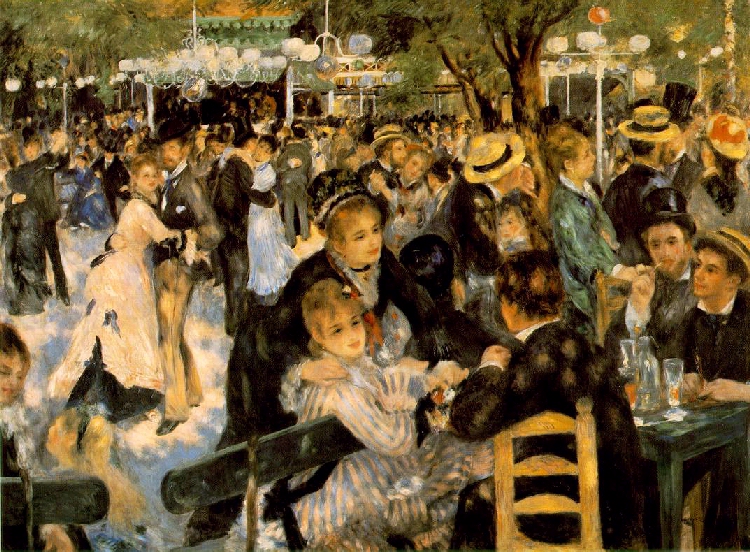
The figure shows a painting by Pierre Auguste Renoir (1841 - 1919), which represents an open-air dance in Paris, painted in 1876. When Jan Steen represented such a scene of revelry, he was eager to depict the various humorous types of the people. Watteau, in his dream scene of aristocratic festivals, wanted to capture the mood of a carefree existence. There is something of both in Renoir. He, too, has an eye for the behavior of the gay crowd and he, too, is enchanted by festive beauty. But his main interest lies elsewhere. He wants to conjure up the gay medley of bright colours and to study the effect of sunlight on the whirling throng. Even compared to Manet's painting of Monet's boat, the picture looks "sketchy" and unfinished. Only the heads of some figures in the foreground are shown with a certain amount of detail, but even they are painted in the most unconventional and daring manner. The eyes and forehead of the sitting lady lie in the shadow while the sun plays on her mouth and chin. Her bright dress is painted with loose strokes of the brush, bolder even than those used by Frans Hals, or Velásquez. . But these are the figures we focus on. Beyond, the forms are increasingly dissolved in sunlight and air. We are reminded of the way in which Francesco Guardi, conjured up the figures of his Venetian oarsmen with a pew patches of colour. |
Click to see a larger picture Le
Moulin de la Galette |