12-5-1005


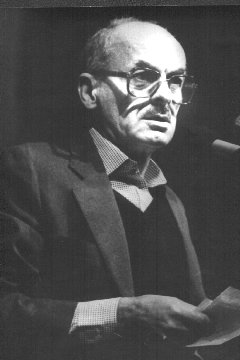
Булат Шалвович Окуджава

BULAT OKUDZHAVA

(1924 - 1997)


HAARETZ.com


Mon., November 01, 2004 Cheshvan 17, 5765

Immortalizing a great Russian bard

By Lily Galili

This article here


LINKS:


Articles in Russian

O O O O O

Articles in English

O O O O O

Poems in Russian

O O O O O
  O O O O O

Poems in English (transl.)

O O O O O
  O O O O O


Дежурный по апрелю

Жанне Болотовой                    
Ах, какие удивительные ночи!
Только мама моя в грусти и тревоге:
"Что же ты гуляешь, мой сыночек,
Одинокий, одинокий?"
Из конца в конец апреля путь держу я.
Стали звезды и крупнее и добрее.
"Мама, мама, это я дежурю,
Я дежурный по апрелю!"
"Мой сыночек, вспоминаю все, что было.
Стали грустными глаза твои, сыночек.
Может быть, она тебя забыла,
Знать не хочет, знать не хочет?"
Из конца в конец апреля путь держу я.
Стали звезды и крупнее и добрее.
"Что ты, мама, просто я дежурю,
Я дежурный по апрелю.
1960


April Duty
 
 
But the nights are really absolutely stunning. 
Only mother's restless worrying has grown: 
Why must you go wandering, my honey, 
On your own? On your own? 
 
I run from one end of April to the other. 
Stars above me mellowed down, grew big as apples. 
Nothing's wrong: I am on duty, mother. 
I'm responsible for April. 
 
But my baby, things have changed since you've been roaming.
But my child, your eyes are sad, I don't believe you. 
Has there been some trouble with a woman? 
Did she leave you?  Did she leave you? 
 
I run from one end of April to the other. 
Stars above me mellowed down, grew big as apples. 
Please don't worry: I am on duty, mother. 
I'm responsible for April. 


  My thanks to Tanya Jean Wolfson,  who permitted the reprodution of her translation of this poem.  


Песенка об Арбате


Ты течёшь, как река. Странное название!

И прозрачен асфальт, как в реке вода.

Ах, Арбат, мой Арбат, ты - моё призвание,

Ты - и радость моя, и моя беда.


Пешеходы твои - люди не великие,

Каблуками стучат - по делам спешат.

Ах, Арбат, мой Арбат, ты - моя религия,

Мостовые твои подо мной лежат.


От любови твоей вовсе не излечишься,

Сорок тысяч других мостовых любя,

Ах, Арбат, мой Арбат, ты - моё отечество,

Никогда до конца не пройти тебя!


1959


Song of the Arbat 


You flow like a river with your strange         name

And your asphalt transparent like water in a        river.

Oh my Arbat, you are my vocation,

You are my joy and my misfortune.


Your pedestrians are not exalted people,

Their heels pound, they hurry on their way.

Oh my Arbat, you are my religion,

Your roadway lies beneath me. 


I will never get over loving you,

Even loving forty thousand other roadways.

Oh my Arbat, you are my native land,

No one could ever come to the end of you.


English translation from here


Молитва Франсуа Вийона


Пока Земля еще вертится,

Пока еще ярок свет,

Господи, дай же Ты каждому,

Чего у него нет.


Умному дай голову,

Трусливому дай коня,

Дай счастливому денег,

И не забудь про меня...


Пока Земля еще вертится,

Господи - Твоя власть,

Дай рвущемуся к власти

Навластвоваться всласть.


Дай передышку щедрому,

Хоть до исхода дня.

Каину дай раскаянье,

И не забудь про меня...


Я знаю, Ты все умеешь,

Я верую в мудрость Твою,

Как верит солдат убитый,

Что он проживает в раю,


Как верует каждое ухо

Тихим речам Твоим,

Как веруем и мы сами,

Не ведая, что творим.


Господи Ты мой Боже,

Зеленоглазый мой,

Пока Земля еше вертится,

И это ей странно самой,


Покуда еще хватает

Времени и огня, -

Дай же Ты всем понемногу,

И не забудь про меня..


 François Villon’s Prayer 


While the earth is still turning, while the     light is still bright,

Lord, grant Thou to each man that which he        lacks:

To the wise man grant brains, to the coward       a steed,

Grant the lucky man money…And don’t       forget about me.


While the earth is still turning,--Lord, it is      in Thy power!--

Grant the man who wants power to rule to      his heart’s content,

Grant the generous man a respite, if only to     the end of the day,

To Cain grant repentence…And don’t       forget about me.


All is in Thy power: I believe in Thy        wisdom,

As the dead soldier believes he’s living in        heaven,

As each ear believes Thy silent speeches,

As we ourselves believe, not knowing what        we do.


Lord, my God, my green-eyed one!

While the earth is still turning, amazed it’s      still turning,

While it still has time and fire,

Grant Thou a little to everyone…And don’t      forget about me.


English translation from here


МЕДСЕСТРА МАРИЯ


А что я сказал медсестре Марии,
когда обнимал ее?
- Ты знаешь, а вот офицерские дочки
на нас, на солдат, не глядят.
 
А поле клевера было под нами,
тихое, как река.
И волны клевера набегали,
и мы качались на них.
 
И Мария, раскинув руки,
плыла по этой реке.
И были черными и бездонными
голубые ее глаза.
 
И я сказал медсестре Марии,
когда наступил рассвет:
- Нет, ты представь: офицерские дочки
на нас и глядеть не хотят.


Maria the Nurse


What did I say to Maria the nurse
when I was hugging her?
“You know that officer’s daughters
don’t look on us soldiers.”


And the field of clovers was beneath us
quite like the river.
And the waves of the clovers became higher
and we swayed upon them.


And Maria, opening her arms,
swam down the river.
And black and eternal
were her light-blue eyes.


And when sunrise arrived
I told Maria
“No, imagine that officer’s daughters
don’t wish to look at us.”


1950


Translation into English by Robert Young, from here.


Все глуше музыка души, 
все звонче музыка атаки. 
Но ты об этом не спеши: 
не обмануться бы во мраке, 
что звонче музыка атаки, 
что глуше музыка души. 


Чем громче музыка атак, 
тем слаще мед огней домашних, 
и это было только так 
в моих скитаниях вчерашних: 
тем слаще мед огней домашних, 
чем громче музыка атак. 


Из глубины ушедших лет
еще вернее, чем когда-то -- 
чем громче музыка побед,
тем горше каждая утрата,
еще вернее, чем когда-то,
из глубины ушедших лет.


И это все у нас в крови,
хоть этому не обучали:
чем чище музыка любви,
тем громче музыка печали,
чем громче музыка печали,
тем выше музыка любви.


1985


The music of the soul is ever fainter,

the music of the attack is ever more resonant.

But don’t hasten (to comment) on that:

so as not to be deceived in the darkness,

that the music of the attack is more resonant,

and the music of the soul ever fainter.


the louder is the music of the attacks,

the sweeter is the honey of the lights of home.

And this was only that way

in my yesterday’s wanderings:

the sweeter the honey of the lights of home,

the louder the music of the attacks.


From out of the depths of years gone by

more sure than ever before,

the more resonant the music of victories,

the more bitter is every loss,

the surer than ever before,

from the depths of years gone by.


And this is all in our blood,

even though we were not taught it:

the more sublime the music of love,

the louder is the music of grief,

the louder is the music of grief,

the more pure is the music of love.


Как наш двор ни обижали -- он в классической поре. 
С ним теперь уже не справиться, хоть он и безоружен.
 
А там -- Володя во дворе,
 
его струны в серебре,
 
его пальцы золотые, голос его нужен.


Как с гитарой ни боролись -- распалялся струнный звон. 
Как вино стихов ни портили -- все крепче становилось.
 
А кто сначала вышел вон,
 
а кто потом украл вагон --
 
все теперь перемешалось, все объединилось.


Может, кто и нынче снова хрипоте его не рад... 
Может, кто намеревается подлить в стихи елея.
 
А ведь и песни не горят,
 
они в воздухе парят,
 
чем им делают больнее, тем они сильнее.


Что ж печалиться напрасно? Нынче слезы -- лей не лей, 
но запомним хорошенечко и повод, и причину...
 
Ведь мы воспели королей,
 
от Таганки до Филей --
 
пусть они теперь поэту воздадут по чину!


1982 (?)


No matter how they insulted our courtyard, it’s in a classic period.

No way of coping with it now even though it’s been disarmed.

There’s Volodya in the courtyard

with his silver strings,

his golden fingers, his voice is needed.


No matter how they fought against the guitar, the peal of strings kept getting hotter.

No matter how they watered the wine of verse, it kept getting stronger.

Who was the first to leave,

who then stole the wagon,

it’s all mixed up now, all rolled into one.


Maybe someone even now isn’t happy about his hoarse voice again.

Maybe someone intends to slip some unction into the poems...

But after all, songs do not burn,

They hover in the air,

The more painful it’s made for them, the stronger they gel.


Why be sad for no good reason: these days, weep or not,

We’ll remember very well the cause and the reason...

For after all, we sang the praises of kings

from the Taganka to Fili,

may they now pay tribute to the poem according to his rank.


Римская империя


Римская империя времени упадка 
сохраняла видимость твердого порядка:
 
Цезарь был на месте, соратники рядом,
 
жизнь была прекрасна, судя по докладам.
А критики скажут, что слово "соратник" -- не римская деталь,
 
что эта ошибка всю песенку смысла лишает...
 
Может быть, может быть, может и не римская -- не жаль,
 
мне это совсем не мешает, а даже меня возвышает.


Римляне империи времени упадка 
ели что придется, напивались гадко,
и с похмелья каждый на рассол был падок --
 
видимо, не знали, что у них упадок.
 
А критики скажут, что слово "рассол", мол, не римская деталь,
 
что эта ошибка всю песенку смысла лишает...
 
Может быть, может быть, может и не римская -- не жаль,
 
мне это совсем не мешает, а даже меня возвышает.


Юношам империи времени упадка 
снились постоянно то скатка, то схватка:
 
то они -- в атаке, то они -- в окопе,
 
то вдруг -- на Памире, а то вдруг -- в Европе.
 
А критики скажут, что "скатка", представьте, не римская деталь,
 
что эта ошибка, представьте, всю песенку смысла лишает...
 
Может быть, может быть, может и не римская -- не жаль,
 
мне это совсем не мешает, а даже меня возвышает.


Римлянкам империи времени упадка, 
только им, красавицам, доставалось сладко --
 
все пути открыты перед ихним взором:
 
хочешь -- на работу, а хочешь -- на форум.
 
А критики хором: "Ах, «форум», ах, «форум»" -- вот римская деталь!
 
Одно лишь словечко -- а песенку как украшает!
 
Может быть, может быть, может и римская -- а жаль...
 
Мне это немного мешает и замысел мой разрушает.


 1979


The Roman empire in its period of decline

retained the appearance of firm order.

The chief was in place, his comrades-in-arms by his side,

life was fine, judging by the reports.


But critics will say that the word “comrades-in-arms” isn’t a Roman item,

that this mistake deprives the whole song of sense.

Perhaps, perhaps, perhaps it isn’t Roman, I’m not sorry,

this doesn’t hinder me at all, and even lifts me up.


The youths of the empire in its period of decline

dreamed constantly of rolled-up capes and combat.

First they’d be on the attack, then in the trenches,

Now in the Pamirs, and then suddenly in Europe.


But critics will say that the word “capes,” imagine, isn’t a Roman item,

that this mistake deprives the whole song of sense.

Perhaps, perhaps, perhaps it isn’t Roman, I’m not sorry,

this doesn’t hinder me at all, and even lifts me op.


The peasants of the empire in its period of decline

ate what they could gel hold of, and got vilely drunk.

And as a cure for their hangovers each one was partial to rassol –

They evidently didn’t know there was a decline.


But critics will say that the word “rassol” isn’t a Roman item,

that this mistake deprives the whole song of sense.

Perhaps, perhaps, perhaps it isn’t Roman, I’m not sorry,

this doesn’t hinder me at all,

and even lifts me op.


The women of the empire in its period of decline

They were the only ones, those beauties, whose lot was sweet.

All paths were open before their gaze,

if they wanted they went to work, if they didn’t they went lo the forum.


And the critics in chorus: Oh, the forum, oh, the forum, there’s a Roman item!

Just one little word, But how it improves the song!

Perhaps, perhaps, perhaps it’s Roman, But I’m sorry,

it hinders me a bit

and destroys my idea.


У поэта соперников нету
ни на улице и ни в судьбе. 
И когда он кричит всему свету, 
это он не о вас -- о себе. 

Руки тонкие к небу возносит, 
жизнь и силы по капле губя. 
Догорает, прощения просит... 
Это он не за вас -- за себя. 

Но когда достигает предела,
и душа отлетает во тьму --
оле пройдено, сделано дело...
Вам решать: для чего и кому.

То ли мед, то ли горькая чаша, 
то ли адский огонь, то ли храм...
Все, что было его -- нынче ваше.
Все для вас. Посвящается вам.


1986

The poet has no rivals

either on the street or in his destiny.

And when he cries out lo the whole world,

it’s not about you, but about himself.


He raises his delicate hands op lo heaven,

expending his life and powers drop by drop.

Burning out, he asks for forgiveness,

not for you, but for himself.


But when he reaches the limit

and his soul flies off into darkness...

The field’s been crossed’ the deed is done.

It’s for you lo decide for what and for whom.


Whether honey, or a bitter cup,

or the fires of hell, or a temple...

Everything that was his now is yours.

All for you. Dedicated to you.


Давайте придумаем деспота, 
чтоб в душах царил он один
 
от возраста самого детского
 
и до благородных седин.
 

Усы ему вырастим пышные 
и хищные вставим глаза,
 
сапожки натянем неслышные,
 
и проголосуем все -- за.
 

Давайте придумаем деспота, 
придумаем, как захотим.
Потом будет спрашивать не с кого,
коль вместе его создадим.

И пусть он над нами куражится
и пальцем грозится из тьмы,
пока наконец не окажется,
что сами им созданы мы.

1979


Let’s dream up a despot,

who will role alone in our hearts

from the most childish age

right down to noble gray hairs.


Let’s have him grow a luxuriant moustache

and let’s put in rapacious eyes,

pull on jackboots that make no noise,

and let’s all vote yes.


Let’s dream up a despot,

dream one up the way we want him.

Later there will be no one lo ask,

if we create him together.


And let’s have him posture over us

and threaten from the darkness with a finger,

until at last it turns out

that we ourselves were created by him.


Примета

А.Жигулину              

Если ворон в вышине,
дело, стало быть, к войне.

Чтобы не было войны,
надо ворона убить.
Чтобы ворона убить,
надо ружья зарядить.

А как станем заряжать,
всем захочется стрелять.
Ну а как стрельба пойдет,
пуля дырочку найдет.

Ей не жалко никого,
ей попасть бы хоть в кого,
хоть в чужого, хоть в свово..
Во, и боле ничего.

Во, и боле ничего.
Во, и боле никого.
Кроме ворона того:
стрельнуть некому в него.


1984


The Omen


to A. Zhigulin           


If there is a raven up above

It means things are moving toward war.


So there shouldn’t be a war

The raven has to be killed.

To kill the raven

A gun has to be loaded.


But when we start loading it

Everyone will want to shoot.

And as soon as the shooting starts

The bullet will find a hole.


The bullet pities nobody,

Wants lo hit just anybody,

One of theirs, one of ours...

That’s it, there’s nothing more.


That’s it, there’s nothing more.

That’s it, there’s nobody left.

Except for that raven,

And now there’s nobody to shoot it.


Письмо к маме


Ты сидишь на нарах посреди Москвы. 
Голова кружится от слепой тоски. 
На окне -- намордник, воля -- за стеной, 
ниточка порвалась меж тобой и мной. 
За железной дверью топчется солдат... 
Прости его, мама: он не виноват, 
он себе на &#