16-10-2002
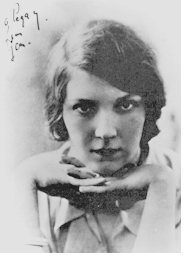
Jean
Rhys
(1894 -
1979)
| |
|
Her
original name was
Ella
Gwendolen Rees Williams,
English novelist, b.Roseau - Dominica – Winward Islands, d. Exeter,
Devon. England. Her novels, written in the 1930s, mercilessly exploit
her own emotional life, depicting pretty, no-longer-young women who find
themselves down and out in large European cities. Without work or funds,
her characters must depend on men, chance encounters, or former lovers,
for money to buy a hotel room, a drink, a pair of gloves. Rhys’s vision
is uncompromising and her literary style is spare. These early works
include Quartet (1929), After Leaving Mr. Mackenzie
(1931), and Good Morning, Midnight (1938). After a long
retirement she published her masterpiece, Wide Sargasso Sea
(1966), which drew equally on her own Caribbean childhood and on a
reimagining of Charlotte Brönte’s Jane Eyre from the perspective
of Rochester’s mad West Indian wife. It was followed by three
short-story collections and the first volume of an autobiography (1979).
|
|
|
|
|
Wide
Saragasso Sea
In writing the novel
Wide Saragasso Sea, it was the ambition of writer Jean Rhys, to create a
history and understanding of the character Bertha Rochester, the mad wife of
Rochester in Charlotte Bronte's Jane Eyre. In order to do so, Rhys set
herself up to appropriate Bronte's story, the consciousness of a woman who goes
insane (Bertha), and the perspective of an English gentleman (Rochester). It
took Rhys nine years to create these characters and this story that
empathetically provided culturally accurate defence for both Bertha and
Rochester. This time commitment in itself is evidence that Rhys was dedicated to
a responsible creation of this story.
Rhys herself lived in
Dominica until she was sixteen and in England for the remainder of her life.
Rhys ' mother was Creole, like Bertha Rochester, and her father was Welsh. With
this ancestry, Rhys lived in a multicultural setting and was likely sensitive to
the differences of people of various cultures.
In Wide Saragasso Sea,
Rhys focuses on the differences between people who come from various places. The
symbolism of the title suggests the barriers, such as bodies of water, that
separate people. Rochester and Bertha's conversations comment on their
difficulty of understanding one another due to their opposing upbringing and
culture:
`Is it true,' she said,
`that England is like a dream? Because one of my friends who married an
Englishman wrote and told me so. She said this place like London is like a cold
dark dream sometimes. I want to wake up.'
`Well,' I answered annoyed, `that is precisely how your beautiful island seems
to me, quite unreal and like a dream.'
`But how can rivers and mountains and the sea be unreal?'
`And how can millions of people, their houses and their streets be unreal?'
`More easily,' she said, `much more easily. Yes a big city must be like a
dream.'
`No, this is unreal and like a dream,' I thought. (Wide 67)
It is Rochester's
inability to feel comfortable in Jamaica, and Bertha's inability to understand
England that forms a barrier between them. Rochester admits that Bertha is a
stranger and that he cannot empathise with her: "I felt very little tenderness
for her, she was a stranger to me, a stranger who did not think or feel as I
did." (Wide 78). Rhys writes of the near impossibility of understanding
another culture.
The novel is from the
perspective of Bertha in the first and last sections and from the perspective of
Rochester in the middle section. Rhys does not depict either character as the
hero or villain, but she focuses on the complexity of each and the dynamics of
their relationship and why it failed them both. Likely, in the nine years that
it took Rhys to complete this novel to her satisfaction, she did a lot of
observing and research of the English gentleman, of mental insanity, of the
situations of Jamaica and England at this time, and of Charlotte Bronte's novel.
Hopefully, Rhys also did much soul searching of her own personal preconceptions
and biases. In the end, Rhys created a complex and multidimensional novel.
LINKS:
Kirjasto -
Finland
Alana Harding
Andrea
Dworkin
Adulterous liaisons:Jean Rhys, Stella Bowen and feminist
reading – Sue Thomas
Fu
Jen Catholic University - Taiwan
- World Literatures in English
Jean Rhys
Biography
THE JEAN RHYS PAPERS
- University of Tulsa
Bryony
Atkinson’s page

The
Washington Post Book Club
'Voyage in the Dark' by Jean Rhys
Presented by
Zofia Smardz
Sunday, June 2, 2002; Page BW12
When she was
very young, just an impoverished chorus girl in England, Jean Rhys fell in love
with an older man, a lower-rung aristocrat with whom she had a brief, somewhat
one-sidedly intense affair. When he broke it off, she was disconsolate; when he
subsequently offered to provide her with a weekly stipend until she could
support herself, she was doubly distraught. In her emotional turmoil, she
impulsively bought four schoolgirl notebooks and some pens and, in a kind of
white heat, spent days pouring the story of her great love and its demise onto
the pages. Then she stuffed the notebooks into a trunk and went on, shakily,
with her life.
Fast forward
some 20 years, to 1934. Rhys, having weathered a tumultuous two decades -- a
disastrously haphazard marriage, more love affairs, divorce, remarriage -- is
now a writer publishing her third novel, Voyage in the Dark. It's the
story of Anna Morgan, an impoverished young chorus girl who has a brief but
ardent affair with a wealthy older man who breaks her heart by breaking with
her, then unwittingly twists the knife by offering to send her money to take
care of her. Sound familiar? Yes, it's the story of the notebooks -- dug up,
brushed off, shaped and molded and rendered into fiction. No -- more than
fiction. Voyage isn't your run-of-the-mill autobiographical novel; it's
a book whose material has been subjected to transformative powers so
exceptional, and a sensibility so unique, as to vault it into the stratosphere
of literature with a capital L.
Rhys
sometimes gets knocked for being unrelievedly gloomy and grim, for writing about
depressed women for depressed women, as my husband likes to needle me (I do
particularly like to read her when I'm feeling blue), or about weak women who
let themselves be used by men -- a subject our 21st century might sniff at. But
it's an unfair rap. Rhys is neither only a "woman's writer" nor the high
priestess of hopelessness nor the scribe of the downtrodden female. True, her
stories are never sunny. Anna's slide after Walter leaves her is pretty
precipitously downhill: In an effort to preserve her dignity, she drops out of
sight so that Walter can't send her any money. But then she gives in to despair,
shuffles from one dreary London bed-sit to another, and finally ends up sharing
a flat with an older woman, a self-styled masseuse who sets her up as a
manicurist for men, with the suggestion that she might offer clients a little
extracurricular service to earn additional cash.
While Anna
stops short of such cynical self-debasement, she does give in to a string of men
she meets through her chorine friends, as well as others whom she picks up on
the street. She sleepwalks or drinks her way through the encounters, numbed to
emotion, drained of hope. Listen to Rhys's rendering of that state: In one
passage, Anna and her roommate Ethel are leaving the cinema. "It was six
o'clock, and when we got into Camden Town High Street it was quite dark. . . .
The pavement looked as if it was covered with black grease. Ethel said, 'Did you
see that girl -- the one who was doing Three-Fingered Kate? Did you notice her
hair? I mean, did you notice the curls she had on at the back?' I was thinking,
'I'm nineteen and I've got to go on living and living and living.' " Or this:
"It's funny when you feel as if you don't want anything more in your life except
to sleep, or else to lie without moving. That's when you can hear time sliding
past you, like water running."
Rhys's
language and imagery are consistently powerful and precise, while appearing to
be astonishingly artless. She often told the editor and writer Diana Athill, who
worked with her in the last 15 years of her life, how hard she strove in her
books "to get things right" and to do it without any "stunts," and she succeeds
again and again. I guarantee that the shock of recognition will hit you more
than once as you read Voyage in the Dark -- even if you've never been a
19-year-old girl disappointed in love.
An essential
element of Anna's unhappiness is her fundamental sense of displacement in
England -- again a mirror of Rhys's own experience. The theme of the outsider is
strong and, in fact, frames the novel: Pay attention to the passages that
contrast Anna's childhood on the sunny island of Dominica with her dismay over
England's grayness and her feeling of never fitting in. How much does this add
to the sense of rejection she suffers at Walter's hands? And to her inability to
get a grip on herself? And finally, ask yourself at the end -- after you've read
one of the most poignant closing lines in all English literature -- whether the
message of this novel is truly one of despair.
Zofia
Smardz is a Washington writer and editor.

October, 8-14, 1999
Wide
Caribbean Sea
Calling up the
spirit of Jean Rhys
by Pamela Klein
WHEN I
ARRIVE ON MOST WEST INDIAN islands, I am empty. I want it to be that way, for
the land fills me up with its heat, its emerald pools, its orchids. I arrive on
the tangled terrain of Dominica, however, in a different state entirely. I am
led here, to Roseau, the island's capital, to 48 Cork St., by a spirit that has
haunted me since I was a very young girl. I am full of this wild woman, having
memorized her every word. She has called me to come.
I am drawn
to a huge mango tree behind Vena's Guesthouse, birthplace and childhood home of
the novelist Jean Rhys. It is midday, and I have had little sleep. A young
Dominican man is drinking rum and pawpaw juice at the bar. I ask him if he knows
whose garden this was. He laughs, a drunken laugh.
I sit
beneath the tree and pretend it is 1900, that I am Jean's playmate. We are 10,
both of us, she of English colonial stock, I of French. Dominica was at times
ruled by England, at other times by France, which stole it from the Caribs in
the late 1600s. Jean warns me that if I stay too long in the sun, the black land
crabs will take me on a dangerous journey. To the mornes, she tells me,
spinning around and pointing to the rain forest, where the lakes boil and the
bats prepare to feed on the night. Touch the water, she says, and your skin will
burn. Wake the bats and night could come early.
Après Bondie c'est la ter,
I hear Jean sing, over and over. After God it's the land, goes the
island's song. Lush and wild and beguiling Dominica, with more colors of green
than there are names for. I want to lie down and kiss the land that fed her such
bitter poetry.
The Dominican girl behind
the bar asks what I would like to drink. The two 10-year-olds retreat into my
head. I order mango juice, fresh. Could it be from the tree? I wonder.
"Have you read Wide
Sargasso Sea?" I ask her. In it, Rhys spins a West Indian nightmare for
Jane Eyre's madwoman-in-the-attic, Bertha Rochester.
"No," she answers plainly,
taking a sponge to the wooden countertop that serves as the bar. This surprises
me, for she prepares mountain chicken and flying fish in a kind of literary
oasis. Readers from all over the world must come here, I think -- Rhys is to
Dominica what Derek Walcott is to St. Lucia, and Saint-John Perse is to
Guadeloupe.
I sit
down in the tree's shade and look around what is now called the World of Food.
It is a grim place, with hard benches and ashtrays overflowing with cigarette
butts. Liquor posters dot the walls. The smell is unsentimental, with a touch of
callaloo that's cooking in a soup pot on the stove. Rhys would be pleased
I ask
the girl where to find out more about the garden, and about Rhys, who left
Dominica at 17 to study in England.
"In
Dominica,
by Lennox Honychurch," she says. "It's a small book. You can get it at Frontline
Bookstore, on Queen Mary Street. That way," she says, pointing toward the sea,
the sponge still in her hand. Her eyes are gentle, sad even. They match her
creamy brown skin. A red-and-yellow madras apron covers her yellow dress.
Sensing my disappointment,
she offers me something: "Rhys mentions that tree in the book. Somebody from the
guesthouse once told me." I smile and sip the mango juice, and let the afternoon
lull me. "I bet the tree's over 200 years old," I tell her.
"Could be," she says,
looking up to the top of the tree, where it reaches toward the dark-blue sky.
What it must know.
While I
want to talk about my ghost, the drunk at the bar, who is amazingly
philosophical and definitely interested, doesn't understand. "Dominicans will
never forget what the Americans did for us after Hurricane David, '79," he says.
A white woman with very long
fingernails and short shorts enters the courtyard, sits in the corner, lights a
cigarette. She lifts her face to the sun. A worshipper, I think: kin.
A man with dreads joins the
drunk at the bar. "Rum," he says, sitting down, speaking to the girl behind the
counter in French Creole, the first language of the locals here. She pours some
white Macoucherie into a heavy glass.
A cock crows very loud, and
I take this as a sign. I order a shot of Macoucherie, to raise the spirit.
"To Rhys," I say, holding
the glass aloft.
"And
her mango tree," says the girl behind the bar as she reaches for the sponge,
smiling.
A woman scorned
Chris Petit on Alexis Lykiard's fond
memoir Jean Rhys Revisited
Chris Petit
Guardian
Saturday June 24, 2000
Jean Rhys Revisited
Alexis Lykiard
Stride, £11.95, 281pp
Although now more widely
read and popular than her once better-known literary mentor and lover Ford Madox
Ford, Jean Rhys spent most of her life forgotten. Alexis Lykiard's fond memoir
is fascinated with the process by which authors slip out of memory, often
undeservedly, and is littered with tantalising references to other vanished
writers (Mina Loy, Anna Kavan), the famously overlooked (Henry Green), and those
who willed themselves into obscurity through a refusal to compromise - a process
Lykiard himself is qualified to write about, having abandoned his own career as
a novelist.
Writing at a difficult time
- the 1960s - when the English novel was an unfashionable thing for a young man
to aspire to, Lykiard also missed out on the comfortable advances and literary
prizes available to the generation after him, which produced careers as secure
and dull as anything in the civil service.
Lykiard met Jean Rhys when
he was a young writer in his twenties and she was getting on, reduced to fairly
ghastly circumstances and stuck in a part of Devon she described as "really one
of the dullest places under heaven". Their attraction was based on mutual exile
(Lykiard had fled London for the west country) and the fact that they were both
outsiders. Lykiard was Greek, filtered through public school, while Rhys had
been raised in Dominica, beyond the usual constraints of English society, until
sent to finish her education in England.
Because of her late arrival,
Rhys's work escaped the network of defensive irony on which so much English
literature depends. Lykiard's portrait presents her as being in all respects
intensely unironic, and therefore intensely difficult. Stella Bowen, the third
party in the ménage with Ford and Rhys, described her as "a doomed soul, violent
and demoralised". The critic Claire Tomalin has marked her down as "as much
monster as victim".
In the current jargon, Rhys
suffered from low self-esteem ("I had a complete conviction that I was a useless
person"), dysfunctional relationships and an addictive personality. But her
neuroses were prescient of today's, and the template of her novels anticipated
the contemporary interior landscape. Her work also deals with sexual and
financial transactions in a recognisably modern way; it is attuned to emotional
short-changing and its by-products, the humiliation and excitement of masochism.
No one has written so well on the nature of careless lives.
Rhys's own sense of
displacement - what Diana Trilling, in a rejoinder to the argument about her
masochism, called her emotional "isolateness" - came out of her unsteady
progress through the rackety world of the chorus line, Bohemian circles and the
dubious world of masculine patronage. Her failure to adopt, and adapt to, Europe
resulted in fiction that can, like her emigration, be read as a movement away
from the light. Nowadays her English depressions would probably be diagnosed as
seasonal affective disorder.
Lykiard paints Rhys as a
haunted figure (and as such unreasoning), who through her upbringing related to
ancient local Caribbean traditions of superstition and magic. He points out how
crucial the dream state was to her. Her surreality was not dissimilar to
Buñuel's in its startling juxtaposition; its collision of dreams, weather,
ghostly eroticism and bourgeois reality, in the shape of money and architecture.
"One day the fierce wolf that walks by my side will spring on you and rip your
abominable guts out," she wrote matter-of-factly in Good Morning, Midnight.
Her work's timeless quality
stands in contrast to her own life, which too often saw her stuck. In 1949 she
wrote complaining that "my bitter enemy next door" was broadcasting that she was
impersonating a dead writer called Jean Rhys, to which she added a rueful PS:
"You think: perhaps I am!" This phantom life was given an ironic succinctness in
Bowen's account of how she and Ford finally managed to get rid of Rhys - getting
her "a job to 'ghost' a book for someone on the Riviera".
The richness of Lykiard's
book depends on it offering more than just a memoir. The danger with Rhys is
that she can be downgraded into a Merchant Ivory costume piece, when, as Lykiard
knows, she is better represented by Lewton and Tourneur's I Walked With a
Zombie. He is alert to the sharpness of Rhys's inner voice, her psychological
acuity and the torpor of her stories in contrast to the exactness of her prose;
he, like Rhys, is drawn to careless lives.
As well as being a
meditation on the nature and business of writing, Jean Rhys Revisited is a piece
of literary archaeology and a book of enthusiasms (Hamsun, Gissing, George
Moore) that performs a useful act of referral. It is also a considered work
about old age and beyond - Lykiard writes movingly about Rhys's fear of her
approaching death - written by a man who was young when he knew Rhys, and is now
approaching his own old age.
Famous drinkers
Jean
Rhys
Chloe Diski
Observer
Sunday November 11, 2001
Jean
Rhys said in 1974: 'When I was happy, I had no wish to write.' Rhys's life
flitted from periods of depression fuelled writing to brief moments of
happiness, but her drinking remained a fixture (along with her passion for
shopping). Born in 1890 in the Dominican Republic , Rhys led a nomadic life,
swaying between European cultural centres and in and out of three marriages. Her
novels are gloomy stories of solitary and drunken heroines, unable and barely
willing to involve themselves in life. Rhys's most productive period was in the
1930s but her books, like Good Morning, Midnight, were not a success at the time
and so she had to wait for fashion to catch up. After a reclusive period of
almost 20 years - she was thought to be dead - she re-emerged and was accused of
impersonating a dead writer called Jean Rhys but proved everyone wrong by
writing a classic prequel to Jane Eyre - Wide Sargasso Sea. She died in 1979.
For the love of Jean
Jean
Rhys came to fame quite late in life and, despite having a reputation for being
difficult, had a coterie of supporters. Diana Athill recalls the trials of being
her editor, and what the writer thought of the feminist interpretation of her
books
Diana Athill
Guardian Unlimited
Saturday September 16, 2000
'I
don't understand why you were all so fond of her.'
A
friend said that to me about Jean Rhys, and I understand why she said it. So
much emphasis has been put on Jean's inability to cope with the practicalities,
such as filling a hot-water bottle or turning on a shower; on her disastrous
muddles in more important matters such as marriage and the handling of her books
once they were written; on her paranoia and her drinking. And her own assessment
of her attitude to other people was that she saw them 'as trees walking.'
Everyone starts out wanting simply 'to be' in his or her own way. Nearly
everyone soon learns that they must accept constraints of many kinds if they
want to be seen as responsible adults. Jean was one of the few who cannot (or
who, for whatever reason, has become unable to) accept such constraints - a
disposition that became her subject - ways she wrote as an outsider who was
trapped inside, showing the 'grown-up' world as it looks and feels to such a
prisoner.
Those
who dislike her books are the people wholly committed to their hard-won
adulthood. Most of us, however, are aware from time to time of our own inner
child fidgeting against its rules and demands, and Jean's novels speak to that
awareness with startling immediacy. It was her childlike disposition that made
her the extraordinary novelist she was - but in life it did often cause pain to
her and those closest to her, and gave a good deal of trouble to many other
people, including me.
When
André Deutsch Limited published Wide Sargasso Sea in 1966 Jean was 76. I, as
their chief editor, had been in touch with her for eight years by then, and was
to see a lot of her from then on. We reissued all her earlier work except for a
few short stories, and we published her two last books. I feel a fraud when
described as 'Jean Rhys's editor', because in her writing she was such a
perfectionist that she needed no editing. But she did need a nanny.
It was
a task much less onerous than I expected it to be. Jean loved her daughter,
Maryvonne Moerman, very much; but she was no better at motherhood than she was
at filling hot-water bottles, so when she hinted that she might move to
Rotterdam, where the Moermans lived, Maryvonne panicked. She came to London,
took me to lunch, and told me that although she would continue to visit her
mother, and could be called on in any emergency, she most definitely could not
have her in Holland: 'It would be the end of my marriage.' So it was me, she
said firmly, who would have to look after Jean.
By
then I had a clear idea of Jean's helplessness, so I knew there would be endless
muddles to be sorted out and a constant need for reassurance. I would have to
find her somewhere better to live than her dreadful little flimsy bungalow in
Devonshire (this was never achieved because she always said: 'Better the devil I
know' when it came to the point - but the bungalow was made much more
comfortable). As soon as she had earned enough money to be taxed, I would have -
oh God! - to deal with the resulting problems...
No one
who knew the history of Jean and Maryvonne could possibly blame Maryvonne for
her attitude, but to say that I was dismayed is an understatement.
As it
turned out, my part of the job was easy in the end. Francis Wyndham, who had
introduced me to Jean's work, was able to help her in many ways. Sonia Orwell
was to do an enormous amount for her, and gradually the whole 'support team'
expanded to include many other people who were drawn to Jean by their admiration
of her work, some of whom were prepared to go to great lengths for her. None of
us was unaware of how difficult she could be - and all of us were very fond of
her. So my friend's question set me thinking.
If you
came upon Jean unexpectedly she was always sunk in her chair, gazing into space
with a deeply sad expression. Her face would light up as she turned towards you,
exclaiming: 'Oh darling - there you are!' as though she had given you up (she
probably had - she expected to be let down).
The
once lovely girl had shrunk to a slightly distorted old woman with hands so
cruelly twisted that she could hardly hold a pen, on whose body clothes sat
awkwardly. The skin over her high cheekbones was still clear, her soft silvery
hair was still pretty, but it was her huge, grey-blue, wide-apart eyes that
showed how beautiful she had been - that made you sure there had always been an
elusive, half inviting, half out-of-reach quality about her... something much
more interesting than the prettiness of a Dresden doll, though 'the Dresden
doll' was what she had once been called when she was a chorus girl in musical
comedies.
On bad
days her talk could be querulous, but usually it was charming, seemed unreserved
and intimate, although the field in which she was unreserved was narrow, partly
because of an old-fashioned sense of decorum and partly because there were
things in her past which she wanted to wipe out. She said that she had no sense
of humour, but her enjoyment of the absurd was great, and she was the only
person I ever knew who'd laugh till she cried. One thing she found very funny
was when a critic attempted to impose a women's movement interpretation on her
books: 'Women's Lib - me!' she'd say. Although when talking more seriously she
always insisted that what her critics made of a writer's work was their
business, not the writer's.
About
her own work she always said the same things: that what she aimed for was
'getting it right, getting it as it really was'; and that one must cut and cut
and cut again. (These simple-sounding rules were, of course, not simple at all,
being a convenient shorthand for a scrupulous and subtle precision and the fine
art of implying more by less.)
She
would also say that ending a novel based on things that had really happened, as
hers all were, was difficult because a novel must have shape, and real life
usually has none - the ending of Good Morning, Midnight had given her a great
deal of trouble, she said, which made her rather proud of it. Two of her
statements, both made more than once, seem to be contradictory: if she really
did hate having been good at writing because it was so difficult, how could she
sometimes feel more like a pen being used than like a person using a pen, which
sounds effortless even if frightening?
She
liked to pass on a tip given her by Ford Madox Ford when she was with him in
Paris: when doubtful about a sentence, translate it into French - if it works in
French it is good. (I never asked her if she had done this, but I suspect that
it's nonsense, and that she hadn't.)
I
never heard her talking about other people's writing, beyond saying that a book
was good, or that she did not much like it. To tear a bad book to pieces would
have been as displeasing to her as unkind gossip, which she abhorred. She used
to laugh at how often she had re-read The Prisoner of Zenda because books found
for her in the Exeter library by a neighbour's daughter had proved unpalatable.
No doubt, she said, The Prisoner was romantic rubbish, but it must be well
written or she could not have read it so often.
The
most fascinating thing about Jean was how consistently she was her stubborn,
beleaguered, central self. People, particularly women, are so often modified by
other people such as a spouse, a child, a parent, an interesting stranger, a
boring old friend, becoming a little (or sometimes a lot) different according to
their company. Jean was always Jean, as a cat is always a cat: a being with an
an essence too strong to be altered by anything but its own emotions, such as
fear or anger. Just as one gets positive pleasure from watching a wild creature
being itself, so I always got pleasure from watching Jean being Jean.
And,
of course - this was by far the most important element in people's affection for
Jean - the more one realised her frailties and inefficiencies, the more one
marvelled at her steely strength as a writer.
It is
impossible to describe briefly the burdens inflicted on her by poverty,
loneliness and the strain of living with a very ill man during the many years
when she struggled with her greatest novel, Wide Sargasso Sea. It is no
exaggeration to say that it nearly killed her: her heart went into failure on
the day she was supposed to hand the book over to me, and it was two years
before she recovered enough to add the two or three little finishing touches
without which she would not let us publish it. It remains a mystery how someone
so ill-equipped for life, upon whom life had visited such tribulations, could
force herself to hang on, whatever the battering she was taking, to the artists
at the centre of herself.
She
kept a diary once, when she had hit rock bottom, in which she imagined herself
being cross-examined by a judge.
'I
must write. If I stop writing, my life will have been an abject failure. It is
that already to other people, but it could be an abject failure to myself. I
will not have earned death.
'Earned death?' Sometimes, not often, a phrase will sound in my ear clearly, as
if spoken aloud by someone else. That was one phrase. You must 'earn death'. A
reward? 'Yes.'
It is
not really at all surprising that one was fond - that one loved - Jean Rhys.
chicagotribune.com
Jean Rhys revealed as more than caricature
By Kate
Zambreno
May 30, 2009
"The Blue Hour: A Life of Jean Rhys"
By Lilian Pizzichini
Norton, 322 pages, $29.95
In her four exquisite between-the-wars novellas, set among the half-shadowed
demimonde of Paris and London, Jean Rhys wrote of the horror of a series of
small rooms, from dreary Paddington bedsits to bug-ridden Left Bank hotels. Her
heroines, based relentlessly on herself, are one-time chorus girls, shop girls
and mannequins collected like china dolls by bourgeois Englishmen, and then
dismissed once they fall to pieces. Rhys' most famous Svengali was the Modernist
writer Ford Madox Ford, who changed Rhys' name from Ella Gwendolen Rees
Williams, encouraged her to write and coaxed her out of her marriage to Dutch
drifter Jean Lenglet and into Ford's bed. This was while she was living with him
and his sculptor wife.
That uncomfortable ménage à trois became the subject for Rhys' first novel,
"Quartet," an act of revenge (the kept woman speaks back), which some publishers
would not touch for fear of libel. But Rhys wrote of her emotional truth, the
masquerade of social encounters and a London she saw full of gray and dread. It
was a chilled contrast to the vivid fires of her native Dominica, which she
changed to Jamaica and characterized as a doomed Eden in her famous novel "Wide
Sargasso Sea," published in 1966 to much acclaim.
In her lyric novels of mood and memory, Rhys speaks for her mute vagabonds, her
former (and current) selves, struggling from the bottom, sinking deliriously in
bottles of rouge, Pernod and barbiturates -- always another, please. Her prose
is also intoxicated, fragmented, elliptical, with snatches of song and dialogue,
every extra word cut away. It is the singularity of voice that stands out, the
perfectly tuned desolation and rage. One only thinks of Rhys' boozy nihilist
Sasha Jansen in "Good Morning, Midnight," one of the finest evocations of
breakdown ever written (a novel that came out at the wrong time, at the dawn of
the
Second World War,
when no one wanted to read something equally acidic and awash in tender
melancholy). But even her
jeunes filles,
the naive chorus girl Anna in "Voyage in the Dark," Marya in "Quartet," are
bitter, wan and lost -- lost in drink, in men and in memory. Rhys herself was
presumed lost and even thought to be dead, after the disastrous publication of
"Good Morning, Midnight." Yet she was holed up in a bungalow in
Cornwall
working for decades on what would be considered her masterpiece, "Wide Sargasso
Sea," which evokes Rhys' childhood and rewrites one of the most famous
screeching mutes in literary history,
Charlotte Bronte's
lunatic Bertha Mason in "Jane Eyre."
"I wanted to write her a life," Rhys said of Antoinette Cosway, her tragic
Creole heiress. Lilian Pizzichini's goal in her new biography, "The Blue Hour,"
is also to rescue Rhys from the caricature of a life of ill repute and drunken
dissolution. Yet the question remains: how to write a biography of someone who
documented herself so mercilessly in her own novels, stories and the unfinished
memoir "Smile Please"? Pizzichini makes the curious decision to write in a
rhythmic impressionistic style that tries, and inevitably fails, to mimic Rhys.
And it seems an odd choice for Pizzichini to ignore much of the archive,
including the published letters or passages of the novels, in favor of her own
biographical sketches. Ultimately Pizzichini focuses far too much on the woman
Jean Rhys, and not enough on the strange tension between Rhys the woman and Rhys
the writer. When Pizzichini writes about the works she does so with insight and
empathy, yet passionate readers of Rhys and novitiates will come away wanting
more of Rhys in her own words.
Kate Zambreno's first novel, "O Fallen Angel," will be published this fall by
Chiasmus Press.

The Blue Hour, a
Portrait of Jean Rhys by Lillian Pizzichini: review
Laura Thompson is
impressed by Lillian Pizzichini's The Blue Hour: A Portrait of Jean Rhys, a life
of the supremely vulnerable novelist and author of The Wide Sargasso Sea
Last Updated:
11:52AM BST 08 May 2009
The Blue Hour: a
Portrait of Jean Rhys
by Lilian
Pizzichini
332pp, Bloomsbury
Jean Rhys was born
in 1890 on the West Indian island of Dominica, the great-granddaughter of a
sugar plantation owner. In her long life – she died in 1979 – she published just
five slim novels, several short stories and an unfinished memoir. Yet she is
regarded by some, including myself, as one of the best writers of the 20th
century. Her voice is pure, poetic and utterly distinctive. Her rendering of the
female condition is so truthful that, although her books could only have been
written by a woman, she transcends the limitations of gender – as a real artist
surely must.
In The Blue
Hour, Lilian Pizzichini shows a near-perfect understanding of her subject.
This is no mean feat. Jean Rhys was catastrophically complex; a mixture of
helplessness and ferocity, who relied on pity and sympathy, then turned against
those who offered it. She was acutely sensitive – the mere sight of London
streets and “white people rushing towards me” could fill her with fear – but
these raw responses also made her savage. “Sometimes,” she once wrote, “I long
to slaughter for a week.”
From the moment
she arrived in London in 1907, never to return to the West Indies except for one
unhappy holiday, Rhys suffered a sense of dislocation between the world of
Dominica and that of Europe. This informed her most famous novel, Wide
Sargasso Sea, the story of Mr Rochester’s “mad wife in the attic” and the
book that, in 1966, gained plaudits from a literary establishment that had
shunned Rhys’s earlier output as – to quote Rebecca West – “enamoured of gloom
to an incredible degree”.
In fact, those
novels – Quartet, After Leaving Mr Mackenzie, Voyage in the
Dark and Good Morning, Midnight – are Jean Rhys’s greatest
achievement. Perhaps no writer is more honest about relations between the sexes;
although her real subject may well be money, the lack of it, the need for it,
the terror of living without a safety net. “Some people walked the tightrope so
beautifully, not even knowing they were walking it,” she wrote in Voyage in
the Dark. She herself was never such a person; she had no resilience
whatsoever, and out of this came her art.
These pre-war
novels are almost entirely autobiographical. They tell the story of Rhys’s life
in London and Paris: difficult years, although nothing compared to the drunken
wilderness that she would enter after the failure of her 1939 masterpiece,
Good Morning, Midnight. They also trace, with a wry melancholic clarity, the
loss of the remarkable allure that Rhys possessed in her youth. “Funny how women
go ‘phut’ all of a sudden,” thinks the ex-lover of the heroine of After
Leaving Mr Mackenzie, before handing out to her a last, pitying sum of money
in exchange for past services rendered.
This was how Jean
Rhys lived. From a young age, she had a strange, angry recklessness in her
character that led her, in 1909, to cut loose from her respectable family. She
found work as a chorus girl and took up with a rich man, ironically named
Lancelot, whose casual intentions she entirely misread. This interlude damaged
her for life (“my God, I’m only 20 and I’ve got to go on living and living”),
although it later provided the material for Voyage in the Dark. Meanwhile
an earlier, unpublished account of the affair drew her to the attention of Ford
Madox Ford, with whom she had the disastrous liaison described in Quartet.
She also made
three hopeless marriages. Her first and last husbands, Jean Lenglet and Max
Hamer, were charming con men who ended up in jail, while her second – a
gentlemanly literary agent named Leslie Tilden Smith – seems to have expired
from sheer weariness at her verbal and physical abuse. She had a daughter,
Maryvonne, with Lenglet, but was incapable of the selflessness required for
motherhood; the child was brought up by her father.
The truth was that
Jean Rhys was a writer, quite simply. She was not equipped to succeed at
anything else. “If I stop writing, my life will have been an abject failure,” as
she put it, adding: “It already is that to other people.”
The wrong sort of
biographer would agree with these “other people”, and portray Rhys as
self-pitying and self-destructive. Pizzichini makes no such conventional
judgments. “It was important to write about her on her own terms,” she says of
her subject, and that is precisely what makes The Blue Hour so good.
Reading this short, poised, moving book, one sees the paradox at the heart of
Jean Rhys. Her real worth lay in her talent, in the independent solitude of her
writing life; but the terrible beauty of her books could only have been produced
by a woman such as she was, whose femininity left her supremely vulnerable.
TheObserver
Tortured, troubled - Jean Rhys in the raw
Mark Bostridge finds the
novelist colourfully captured
The Observer,
Sunday 17 May 2009
The Blue Hour: A
Portrait of Jean Rhys
by Lilian
Pizzichini pp336,
Bloomsbury,
Lilian
Pizzichini's The Blue Hour is a compact examination of what it felt like to be
Jean Rhys, the writer who ended her days staring at the world through the bottom
of an empty whisky bottle. More than 20 years ago, Carole Angier's
biography was a sprawling epic whose accumulation of
jagged detail came to reflect the messy, bewildering nature of Rhys's
pain-stricken existence. Pizzichini is heavily indebted to Angier's research,
but her book has more in common with the spare, broken rhythms of one of Rhys's
novels or short stories, though she attempts to do what her subject would never
have countenanced: to explain the psychological turmoil that made Rhys a great
modernist writer as well as the most impossible of human beings.
Rebecca West wrote
of Rhys's 1931 novel, After Leaving Mr Mackenzie, that if one wasn't entirely
free from misery when one started the book, one would be close to suicide by the
end. Something of the same could be said to apply to Rhys's life story, which
begins with maternal neglect and then moves swiftly through heartbreak, a
near-fatal abortion, prostitution, destitution, imprisonment and public acts of
self-degradation.
Born in Dominica
in 1890, Ella Gwendolen Rees Williams, the first of a variety of names Rhys
would go under, was a white Creole, a member of a family who had been sugar
traders on the island for several generations. In 1907, she was sent back to
England to complete her education in Cambridge. Two years later, she entered
London's Academy of Dramatic Art but after only a couple of terms abandoned
respectability, embraced sexual freedom and began a career, which extended
throughout the war years, as a chorus girl.
By her early 30s,
living in Paris, her descent into personal chaos was well advanced. She was
embroiled in the first of three marriages, the neglectful mother of a daughter.
In 1924, she embarked on a complicated affair with Ford Madox Ford. It was Ford
who recognised her "singular instinct" for literary form and who recreated her
as the writer Jean Rhys.
Pizzichini
presents Rhys, plausibly enough, as an unconventional woman who was tormented by
her inability to conform. She was an outsider, an outcast, from the beginning.
In Dominica, the lush island Rhys dreamed of all her life, and which provided
the setting for her masterpiece Wide Sargasso Sea, she was rejected by her
mother for being too fair, unlike her swarthy-skinned brothers and sisters, and
was cold-shouldered by the black natives, suspicious of her family's
slave-trading past.
At her Cambridge
school, she was taunted by her classmates for being a "coon". Friends later
mocked her voice and accent and as a result, she spoke in a whisper for the rest
of her life. During the Second World War, ensconced in rural Norfolk, Rhys,
possessing a black person's eyes in a white face, according to Carole Angier,
was accused by her neighbours of being an enemy alien.
No wonder then
that Rhys threw the world's refusal to understand her back in its face. "She
wasn't attacking me, she was attacking the world," wrote one sympathetic friend
who suffered abuse during a drunken rage. Pizzichini has a memorable description
of Rhys in her final years, at Ronnie Scott's night-club, sporting an ornate
pink wig like some punk prototype.
The miracle is the
discipline that allowed her to produce such tautly phrased and structured
writing. Contemporary readers found her books too dark and too shocking, and
there was a gap of almost 30 years between her fourth and her fifth (and final)
novel. But Ford Madox Ford made Rhys appreciate that her sense of alienation
could work for her artistically and that only through her writing would she be
able to make sense of her feelings of dislocation.
Lilian
Pizzichini's cod psychology occasionally comes across as trite. Her book is
inadequately sourced, so that one is sometimes uncertain about how much weight
to give to certain remarks, and she accepts too readily the idea that most, if
not all, of Rhys's writing must be autobiographically inspired. However, there
is something genuinely heroic about her determination to recapture Jean Rhys's
angry, bleak vision and her gripping narrative is an important contribution to
helping us understand the underlying mystery of both the woman and the writer.
Mark Bostridge's
Florence Nightingale: The Woman and Her Legend (Penguin) is out in paperback