16-11-2001
Her Husband, by Diane Middlebrook, here
The biography of
TED HUGHES
by Elaine Feinstein
October 14 2001
Elaine Feinstein Ted Hughes, the Life of a poet - 352 pages Weidenfeld; ISBN: 029764601X
The poet caught in the eye of the tornado
|
He was a nicely brought-up English boy, fond of animals, polite to women. His parents were warm-hearted Yorkshire folk - dad a carpenter, mum famous for her jams and gooseberry pies. He jumped through all the required hoops - passed the 11-plus, wrote poems his teachers admired, won a scholarship from grammar school to Cambridge. The snobbery there upset him for a bit, but he got a good second-class degree. Then, at a student party, the tornado struck. An American girl, very drunk, came up and bit him on the cheek, really hard. It bled. Nobody had ever behaved like that in Yorkshire. She was his opposite in every way - sexually predatory, rabidly ambitious, mentally unstable, a quivering morass of self-doubt behind her brash front. They married four months later. For the next six years - in London, in America, and at the farmhouse they bought in Devon - he nursed and cosseted her through black depressions, sulks, violent rages. He never reproached, never complained, even when she ripped up his half-finished poems and his cherished copy of Shakespeare, because she suspected him, falsely, of infidelity. She was desperate for poetic fame, and he encouraged her unstintingly, buoying her up when publishers rejected her work. He insisted on taking an equal share in the household chores, and in caring for their two children, so she had time to write. Then came the second tornado. Once more, it was a pre-emptive strike, and he was the chosen victim. This time, the woman was altogether more sophisticated, German-born, cosmopolitan, immaculately groomed and manicured, with film-star looks. She had already been married three times, but she was determined to add him to her trophies. She joked with women friends about putting on her "war paint" when she went to see him. It worked, and he succumbed. |
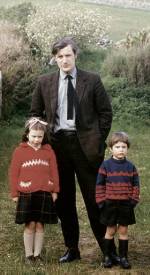
Hiding the truth: for eight years Hughes did not tell Frieda and Nicholas about how their mother died. Photograph: Camera Press |
That, in outline, is the story of Ted Hughes, Sylvia Plath and Assia Wevill, as remembered by those who knew them, and as retold in Elaine Feinstein's biography. It has the makings of a bedroom farce. What turned it into tragedy, of course, was that Sylvia killed herself soon after Hughes began his affair with Assia, and Assia killed both herself and her daughter, Shura, whom Hughes had fathered.
As Feinstein points out, it was not just these unforeseeable deaths, but Plath's writing that created the myth of Hughes as a monster. She represented him in one poem as a fascist, a "brute", with a "love of the rack and the screw". All the evidence indicates that, on the contrary, he was gentle and considerate. But Plath's masochism demanded she should see herself as a victim. Feinstein cites her poem Pursuit, read to Hughes during their first night of lovemaking, where he is already a "panther", a "black marauder", who has left "charred and ravened women" in his wake and will one day kill her. The feminists who espoused Plath's cause in the 1970s took these heated, wishful fantasies as the truth, and pursued Hughes with insults and death threats. They also believed Plath's complaint, in letters to her mother, that he had left her in poverty after their separation. In fact, he gave her all their joint savings. But with the publication of Letters Home, her lies became the accepted version.
Feinstein's biography breaks up rather in its second half. That is partly because people close to the later Hughes, including his second wife Carol, seem to have proved less willing to talk to her. But it is also because Hughes himself lost direction. He took up various causes - the preservation of salmon in British rivers, the royal family, eastern European poetry. But he never really recovered from Plath's death. To an outsider reading her journals, the marvel is he stayed with her so long. But she was his second self; they fed each other's poetry; they even dreamt the same dreams. With her gone, he drifted. He had several affairs, some prolonged. He told his partners he did not want to be in any woman's power again, and that one woman was not enough for him. It was another way of saying that he no longer had a centre.
Feinstein, while adept at gathering and sorting gossip, is not much help on Hughes's ideas. He was extraordinarily superstitious, a practising astrologer and devotee of the Ouija board, with a serious interest in shamanism, hermeticism, and all points east. The question is not just how he came to believe in this rubbish, but how it squares with the poetry. Crow, Ghost Crabs and other central poetic statements are utterly nihilistic - derisive rejections of all conceivable belief systems. The animal poems, too, assume a post- Darwinian universe, ravening, destructive, emptied of divinity. It is bizarre to think of their creator poring over horoscopes or imagining, as he seems to in Birthday Letters, that his life is directed by supernatural beings. Maybe he just could not think straight, but it would be good to know Feinstein's opinion.
What her biography does bring out is his total devotion to the poetic craft. He had no idea of getting a job. He did not care about money or fashion or reputation. He was resolved to write. For a time, poverty reduced him to sleeping in a chicken coop. It is hard to think of an English poet since Milton so obstinately self-confident. His reward was that he was able to develop a poetic style of devastating power - a kind of enormous, versifying hedge-cutter, with which he attacked the whole tradition of Wordsworthian nature poetry and reduced it to violence. His greatest poems exhibit huge technical expertise and no beliefs. That is what makes them modern.
There will be many more biographies of Hughes, but this first one will remain useful not just for preserving survivors' testimonies but for its indecisions. Feinstein does not pretend to know why Plath and Wevill killed themselves, and she refuses to attribute blame. There is some evidence that in the last week of her life, Plath confessed to Hughes that divorce was the last thing she wanted, and realised he was prepared to come back to her. A mutual friend thinks they would have been together again in a week if she had not died. With Wevill, fear of losing Hughes was probably a factor. But he was negotiating to buy a house where they could be together when she suddenly took her life and their child's. What we can be sure of is that we shall never know the truth, and that the deaths were shattering to nobody more than Hughes.

WEDNESDAY OCTOBER 24 2001
Ted Hughes
By Elaine Feinstein
Weidenfeld, £20; 352 pp
ISBN 0 2976 4601 X
Take a close look at the cover of this elegantly produced book: you will see a graphic demonstration of the difficulties the biographer of Ted Hughes confronts. The jacket is translucent - a device more fashionable in the United States than in Britain - and is printed with the author’s name, the book’s title and a picture of the young Hughes.
Underneath, on the actual cover of the book, the reader can discern what looks, at first glance, like a sample of Hughes’s own hand. The writing is strong and sloping, distinctive, apparently written with the black fountain pen the poet favoured.
But remove the jacket and look at the text closely: this is not Hughes’s writing, these are not Hughes’s words. They are Elaine Feinstein’s, got up to fool the eye - for her biography is unauthorised and, in this thoughtful and considered book, she has been allowed to use the poet’s own words only very sparingly indeed.
It is said that Hughes did not want a biography written; that is the line that his widow, Carol, takes, defending his estate against all-comers. Feinstein, speaking recently at the Cheltenham Festival of Literature, wondered - it seemed to me quite fairly - why it was then that he left an extensive archive (over 100ft of library shelving) at Emory University in Atlanta for scholars to consult.
And Feinstein is a scholar, not a scandal-monger, though a sensationalising serial in The Sunday Times might lead one to believe otherwise. Her book is a serious attempt to set out this complex poet’s life and to understand the poetic task he set himself. A fine poet herself (and a friend of Hughes; they first met in 1969), her readings of his work are sensitive and never over-psychologise.
Hughes’s background would not, in his day, have marked him out for a life in poetry. His family was in theory working-class (his father was a carpenter who later owned a tobacconist’s shop); but one of his mother’s ancestors was Nicholas Ferrar, who founded the monastic community of Little Gidding in the 17th century. He recalled his childhood - a time when he was already fascinated by animals - as being overshadowed by the First World War; his father was one of only 17 men to survive from his regiment at Gallipoli.
He was close to his sister Olwyn and his older brother Gerald; he was fortunate in his teachers, who recognised his academic talent early on. He won an Open Exhibition to Pembroke College, Cambridge, in 1948, but didn’t go up until he’d finished his national service in 1951. It was at Cambridge - despite his dislike of academia - that his literary reputation began to grow; well before he was 30 years old he was a star of the then vibrant poetry scene.
At Cambridge, too, he met his first wife Sylvia Plath - and it is at this point that the poet’s work threatens to become overshadowed by the poet’s life. It is to Elaine Feinstein’s great credit that she never allows this to happen, despite her diligent cataloguing of his succession of mistresses.
For, as she remarks (in both instances quite rightly): “Dedication to writing and a belief in the power of poetry to heal the human spirit marks Hughes’s whole being as almost no other poet since Lawrence”; he was also, she says drily, not the only man in London to commit adultery.
Yet his infidelities, and the deaths by suicide of Plath in 1963 and then the woman for whom he left her, Assia Wevill, in 1969 created a firestorm of emotion around this apparently gentle man. Feinstein’s biography, which thankfully steers clear of emotional conjecture, adds to the impression given by the last book that Hughes published in his lifetime, Birthday Letters, of a kind of mystification at his own and others’ emotional states. Olwyn, it seems, found Plath rude and could not understand why Hughes would not take her to task for it, “but Ted only ‘replied with a helpless gesture’. It seems unlikely Ted could have succeeded in explaining the two women to each other . . .”
It does indeed. A picture grows of a man who was comfortable with the stark realities of the animal world (“Now I hold Creation in my foot,” he writes in Hawk Roosting, “Or fly up, and resolve it all slowly - / I kill where I please because it is all mine”) or the iconic structure of myth, but uncomfortable with the day-to-day realities of human interaction. It was perhaps that discomfort which led to his long silence over Plath’s death.
Feinstein ventures delicately: “Looking back across 30 years, he may have thought of his own years of silence as resembling those of his father, brooding over those who died at Gallipoli.”
What the biography is missing - and this is not Feinstein’s fault - is Hughes’s voice. Hughes was not only a prolific writer of poems, prose and criticism, he was a remarkable and voluminous correspondent. His letters could easily run to a dozen pages and his correspondence, as Feinstein says, revealed - as he changed his tone to suit his reader, as we all do - the different sides of his personality.
Some of that correspondence (particularly that between Hughes and his great friend, Seamus Heaney) remains sealed; but much of it does not - yet Feinstein is nearly forbidden to quote. This is a shame, for a writer’s real life is in his words, and paraphrasing will never quite convey Hughes’s essence.
That said, this is an admirable book, fond but fair; hard to believe it could be bettered any time soon.
Erica Wagner
An important review of the biography in the main site about Ted Hughes here

27-10-2001
TED HUGHES (1930 – 1998)
"Every work of art stems from a wound in the soul of the artist... Art is a psychological component of the auto-immune system that gives expression to the healing process. That is why great works of art make us feel good. "
Birthplace
Yorkshire, England
Education
Hughes started writing by composing comic poems "for classroom consumption" at
the age of 11. At Pembroke College, Cambridge he began studying English but,
finding his own writing stifled, changed to archaeology and anthropology.
Other jobs
He did his national service with the RAF as a mechanic in Yorkshire, with "nothing
to do but read and reread Shakespeare and watch the grass grow". Jobs to support
himself while writing - though the urge to produce children's stories was also
financial - included "rose gardener, night-watchman in a steel factory, zoo
attendant, schoolteacher, and reader for J. Arthur Rank".
Did you know?
Having resisted all publicity, Hughes's last interview was given to the American
fishing magazine Wild Steelhead and Salmon; he had felt confident he would not
be asked about Sylvia Plath.
Critical verdict
Hughes took a magical, shamanic view of poetry: it is "a journey into the inner
universe", "an exploration of the genuine self", "a way of making things happen
the way you want them to happen". Always critically valued, his dense, bloody
poetry of the natural world made him a surprise poet laureate in 1984. With his
last works, Metamorphoses and Birthday Letters, published without fuss while he
struggled with colonic cancer, he found runaway success (Birthday Letters was
said to be the fastest-selling book of poetry ever, though this probably had a
lot to do with the Plath myth).
Recommended works
Of his work for children, How the Whale Became offers ageless creation myths.
Shakespeare and the Goddess of Complete Being, though leaning towards the
New-Age, is criticism written from love; the translation of Ovid's Metamorphoses
is a sustained tour de force. Of his original poetry, the Crow sequence, red in
beak and claw, epitomises Hughes's vision; while Birthday Letters, a moving and
redemptive literary document, sees the achievement of a new kind of poetry.
Influences
Blake and Yeats, with their mystical influences, conception of the poet as
shaman and muscular relationship with the natural world are both strong
influences.
Now read on
The Yorkshire Moors are as much a character in Wuthering Heights as they are in
Hughes's poetry; many of Plath's poems are echoed or responded to in Birthday
Letters.
Adaptations
The forthcoming The Iron Giant ("It came from outer space!") is loosely based on
the children's story The Iron Man.
Criticism
The Epic Poise: A Celebration of Ted Hughes (ed Nick Gammage) contains tributes
to Hughes, meditations on individual poems and new poems for Hughes, with
contributors including Seamus Heaney, Andrew Motion, Roger McGough and Marina
Warner.
Poetry
Keeper of a stubborn faith
The first biography of
Ted Hughes reveals the man behind the shaman, finds Blake Morrison in Elaine
Feinstein's The Life of a Poet
Saturday October 27, 2001
The Guardian
Ted Hughes:
The Life of a Poet
Elaine Feinstein
273pp, Weidenfeld, £20
In one of his earliest poems, Ted Hughes describes the martyrdom of Bishop Farrar, who when burned at the stake by his enemies stubbornly kept the faith without once flinching:
... out of his eyes,
Out of his mouth, fire like a glory broke,
And smoke burned his sermon into the skies.
Ted Hughes was related to Farrar, on his mother's side; the stoical gene helped him get through his own years of trial and persecution. When feminists accused him of the murder of Sylvia Plath or critics rubbished his laureate poems, he took the punishment without complaint. There were occasional wounded letters, to protest that Plath's work was being distorted or the privacy of his children breached. But as to himself, he kept his trap shut. His one recourse was poetry, and on the central tragedies of his life (the suicides of Plath and Assia Wevill) the poetry had nothing to say.
Then in 1999, as though from nowhere, came Birthday Letters, a book less of self-discovery and self-exculpation than of self-healing, published because he couldn't "bear to be blocked any longer". After years of rancour and blame, of vicious rumour and tight-lipped evasion, the most mythologised literary marriage of the 20th century was seen through his eyes at last, in poems mixing vérité with folklore. Within months of the book's appearance, Hughes was dead. But Birthday Letters brought resolution and acceptance. A kinder, more candid era seemed about to begin.
How far is Elaine Feinstein's book, the first ever life of Hughes, part of this new era? In spirit, very much so. A contemporary of Hughes at Cambridge, a distinguished biographer and translator, and a poet in her own right, Feinstein is well placed to tell his story. When approached with the idea three years ago, she tells us, she quickly accepted, in part because she knew Hughes to be a man of warmth and generosity, not the callous predator or staring-eyed monster of legend. Her acknowledgments page, with its list of private letters consulted and interviews conducted, suggests that many friends of Hughes have been willing to talk to her.
But there are also those she thanks "who do not wish to be named", as well as others, likewise unnamed, who have refused to help - whose lips or letter archives remain sealed because they feel it's too soon, or fear being implicated, or think discussing their friend Ted would be disloyal, or regard any biography (however scrupulous) as prurient. Such mistrust is understandable; novelettish confessions - I Had That Ted in My Bed - will always find an audience, and there's a wish to do right by the subject. Birthday Letters may have cleared the air, but the ground is still a minefield - access strictly prohibited.
The innocent reader is made aware of this as early as the second page, when Feinstein describes photos of William Hughes, Ted's father, a survivor of Gallipoli, looking jolly. Then comes a reference to Edith, Ted's mother, having olive skin, the hair of a Native American and, "to judge from photographs", the good looks inherited by her three children. Unfortunately, the illustrations don't allow us to confirm the truth of these asides: neither William nor Edith appears (an omission made stranger by the inclusion of photos of Sylvia Plath's parents, though this is Ted's biography, not hers).
Making the best of it, Feinstein fills in the essential details of Hughes's 1930s upbringing in the Yorkshire Pennines, with emphasis on the parts played by his sister, Olwyn (a keen reader), and his brother, Gerald (who was 10 years older than Ted and taught him to shoot and fish). Until he was seven, the family lived in Mytholmroyd, little more than a village, where William worked as a carpenter. After Edith came into a legacy, they ran a newsagent's in the town of Mexborough, which boasted a cinema and library. An idyllic childhood, you'd have thought: first nature, then civilisation. But Ted perceived it as a fall. Partly this was because Gerald didn't join the family in Mexborough, moving to Devon to work as a gamekeeper and then emigrating to Australia, from where Ted, despite later efforts, failed to prise him.
It was Gerald who first took his kid brother up on the moors, and gave him a sense of life beyond the grim cradle of the valleys. Two years' national service, mostly spent reading, continued the process. But if he'd hoped that Cambridge would also broaden his horizons, Hughes was disappointed: he felt at odds with the smart young things there, and later described these as "years of devastation" which all but killed off his poetic gift. He was saved, so he said, by a dream in which a bleeding fox appeared and told him "Stop, you are destroying us" - after which he gave up Eng Lit and switched to Archaeology and Anthropology. More prosaically, he had the support of like-minded friends, to whom he played the roles of bard and bloke. The bard was into astrology, shamanism and ouija boards. The bloke dispensed advice on how to seduce and subjugate women until they were "doing the laundry without argument".
After graduating, Hughes slept rough in a shed that smelled of chicken shit. Tall, craggily good-looking and hugely talented, he was spoken of as a kind of Heathcliff. Though Feinstein, anxious to scotch the legend of the saturnine ladykiller, tempers the comparison, emphasising his gentleness and domesticity, Sylvia Plath certainly saw him in such terms ("Oh, he is here; my black marauder"). Her high excitement was matched by Hughes's sense of doom. An inner voice told him to "stay clear" of Plath, but he ignored it, with tragic consequences. "It doesn't fall to many men to murder a genius," he said later, in one of his fits of self-accusation.
The Hughes-Plath marriage has been ploughed over so many times that Feinstein is hard put to turn up fresh material. The latest theory - that Plath committed suicide after discovering Assia Wevill was pregnant with Ted's child - is one she rightly regards with suspicion. What does emerge is how hemmed in Hughes felt almost from the start: "wived, ringed and roofed". By the standards of most men in the 1950s, he was easy-going and enlightened, seeing his wife's work as equal in importance to his own. But the strain of living alongside the volatile Plath proved too strong, or the lure of other women did. Once he had strayed with Assia, Sylvia, stripped of her illusions, wouldn't have him back. "He's become a little man," she complained, and turned their intimate struggles into poetry, which he thought treacherous. At times she savoured her freedom: "It is as if life were being restored to me," she told one friend, before throwing that life away in the icy winter of 1963.
Assia, thrice married, still had a husband at the time, and her relationship with Ted, of which his parents strongly disapproved, was never likely to survive its torrid origins. She gave it her best shot, moving in with him in Devon, along with his parents, his two children, and her own child by him, Shura. But it was an uncomfortable set-up for a chic advertising copywriter with expensive tastes and aspirations, and within two years she moved back to London as a single parent, just as Sylvia had. When he wasn't in retreat in his garden writing hut, Ted continued to see her; but by now he was seeing other women, too. Worse, Assia felt blamed by everyone for Sylvia's death. Stolid with misery, afraid she'd lost her youth and beauty, she sank into depression - and in 1969 killed herself and Shura.
In his despair, Hughes decided that the true depressive must be him; that his darkness was a disease which any woman who lived with him might catch. His various liaisons around the time of Assia's death and afterwards border on the manic: as he told a friend, his entanglements grew two heads whenever he lopped one. Perhaps he needed to prove his attraction wasn't fatal, or to keep himself at a safe distance by loving more than one woman at once. Or perhaps he was just bad at saying no; as Al Alvarez says, he was oddly passive - "women went for him rather than he pursued them". Part of the problem was his intensity; he hadn't much interest in casual flings. He didn't pretend to be monogamous, but nor were his inamorata always aware of the others or willing to admit how attached he might be elsewhere. The confusion reached a pitch in August 1970, when Hughes married Carol Orchard, having been living with Brenda Hedden just weeks before. Thereafter things were simpler but hardly plain sailing, as the testimonies of Emma Tennant and Jill Barber, two lovers from the 1970s, bear out.
The complications of Hughes's heart aren't easily explained, and it's enough for now that Feinstein finds a tone that isn't glib or punitive. In a low moment, Hughes told his brother that his whole life had been "quite false"; the best he could hope for was the occasional holiday from public excoriation. But the remaining 30 years weren't all misery, either for him or for the women he loved. Those quoted here speak affectionately of him, as Carol, his widow, if ever she chose to speak, surely would too.
Even in the worst times, Hughes went on writing poems, and though it was late in the day before he regained his literary reputation, with Tales from Ovid, books from the 1970s such as Season Songs and Moortown Diary contain much of his best - and happiest - work. The great mistake, as he saw it, wasn't becoming poet laureate (he'd already met the Queen and fished at Balmoral by the time of the appointment), but spending five years writing a critical book about Shakespeare. Prose had destroyed his immune system and was killing him, he told friends - and he meant it.
I could read a lot more about Hughes's childhood, his male friendships, his politics and his life in Devon. But in the absence of an authorised biography or selected letters, Feinstein's book - pleasingly brief, even-tempered and unsensationalist - fills the obvious gaps. Well worth reading alongside it is the current issue of the magazine Areté (available from New College, Oxford at £7.99), which includes a fascinating piece by a young Devon neighbour, Horatio Morpurgo, on the "table-talk of Ted Hughes", with its inspiring, exasperating blend of blunt logic and cranky wisdom.
Birthday
Letters was meant as Hughes's last word on himself. He'd rather we skipped the
life and read the work. But the man himself was extraordinary, a rare instance
of English genius. And the fire is far from extinguished yet.

Ted Hughes: the life of a poet by Elaine Feinstein
Michael Schmidt welcomes a perceptive portrait of a poetic legend
27 October 2001
Last time I went to visit my friends in Boulder Clough, Yorkshire, they took me for a long walk down Jumble Hole Clough, with its angry tarn, high foliage, craggy hills above and, at the heart of it, a ruined mill with the lumb or chimney still standing. It was Hughes country, a landscape as allegorical as anything in Narnia.
Hughes, more than most poets of his generation, is rooted in place, in the particulars of a landscape. The farther he travelled, the more insistently his imagination returned. Memory may exaggerate its extremes. But the landscapes of Canada and Alaska, the creatures real and imaginary that roost in his poems, all refer back to such cloughs, with their sounds and textures, seasons and times. Here social man encounters primitive fears and fulfilments. Nature repossesses history, overwrites mills and cobbles, hovels and chapels, with nettles, balsam, thorn.
After personal memoirs and kiss-and-tell revelations, Elaine Feinstein has written the first full biography of Ted Hughes. "She has a sinewy, tenacious way", he wrote, "of penetrating and exploring the core of her subject." Now, the subject of this "she" whose poems Hughes admired is the poet himself.
The risks involved in Feinstein's undertaking are considerable. As a woman, should she write the life of Sylvia Plath's vilified husband? As a friend, should she reflesh the skeletons in his cupboard? Judging from the book, she knows that as a woman she is qualified to write because she knew its subject well and can ask questions that a male biographer might miss. And, like most of Hughes's friends, she is weary of the lies that have silted up his reputation. Given a chance to tell the truth, or more of it than previous writers, she took it. Hughes said of her poems: "There is nothing hit or miss, nothing for effect, nothing false." That seems to me true of this book: it is intimate, interweaving her and others' memories, readings of poems and secondary sources in conversational engagement.
This is Feinstein's fourth biography (her fifth if we count her "faction" Loving Brecht). It must have been the most difficult. With Pushkin, Lawrence's Women (a subject close to Hughes's heart) and A Captive Lion: the life of Marina Tsvetaeva, much of the superstructure existed. Research could be conducted conventionally, and though there were jealous acolytes keen to rubbish the writer, the volatility of the material and its reception could not compare with this exercise.
Hughes and his family were jealous of their privacy. Biographers of Plath often mauled fact and defamed him. Journalists never tired of baiting him. He had children to protect. Feinstein, a friend for more than four decades, knows the story of his persecution. Her readers include not only critics, scholars, poetry-lovers and gossip-mongers but a surviving family and all the witnesses who contributed to her account: a host of severe readers.
She quotes sparingly from the poetry. Her extensive use of Hughes's archives results not in quotation of his vivid letters and essays, but in paraphrase. She was allowed unhindered access to most records, but in order to maintain independence (she is not "authorised") she chose not to submit her work to censorship by copyright. So Hughes's own voice as poet, correspondent, critic is unfortunately muted. It is hard to discuss poems not quoted in extenso. The life and the poems cannot quite come together.
As with Lawrence, Tsvetaeva and Brecht, she refracts Hughes through his lovers. There are rather more than expected, and they crop up just when one might have imagined that his libido had settled, for example at the time of his second marriage. It makes good copy, though the stories are troubling for their sense of waste and hurt. And one witness is significantly absent: the poet's widow, Carol, who sustained him for 28 years.
For all his passions, and despite his enthusiasm for Robert Graves, this inexhaustible lover was not a love poet. The biography might have probed more into the strained sexuality that mars, for example, Crow, with its hideous decapitating vulva. Crow was dedicated, Feinstein reminds us, to Assia and Shura, Hughes's partner who committed suicide, and his daughter who died with her. That dedication is one of the keys Feinstein provides, though she does not insert it into the lock.
Her Hughes is – like the man himself – larger than life, a force of nature among the bric-a-brac of the modern world. She sees him, as we must, from the perspectives of that world. Apart from his relations with his brother Gerald, his childhood and formative years – his Yorkshire, his family, his National Service – are remote, almost fictional. She is eager to get on to the poet she knew and understood. Feinstein's Hughes is the one who surfaces as a scholarship boy at Cambridge and begins there his inexorable development as a writer, comrade and lover. It is a story full of fascination, told with judicious candour. There are warts, she concedes, but they are not all, and it is her sense of that vigorous, abundant "all" with which the biography leaves us.
Michael Schmidt's 'Lives of the Poets' is published by Phoenix

The Colossus diminished
Elaine Feinstein tiptoes
through Ted Hughes's turbulent life and hints at the harsh truths only in
brackets
Nicci
Gerrard
Sunday October 28, 2001
The Observer
Ted Hughes: The LIfe of a Poet
Elaine Feinstein
Weidenfeld & Nicholson £20, pp352
Ted Hughes died three years ago today. At his funeral, mourners - from his village and from over the Atlantic - were awed by his great coffin, for he was a huge man: a colossus, said his first wife, Sylvia Plath, when she met him, and 'the only man big enough for me' (others called him Heathcliff, perceiving him as elemental, with a forceful, unswerving genius).
He was tall and dark; he had a face like a granite cliff, an intense gaze, and a low, clotted voice. His poetry was savage, brutal, brooding, stunning. He had dominated English poetry for decades, since he was a Yorkshire teenager obsessed by hunting and fishing for pike. He was Wordsworth soaked in blood and cruelty, bleak and euphoric. He changed the face of English literature.
His memorial service in the May following his death was attended by the great and good. After all, he was the Poet Laureate. The final reading was from Cymbeline, and it was a recording of Ted Hughes's own rendition, in a slow, soft, deliberate voice: 'Fear no more the heat of the sun,/ Nor the furious winter's rages;/ Thou thy worldly task hast done,/ Home art gone, and ta'en thy wages;/ Golden lads and girls all must,/ As chimney sweepers, come to dust.'
Ted Hughes had lived in the heat of the sun, and suffered winter's rages. For a man who wanted to dedicate himself to poetry, his life had been arduous and tempestuous; full of heat and chill, of injury and pain.
By the time he died, of colon cancer and a final heart attack, he was a myth and like many myths he had multiple meanings and contained multiple contradictions. He was a gentle giant and a monster. He was blunt and down-to-earth but believed in magic and cabbalistic meanings, seances and healers. He was a totemic male - in this book, as in others about Plath or Hughes, his maleness is often capitalised or put in italics. He represents the wild man of the North; he is endowed with an instinctive, fateful, towering, irresistible masculinity, dark-edged and blood-stained, like a creature out of the Ovid legends he re-wrote.
At the same time he is seen as a gentle giant, a confused and oddly passive male surrounded by harpies and masochistic neurotics. He is the murderer of his wife and he is her victim. He is a generous executor, a literary assassin. And it is as if readers must fall into one camp or another like zealots; a Hughes fan or a Plath supporter. It is impossible to read his poetry, or hers, without their lives flooding in.
Most people know some of the story, at least its central chapter - for Hughes and Plath were the Charles and Diana of the literary world, and when Plath killed herself, putting her head in a gas oven while her children lay sleeping next door, she lit a fuse that Hughes could never extinguish.
Hughes was a Yorkshire boy (born in Mytholmroyd, as if even his geography bears the imprint of destiny), the youngest of three, who always knew he was destined to be a poet. He roamed his countryside, hunted and fished and put words about nature together, encouraged by his English teacher.
He left home, did National Service, went to Cambridge. There he met a vivacious, lipsticked American girl, who talked about poetry and bit his cheek until it bled. 'Whoosh!' she wrote in her journal. They fell in love, and their love was a potent mix of desire, ambition, excitement, rivalry, a shared image of the world that waited them.
They married, struggled, travelled to America and back again, had two children (desired by her rather than him), quarrelled, made up. She was ferociously insecure and needy, a history of suicidal depression behind her; her gushy good-girl manner concealed a lava of emotions. He was unfaithful, with the beautiful Assia Weevil, and they separated. Out of Plath's despair, her anger, her sense of abandonment, she produced some of the most electrifying poems of the twentieth century - scorched and screaming and technically perfect. Then, one cold winter day in 1963, she gassed herself.
Her early death meant she would become an icon for generations of women readers, and fix Hughes in the role of brutal male. He lived thereafter haunted by Plath and her legacy (a legacy of which he was of course the executor) and went on to live with Assia, who had a child, Shura. But their relationship foundered. There were other women, and of course there was the woman, who, dead, became more powerful than she ever could have been alive. In 1969 Assia also killed herself, and her child. She drank whisky and pills and turned on the gas, in a spooky echo of Plath's death. These two women and their early deaths must dominate our understanding of Hughes's life.
Ted Hughes was a man who loved privacy. The crime he could not forgive Plath was the way she turned their lives and his betrayal into poetry, and mythologised domestic hurt. After her death, he rarely gave readings (and when he did, he was often heckled and abused from the crowd).
His sister, Olwyn, guarded him ferociously, and made life for biographers of Plath nearly impossible. But he knew he would be written about after his death; that his life would be picked over, his letters read, his secrets finally let out. The extraordinary sequence of poems about Plath, Birthday Letters, in which he lets grief and guilt finally find a confessional voice, is perhaps a way of getting his version in first, or of having the last word to set against all her last words.
Elaine Feinstein is a fine poet, novelist and biographer. She was also a friend of Hughes in his later years. She must have seemed the ideal choice for the US publishers, WW Norton, who commissioned her in 1998, a few days after Hughes's funeral. She says in the introduction: 'I knew there was an important story to tell. My hesitations lasted no more than a few weeks.'
But this biography should not have been written. Perhaps because she knew and admired Hughes, or was anxious about hurting his children and wife, or because she is a poet and Hughes towered over his generation of writers, or because she was intimidated by the enduring power of the Hughes-Plath myth, she is fatally constrained.
There is a story to tell, an appalling drama in which everyone suffered and great poetry was born, but she can't tell it because she must move so carefully among the recent dead and the still living, tip-toeing through the turbulent emotions. In a Freudian sense, her biography reads like an act of bad faith - it is drab and exterior because she was writing against the grain of her scrupulous conscience.
It is also curiously perfunctory. Hughes's childhood in Yorkshire, which was so important to him, is dealt with in less than 20 pages. By page 21, he is 21 himself and going up to Cambridge. The hold his mother had over him, and the grip nature held, are dealt with swiftly. The boy, waking at dawn to race over the moors in the wake of his adored older brother, is never summoned to the page. The savagery and beautiful bleakness of his poetry was evident early on; a biography should deal with it.
Cambridge is also galloped through. Hughes called his time here 'devastating', but the devastation never breaks the calm surface of Feinstein's prose, and she doesn't like to guess at its causes.
It is galling to be told, for instance, that because of his sexual experience, Hughes advised friends about women - for we've never been told of these sexual experiences. The book is full of odd parentheses, as if the most important things are wrapped in safe brackets so that they do not spill over into the book. For instance, on the weekend that Hughes begins his adulterous relationship with Assia he was, apparently, 'his usual generous and attentive self' to Sylvia and to Assia's husband, his friend.
Even the notorious destruction of Plath's final Journal is thus dealt with: 'It was Assia who found and read Sylvia's journal of the last months of her life, according to Suzette Macedo, and was overwhelmed by the spite and malice directed towards herself there. This may have been a factor in Ted's decision to destroy the journal.' If there are other references to an act that has so upset generations of readers and feminists, and made Hughes even more a target of hatred, I could not find them. This won't do: defend Hughes by all means, explain him, imagine his feelings, take sides - but don't corral the more uncomfortable moments of his life into underhand sentences.
Sylvia dies. Assia dies. Shura dies. They are put away in a few pages but loom up again in our minds. Feinstein fails to rise to their monstrous occasion. Writing of Plath's suicide, she says: 'A biographer has to admit that Sylvia's tears in the car with Gerry on her return to the flat remain unexplained, as does her decision to kill herself.' No, no and no. The tears are too easily explicable: Sylvia was alone with two children in the freezing English winter; her husband had gone off with her friend; she was wretched to the bone. And to couple the 'unexplained' tears with the later death is jarring. But Sylvia fares better than Assia, who remains a secondary figure, Sylvia's poor substitute and spooky echo, abandoned all over again by the narrative.
If Feinstein wanted to answer Hughes's critics and put the record straight (in her introduction, she says rightly that the image of him as callous husband is a caricature) she should have done it more boldly, imaginatively, passionately. She should have allowed Hughes to live on the page, seen whole and human. He was loving, he was unfaithful, he was passive, he was generous, he was consumed by guilt, tender, brilliant.
He
was a man who wrote about myths and became trapped in his own myth. Feinstein's
book does nothing to shatter that myth and let the man escape at last. Her words
are like gravel thrown against a cliff wall. They fall harmlessly to the ground
and the myth of Sylvia and Ted remains. And their words remain. Maybe one day, a
long while from now, that is all we will have left: beautiful, terrible words,
living long after the light has gone out.

Shelter from the storm: The true history of the writer remains elusive, argues Andrew Motion
FINANCIAL TIMES,
Nov 3, 2001
By ANDREW MOTION
Philip Larkin and Ted Hughes dominated British poetry during the second half of the 20th century, and the stronger their authority became, the greater the differences between them seemed to be. Larkin was "genteel", Hughes was Heathcliff; Larkin was orthodox, Hughes was adventurous; Larkin was formal, Hughes was free; Larkin was shy ("the hermit of Hull"), Hughes was . . . Well, Hughes had been married to Sylvia Plath, so as the story of her life came to light, large parts of his own did as well.
Even when Larkin and Hughes were both alive, these distinctions seemed pretty daft. Now they're both dead, and the "long perspective" Larkin mentioned is starting to get longer, we can see just how unhelpful they really were. Larkin did indeed have strong anti- social instincts, but he also had a highly developed sense of community. And Hughes was indeed thrust into the jaws of the media - not only because of Plath but because he did, after all, accept the post of Poet Laureate. His wish to withdraw was nevertheless so strong that it makes Larkin seem gregarious by comparison.
Hughes's reserve, of course, had its foundation in the horrific dramas of his life - not only Plath's suicide in 1963, but also that of Assia Wevill, his next great love, who killed herself in 1969, after a six-year relationship, along with their five-year-old daughter. Although details of the Wevill story have never been well known, the bare facts have been in the public domain for years, and they combined with the Plath tragedy to make Hughes appear - for some - a monster, for others a self-justifying genius, for everyone a fascination. The marvellous reading voice - at once rolling and intimate - and the electric crackle of his physical presence, made his story even more compelling. Very few poets, in any century, have had to bear such a weight of curiosity about the circumstances surrounding their work.
In this respect, his reticence seems completely understandable. But as well as protecting him, it also encouraged rumour, and lies. Following Plath's death, he faced a steadily mounting barrage of criticism for the way he had treated her, and, although much of it was ill-informed, he seldom took the chance to put the record straight - until he published Birthday Letters in 1998, the same year that he died. Although not intended as self-exculpation, these poems did balance the Plath-orientated view of things - partly by showing the other side of many famous stories, and partly by demonstrating on virtually every page that he still loved her. It meant that by the time of his death, the public image of Hughes had in some senses softened, and in every way become more admirable: he'd kept his dignity all these years; he'd been silent to shelter his children; his reward was to end his life with a burst of writing that brought him to the top of his form.
Since then, the struggle between revealing and sheltering has resumed. On the one hand we've been treated to some venal kiss-and-tell stories from Emma Tennant and other less well-known girlfriends of Hughes; on the other, the Hughes estate has released nothing in the way of fresh material. In fact the most notable "new" publication over the past three years is a modest Selected Poems, chosen by Simon Armitage. There is no sign of a "Selected Letters", or of an "official" biography, though one would hope that a good big edition of the poems might appear soon.
Yet even without permission to quote from published or unpublished sources, and without the co-operation of many people who knew him best, it was inevitable that someone would have a go at telling his story - and, given the circumstances, Hughes would probably have thought himself lucky to have ended up with Elaine Feinstein. She was a friend of his for many years, she is level-headed when dealing with the Plath side of things, and she is generous in her judgments of almost everything. Furthermore, she is hardworking enough to have discovered the basic shape of Hughes's career, for which all his subsequent biographers will be grateful. Although the story is full of silences, very oddly paced (only 20 pages on his childhood), and unable to validate its literary opinions by showing us enough of the work, it at least makes sense as a narrative.
But in all honesty, that is not saying much. When Peter Ackroyd wrote his unauthorised life of T.S. Eliot, he proved how much could be done even without the support of a literary estate, and without quotes from the work or the letters. Feinstein comes nowhere near his mark. She doesn't create a coherent psychological portrait of Hughes, she doesn't show what is weak as well as what is good in the work, and she doesn't mould the various parts of his life into a whole. In other words, Hughes is crucially absent from his own story.
It's clear, for instance, that his Yorkshire boyhood, during which he was greatly influenced by his elder brother Gerald, combined the sensuous with the mystical to an exceptional degree. This became the foundation for all his best writing, and also the framework for his most interesting ideas - about spirit-life and shamanism, and about ecology and the environment, and about how they might combine. The trajectory of his thinking about these things shoots in a clear line through his undergraduate days at Cambridge, remains steady through the love-storms of his middle life, and endures into the complications of late prose works such as the essay on Coleridge and the book on Shakespeare.
Feinstein can't blame lack of access for this failure; she does not make the best of what she has. In the same sort of way, her account of Hughes's relationships with women is disappointing. It appears that by the time he met Plath he had already developed a distinctly two-sided attitude. Women were delicious passion-arousers (the first kiss with Plath led to the notorious biting episode, and the first time he slept with Assia he wrecked her nightdress), and they were also necessary because he wasn't that keen on doing his own laundry. In other words, the demon lover and the mild mother needed to co-exist - an impossible thought, since as soon as the former melted into the latter, she had to be reinvented as a separate creature. Hence the trail of seductions, which continued after Assia's death and his marriage, the following year, to Carol Orchard.
Hughes himself was canny and curious about psychologies - a brilliant observer of surfaces, and a great rootler in underworlds. But he was also someone capable of astonishing innocence, and therefore fated to repeat his experience over and over again. That is partly why his life has the force not just of tragedy but of myth, and why, one day, it will be so well worth reading. Feinstein was doomed from the start to seem limited, but has ended up even more diminished than she needed to be. For all that, the best that can be said of her book is significant. It is honourable.

Books: The real hughes escapes
ted hughes: the life of a poet by elaine feinstein (weidenfeld & nicholson, £20). Reviewed by david wheatley
'WHAT can I tell you that you do not know/Of the life after death?' Ted Hughes wrote in Birthday Letters, the 1998 collection in which he belatedly offered his account of life with Sylvia Plath more than three decades after her suicide in 1963. Poem after poem in that book found him returning obsessively to Plath's work, as though concerned to give his side of the story before he too fell victim to the 'life after death' he had seen inflicted on his wife by prurient biographers. Paul Muldoon has used the word 'shitepokes' to describe the purveyors of tittle-tattle about Hughes and Plath, and with the death of Hughes it was inevitable that they would come poking about in his life too. His first biographer, Elaine Feinstein, is anything but a muckraker, though: a respected poet and biographer, as well as a long-time friend of Hughes's, she has written a sympathetic book that goes to considerable lengths to avoid acrimony and the apportioning of blame, even if the end result is more than a little insipid.
Ted Hughes was born in the West Yorkshire village of Mytholmroyd in 1930. His father was one of only 17 soldiers in his regiment to survive the Gallipoli landings of 1917; horrified at such senseless slaughter, Hughes would later refuse to wear a poppy on Remembrance Day. While he was still a child the family moved to the mining town of Mexborough, from which he longed to escape to the country, but unlike his beloved brother Gerald, who became a gamekeeper, Hughes chose university, studying anthropology at Cambridge. In February 1956 he went to a party to launch a student magazine. At the party was Sylvia Plath, a visiting Fulbright scholar. They married four months later.
The story of what happens next has been told innumerable times, to the point of having become a ghoulish soap opera. Hughes's Yorkshire childhood is dispatched in a mere 16 pages, with his early years at Cambridge taking up another short chapter before we get down to the central drama of the encounter with Plath, the couple's marriage, the disastrous affair with Assia Wevill on which it foundered and the suicides of first Plath, and then Wevill.
From his student days he was obsessed with spiritualism. He found a fellow addict in Plath, with whom he shared long sessions on the Ouija board. Many years later this side of Hughes seduced him into the melodramatic cult of fate that scars Birthday Letters, where merely human explanations for the collapse of his marriage take second place to myth-spinning.
Of Hughes's life after Plath and Wevill, Feinstein has little of interest to tell. The poet laureateship came in 1984, and at the end of his life the late rally that produced Tales From Ovid and Birthday Letters, but by the end of the book it is impossible not to suspect that the real Hughes escapes the biographer's efforts. Then again, I'm not sure I have the stomach for the sort of book Muldoon's 'shitepokes' would have wanted anyway. There may be some final paydirt of revelations awaiting us in the famed sealed box in Emory University, not due to be opened until 2018; personally, I wouldn't be unduly perturbed if it stayed sealed until Doomsday. What will endure is the best of The Hawk In The Rain, Lupercal, Wodwo and Moortown Diary. As for the private tragedies and agonies of remorse that animate Crow and Birthday Letters -- emphatically not his best books -- maybe they should be allowed to stay private.

Robert Hanks
10 November 2001
Here is a fresh and plausible attempt to sort out a poet's mythology
If any poet needs to have the facts about his life set in order, it is Ted Hughes. For all the public honours showered on him in this country before his death in 1998 - poetry prizes, the Laureateship, the Order of Merit - it remains true that his reputation has been distorted immeasurably by public perceptions of his marriage to Sylvia Plath and her suicide. As Elaine Feinstein is at pains to point out in her biography, his situation was made far worse by his courageous decision, as Plath's heir, to allow publication of all her later poems. Many of Plath's enthusiastic readers - especially American readers - were inclined to take literally allusions to Hughes as a brute and a Nazi; and, at least partly in consequence, his own work came to be neglected, if not treated with outright hostility, in America.
So some sorting out of the myths from the truth is welcome; and Elaine Feinstein has the CV for the job. She is a poet herself and an acclaimed biographer of poets - Marina Tsvetayeva and Pushkin (in both of whom Hughes was keenly interested) and D H Lawrence (whose life and poetry have many parallels with Hughes's). She knew Hughes, though not intimately; and while she never met Plath, she does know many people who did, and is at times crucially able to see her point of view.
Ted Hughes: the Life of a Poet has many good qualities. The tone is by and large cool and judicious, in an area where passions are easily inflamed. Feinstein has done her research carefully, and the picture she presents of Ted and Sylvia's marriage is fresh and plausible - apart from anything else, the reader feels the justice of Hughes's remark, years later, that the two precociously talented poets were in other respects "just kids". She also offers a remarkably full account of Hughes's affair with Assia Wevill, which precipitated the separation from Plath, and of Wevill's own suicide (she gassed not only herself but her two-year-old daughter by Hughes, Shura).
Yet it is also a flawed book. There are many loose ends, inconsistencies and unsupported assertions - in general, the signs of a book written a little too quickly and not edited quite thoroughly enough. There is occasional resort to slightly dogmatic psychobabble - the silliest instance comes when Feinstein tries to account for Hughes's reluctance to settle with Wevill:
In his north of England childhood, he would often have heard wives referred to as "Mother". At a verbal stroke, men would be claiming the indulgence of a child and be licensed to look elsewhere for their erotic pleasures . . .
This not only demonstrates a profound ignorance of the puritanical Northern non-conformist culture from which Hughes came; it overlooks the awkward fact that husbands were likewise referred to as "Father".
More damagingly, Feinstein too often accepts Hughes's version of events, sometimes using such loaded verbs as "confess" or "acknowledge" - a confession of weakness may well be an evasion of responsibility. She even has a habit of relying on Hughes's verse as an authoritative source of information. For example: a friend of Assia Wevill's recalls Assia saying, at the beginning of her affair with Hughes, that she had sent him a red rose pressed between two sheets of paper. Feinstein comments that this "does not accord with Hughes's own recollection", citing a poem from his 1990 volume Capriccio (explicitly about Assia) in which "She sent him a blade of grass". When, much later in the book, Feinstein comes to discuss Capriccio at greater length, the blade of grass seems to have become unquestioned fact.
Not only is a poetic transformation of events misclassified as a "recollection", it is privileged over other recollections. This is the most clearcut instance of this fallacious thinking, and perhaps not significant in itself; but similar, more subtle conflations occur at several points in Feinstein's account of Hughes's life with Plath, when she takes his book Birthday Letters (1998) at face value. Given the extent to which Hughes himself suffered as a consequence of over-trusting readings of Plath's poems, this seems particularly ironic.
When she reads the poetry simply as poetry, Feinstein is a sound critic, if rarely inspired - a reader who does not care for Hughes or Plath is unlikely to find any doors unlocked here. All the same, the life does throw light on the poetry, sometimes in unexpected ways: Plath has come in for much criticism over the concentration camp imagery in her poems "Daddy" and "Lady Lazarus" (both written in October 1962, within weeks of Plath's discovery of Hughes's affair with Wevill). The appropriation of victimhood seems to make more sense once you know that Assia was herself of German-Jewish origin, her family having fled Germany in the 1930s; what Plath is claiming is that her own situation - humiliated, death-haunted - brings her closer to Jewishness than the beautiful, predatory Assia. It is still not a palatable thought, but at least it is not gratuitous.
However much Feinstein's interpretations might be open to dispute, she provides enough facts to allow for informed disagreement, and that scrupulousness makes up for a lot. This is not always a good book; that does not mean it is not a useful one.
 Issue
six - Autumn 2001
Issue
six - Autumn 2001
Horatio Morpurgo
THE TABLE TALK OF TED HUGHES
|
I remember him once teasing a young painter in front of other guests. The painter had taken to abstraction, of which Ted took a dim view. He mock-introduced him: '------ is an artist who used to do wonderful figurative paintings of mackerel'. The reference was to something done in his teens. The artist stood up for himself. 'Yes, I did a painting of some mackerel when I was seventeen - it was a good painting and Ted liked it too. Later I discovered abstraction and found my vocation.' |
|
Ted groaned. 'Oh yes. Come on then, explain it again. For thickies like me.' The painter smiled, which Ted took as an invitation to re-start an old conversation: 'You have to begin with something people can recognise...' Abstract art, by contrast was too cerebral, detached from real life. It was unhappy art. The painter made to interrupt him now, but Ted had just thought of something: 'When you die, and all that's left of you is molecules, and then when the earth is involved in some final catastrophe, and those molecules and atoms that were you go streaming through space with the dust and the radiation, every single one of them will be shrieking - "Mack - er - el! Mack - er - el! Give us back those mack - er - el!" ' He did the voice of the molecules in a harsh whisper, indicating their flight through space with his arms outstretched, a glass of champagne in his right hand.
It made everyone laugh, the painter included, so he stopped badgering him. To everyone's relief, no more was heard of abstract-versus-figurative that evening.
* * * *
He once told me the life-history of an English middle-aged poet, whose work he was trying to promote. This poet had always been the wordsmith of the family while his brother was the artist. He described to Ted a formative crisis in his late twenties: a complete and completely inexplicable block. He tried psychoanalysis: Freud, Adler, Jung. Nothing doing. Meditation, special diet - the works. Finally, after a car accident, he fetched up in a hospital ward, quite literally having his head examined. The doctors took their X-rays and studied his brain-wave patterns. There was no damage from the accident but the doctor was astonished by something else: 'You have the most repressed right hemisphere I have ever seen.' That was the clue the poet needed. He knew that spatial awareness is governed by the right hemisphere, language by the left. So he began to draw, to see if this would restore his creative abilities. And indeed they gradually returned. He had suppressed part of his brain as a concession to family feelings and it had almost destroyed him as an artist. Ted had a similar theory about Vitamin C. If it made all the difference for Olympic athletes, why not for writers? He would explain all this in dramatic, urgent detail. He turned up one evening with a video of two ganglions in a rat's brain actually forming a new connection - the birth of a thought captured on film.
When microwave ovens came in, he read up all about the Ôfree radicals' they activate in food and how dangerous these are. Or there was some theory of memory loss he had just read about. He enjoyed haranguing people, making them sit up with his tales of 'startling new evidence'. The more arcane and scientific-sounding his theory, the happier he was - all the better to brow-beat complacent neighbours.
And then the next time you saw him he'd sit there and solemnly inform you that the rational, scientific, Hellenistic part of the inheritance had ruined everything.
That said, he could get these things spectacularly right. He saw the BSE crisis coming years before it was news. He was for some years heavily involved in a campaign to stop a sewage filtration plant being built at the mouth of the Torridge estuary. And it was the science he talked about, not the aesthetic angle. Near the end of his life, the scope of the powers being transferred by governments to multinational corporations began to worry him. One of the last times I saw him, he said that what we recognise as civilisation had about forty years to run. I shook my head at his reflex pessimism.
He clearly needed this restless theorising. Perhaps it accounts in some way for the amazing range of his poetic voice. The restlessness went very deep. He would rather have lived in Ireland than England. Devon was 'the graveyard of ambition' - drab compared to Alaska, boring compared to London. 'Are we living in a museum?' he asked one evening, after someone had described the 'picturesque' life of a local small-holder, soon to retire. He would have preferred to be Jewish rather than question-mark Anglican. In some ways, he would rather have been a doctor rather than a poet. If only he hadn't wasted so much time running around with women when he was young he 'might have really achieved something'. And so on and on.
Whether the discontent was divine or not, it was certainly relentless. When he didn't get stuck on one of his pet-hates, sometimes it was as if he demanded of everyone around the table that they review their lives completely - reassess everything, start again, as of that evening, completely true to their actual selves this time. (Or his version of their actual selves.) It's how an artist operates - beginning afresh time after time. Otherwise why bother talking / writing at all?
If this mood of radical reassessment misfired, a curious atmosphere ensued. A laboured attempt to keep the great man amused. Everyone about to say something supremely witty. Everyone radically open about their lives, at long last. In other words, everybody double-locking the doors.
Or it could be exhilarating. One example: I was unsure of whether to take up my place at university. Ted went with the mood. Yes, undergraduates are like baboons, he said, all crammed into the same cage, all shouting 'Me! Me! Me!' And as for the teachers... He grew more serious. The underlying principle of university life, he said, is observation, rather than action. When he visited Cambridge now, it was full of people who, instead of plunging bravely into life, had 'held their breath somehow' instead. And gone on holding it, until at last they became incapable of breathing the harsher, truer air of the real world. Perhaps, he thought, that was what I was sensing and shying away from in the idea of university. It was a genuine attempt to engage with what was on my mind. As an idea it has stayed with me.
Still, his theory was probably more revealing about himself: the dichotomy between the writer trapped in his 'sedentary trade' and the man of action was one he struggled with. He admired action-man/woman politics. Mrs Thatcher was a big enthusiasm. Michael Heseltine became a friend. Kenneth Baker - Thatcher's ideologue-in-chief - was also a buddy. He liked Mrs T's belligerent business sense, her militarism, patriotism and all-round impatience with slackers. These were traits he shared and was proud of. Politics were not his forte but, for a while at least, he wouldn't leave them alone either. After Thatcher fell from power and Heseltine lost the leadership contest, his interest seemed to drop off. He began to complain about Thatcher's anti-European rhetoric. I suppose he thought that for a few years she was, in her way, 'making it new' - rather as his conversation sought to start afresh, liberated from the preconceptions that stifle and inhibit. Perhaps, though, there are some preconceptions we don't need to be 'liberated' from.
* * * *
He used to talk affectionately about North Devon as he had known it in the early 60s - how he had chosen the area because it was upwind of the nuclear power stations, for the sea-trout in its rivers and the red deer on its moors. How in those days it was 'full of farms where nothing had changed since the Fourteenth Century, and you could buy them up for almost nothing'. For ages he kept the wreck of the Morris car he first came to Devon in. He was still driving it around into the early 80s. How he got it through its MOT remains a mystery. Partly, he reminisced like this because he liked to make 'new-comers' feel how much they'd missed by arriving too late or being born too late. And partly of course it was other things.
But his attachment to the history of his chosen home was serious. He loved talking about the Iron Age associations around North Tawton. He said the whole area had been some kind of sacred forest and liked to explain the (extremely good) evidence for this. The 'Nymet' place-name, for example, is common and comes from the Celtic word for sacred grove. River and field names also point to a marked persistence of un-Romanised Celtic populations and culture here - as do 'Devon rounds', a form of small late Iron Age fortification particularly common in the area. Ted used to say he knew a farmer nearby who turned up strange white stones in one of his fields - fragments of a pre-Roman temple-floor, he felt sure. I could never get any details out of him about this, though.
North Devon wasn't on the way to anywhere the Romans wanted to go. Their occupation of North Devon was brief and left almost no trace - other than a few mentions in Tacitus and the works of a Byzantine historian and one or two archaeological sites. The garden at Court Green is one of them: it contains part of the rampart of a Roman military camp (he said fox-cubs used to play on it some years.) The camp at North Tawton was set up by Vespasian during his campaign in the area in the 50s AD.
In other words, he had, literally on his door-step, and all around him, traces of this tension between a native culture more or less stamped out elsewhere, and an 'acquired', wider European one. He referred to rural England as his 'sub-culture' - it was what he knew best, it was where his voice was from - and yet it could never be the whole picture. There was always an acquired wider culture to integrate somehow. There was always a balance to be struck.
He liked Devonians, he said, because, assuming they are impressed at all, they are less impressed than most by celebrity - as if they have kept something that matters more to them. And a certain resistance to the passing crazes of the mainstream goes back a long way. Just as the Pilgrimage of Grace started in West Yorkshire, so North Devon was the centre of an armed uprising triggered by the introduction of Cranmer's Prayer Book. Many of its churches retain elaborately carved altar-screens - and other signs that the reformed, de-ritualised faith was received sceptically.
He admired a quality of resistance in foreign cultures too. Japan and Israel seemed to be favourites. He was fascinated by Mishima's On Hagashuke. He admired both Zen in the Art of Archery and Zen and the Art of Motorcycle Maintenance. He advised a friend on a documentary he was making about Basho's Long Road to the Deep North. He was fascinated by netsukes and sometimes said that Japan's apparently unstoppable success was owing to its having adapted a genius for miniature ivory carvings and verse-forms to the world of electronics.
He admired Israel for its tenacity against the odds, but it was Singer's Israel, as well as Amichai's. He valued the spiritual tenacity and the receptiveness that had, over the centuries, kept the Jews culturally confident in spite of everything, making them so fertile in religious ideas. And he felt that the scientific, political and psychological ideas of Einstein, Marx, Freud were rebellious products of the same spiritual matrix.
This had another side. He thought the economic success of Japan was revenge being exacted. 'People wonder how they do it,' he once said, 'It's the atom bomb that's driving Japan.' Israel's continuous war-footing was also proof that it still had something sacred to fight for, even if it was only survival. He said he envied Amichai his having fought in three or four wars and exulted in the Falklands adventure as if he thought it might re-awaken the English to some comparable sense of themselves. There's no point in trying to air-brush this out of the picture. At a lunch once the hostess said her son, a pilot in the RAF, had decided not to come because he knew Ted was a poet and he knew that poets are anti-war. 'Oh no,' came the reply, 'I'm pro-war.' He wasn't just being funny.
He admired in Japan and Israel something he felt the English had lost - something he was constantly looking to re-discover anywhere and in any way he could. Perhaps he found it in monarchy at the end. His sense of English history - from the Tudors, through the Civil War to the Restoration, even up to the Industrial Revolution - was charged with a sense of Revelation betrayed. Rather like the Old Testament's mixture of history and prophecy. For Sinai read Shakespeare. Or Blake maybe. I'd heard a techno version of Jerusalem played at closing-time in a run-down pub on the South Coast. I asked at the bar why they were playing it. The girl said it was always played at the end of raves. 'Yes,'
Ted said, unsurprised, 'Jerusalem is the unofficial national anthem.'
He took pride in the wealth his work had brought him and his attitude to money probably helps to clarify some of his stranger politicking. He liked it and he liked people who had lots of it, especially if they had land along salmon rivers too. Next door to us the land belonged to an old farmer who had no children. It was a tumbledown place, full of wildlife, and I used to spend a lot of time birdwatching there. This farmer told me that when he sold up I could have first refusal on some marshy fields by the river, which were very good for wildfowl. He made the offer but never repeated it. I was worried he'd sell elsewhere and the new owner would drain the land. I shared my concerns with Ted, who said I should fill a sack with £5 notes matching the value of the land. Then I should take it down to the farmer's house, tell him it was for the promised land, and simply leave the money by the door. He might ignore it at first. He'd take a couple of fivers out to begin with, intending to replace them. But he wouldn't. Slowly but surely he would use up the sackful.
That was very much the Hughes approach to money - a combination of nonsense and no-nonsense, a bit cynical, tough, funny, like something out of a folk-tale. The only trouble being that money isn't like something out of a folk-tale. How serious was he? Does it matter? Maybe it does. One aspect of him became, for at least one admirer of his work, more and more off-putting - where money seemed to determine politics, to distort his natural inclinations. My family was on his well-to-do Devon list. He may have talked differently elsewhere. I can't say. But in our company at least, he went through a phase of slagging off the French in a way entirely worthy of some wit on The Spectator. And then translated Phædre. He introduced a generation to Yoruba poetry. Yet he could argue at length that British aid to the Third World was a waste of money. Africa, for example, was simply over-populated. Nature must take its course. He spoke of how much he owed to the fairness of Butler's 1944 educational reforms - then suddenly Kenneth Baker was coming to dinner and 50% of school-teachers were homosexual. Fact.
When I returned for Christmas 1989, from the revolutions in Prague and Berlin, Ted's greeting was characteristic: 'So did you see any cracking of skulls?' In other words, had I actually witnessed any policeman versus demonstrator punch-ups? It didn't seem that funny in the context of people still being beaten to death in Romania. He sneered at Vaclav Havel, said he wasn't up to the job. You could have been forgiven for wondering if he didn't rather regret the end of the Cold War. The environmentalist aspect of 1989 has been largely forgotten (conveniently so for western corporations). Even at the time it didn't seem to interest Ted.
In 1991 I'd heard Harold Pinter and others were helping to found and stock good libraries across Central and Eastern Europe. Harmless enough, you might think, and something a voracious reader might approve. I asked Ted if he'd heard about it. 'No,' he answered, in his definitely-not-interested voice, without even looking at me. Instead he caught the eye of the only woman present: 'Dreadful people...' (i.e. Pinter and anyone who might agree with Pinter about anything). Ted smiled winningly, got the giggle he wanted, and that was his answer.
Maybe he felt there was something distinguished in holding such downright views. Maybe he enjoyed trailing his coat, teasing an earnest young man. It's possible. He affected to find Liberalism and the whole area of 'public discourse' wearisome, though he subscribed to any number of magazines and newspapers. I mentioned some feature in the New York Review of Books about T S Eliot's alleged anti-Semitism. Ted's response was that you have to decide whether or not you're going to spend time getting worked up over these 'great literary debates'. As if it was clear which way he'd decided.
His suspicion of 'great literary debates' isn't hard to understand. They were neither literary nor debates in his experience - people climbing onto Court Green's churchyard wall to shout things at him in his own home. English postgraduates presumably, with queries about scansionÉ I remember one particularly vicious run-in with a British Liberal broadsheet, which claimed he'd been at a party in the flat downstairs on the night Sylvia Plath died. 'They wreck whole months of your life and then print an "apology" somewhere on the inside pages where no one can find it...' He had threatened court action and the threat prompted the 'apology'. You were aware of an atmosphere heavily charged with libellous accusations and pending law-suits. He always seemed just about to go to war with the whole of Fleet Street and/or Hollywood. He felt that most of the curiosity was simply prurience - tricked out as 'criticism' or 'theory'. Given this hypocrisy, why should he be 'balanced' about it? If he sometimes retreated into a kind of Tory Shires crustiness, who can blame him?

Sunday, May 20, 2001
Footnotes on Ted and Sylvia
Diane Middlebrook
Crow Steered, Bergs Appeared
A Memoir of Ted Hughes and Sylvia Plath
By Lucas Myers
Sylvia and Ted
By Emma Tennant
HENRY HOLT/JOHN MACRAE; 192 PAGES; $22
Remember Gertrude Stein's crack about Ezra Pound: that he was a village explainer, excellent if you were a village but if you were not, not? The sentiment applies to cult books, too.
Lucas Myers' little memoir, "Crow Steered, Bergs Appeared," is unashamedly a cult book, and Myers a congenial village explainer. He and Ted Hughes were students together at Cambridge University. Hughes stayed in Myers' digs while courting Sylvia Plath; and two years after Plath's suicide, Myers stayed in Hughes' home in Devon for several months. So Myers was a real insider.
His memoir is more or less a set of meditations on Hughes' own memoir of his marriage to Plath, "Birthday Letters," the book of poems Hughes published shortly before his death in 1998. Various phrases in Hughes' poems set off a process of reverie in which Myers fishes up details that serve as affectionate, eyewitness footnotes to "Birthday Letters," details that could arrive in the published record of Hughes' life by no other means.
Myers loved Hughes; the strongest passages in the book evoke the romance of being young men together, members of a sort of fraternal organization of poets.
(The odd title is excerpted from a dedication Hughes wrote into the flyleaf of a book for Myers, an affirmation of their special understanding.) Myers provides a lot of minutiae about life on the margins of a Cambridge education in the mid-1950s, the sort of thing we expect from a cult book. He also provides an insider's sketch of the home life of Hughes' paramour Assia Wevill and her husband, David Wevill, during her pregnancy with Hughes' child. (Myers stayed in their flat, too).
On the whole, this is not a gossipy memoir, though. An honorable loyalty to Hughes' living family appears to have inhibited Myers from exploiting his intimate knowledge of Hughes' foibles, so he settles for lionizing his friend. But Myers is a good writer, and occasionally seems itchy in the role of Prufrock that the memoir genre imposes on him, "one that will do / to start a progress, swell a scene or two," as Eliot put it so killingly.
So Myers lets himself go on Sylvia Plath. He doesn't just want us to know that he disliked her, he wants to be right. (Among Myers' more amusing judgments: Plath should have become a lawyer.) Plath's fans will find plenty to annoy them; the catfight is one of the generic components of the cult book.
Myers' deployment of his eye-witness status in "Crow Steered" is vastly preferable to what can be found in Emma Tennant's "Sylvia and Ted." The novel is a kind of sequel to Tennant's memoir of an affair with Hughes (1999's "Burnt Diaries"), which established Tennant as one of the cult's village explainers. In "Sylvia and Ted," an author's note asserts that the events described are based on facts, many of which "were previously concealed or unknown" but that the novel is nonetheless "a work of the imagination." Most of the scenes in the novel are keyed to the recently published unabridged edition of "The Journals of Sylvia Plath, 1950-1962," and many of these scenes come complete with subtitles; you can look up Tennant's version in the index to Plath's journals.
But in case you should fail to understand that "Sylvia and Ted" is a work of, um, the imagination, you'll run into "facts" that are incorrect. For example, the chapter in which Plath attempts suicide at 18 is subtitled "Wellesley Massachusetts, June 2, 1953" -- the day of the coronation of Elizabeth II -- when the actual date was Aug. 24. Trivial substitutions are the novel's main claim to fictional status.
With several breathtaking exceptions, that is. In a section titled "Lolita 1962," Tennant invents an ugly little episode in which Hughes seduces and deflowers their Devon baby-sitter, a pubescent girl of 15. The real Ted and Sylvia didn't have a baby-sitter in Devon; this part of the novel appears to be a fantasy Tennant based on a couple of jealous notes Plath made in her journal about a 16-year-old neighbor who visited a little too often in April 1962. Equally fictional, one assumes, is the lover Tennant produces for Plath out of an ambiguous reference in one of Hughes' letters.
What an unusual line of criticism to take against a novel, that a few of the scenes appear to be authorial inventions! However, Tennant has made a career as a novelist writing books fastened like barnacles to greater outcroppings in the sea of literature. Her novel "Pemberley" continues the story of "Pride and Prejudice"; "Adela" is about the ward for whom Mr. Rochester hires Jane Eyre as governess; "Faustine" is a modern-day update of the Faust legend. Etc., etc.
Fair enough, if the "information" on which the new work is based circulates within closed systems of fiction. But what about the story "re-narrativized," as they say, from information about actual people? At no point in such a book can invention trump the play of fact; a coy author's note will not prevent readers from assuming everything is "true." No use trying to take refuge on Parnassus, now. "Sylvia and Ted" isn't a novel, it's dirt.
Diane Middlebrook is the author of "Anne Sexton, a Biography" and "Suits Me: The Double Life of Billy Tipton."

February 3, 2002
'Ted Hughes': In Sylvia's Shadow
It was Ted Hughes's misfortune to be indissolubly linked, throughout most of his career and even after his death, to his wife, Sylvia Plath. Her suicide in 1963 coincided with the birth of the so-called ''new feminism,'' which presented a powerful reinterpretation of marriage and the female role within it. The posthumous publication (by Hughes) of Plath's brilliant and deeply disturbing last poems under the title ''Ariel'' turned this doomed woman into an icon. Especially in Plath's native United States, Hughes was demonized as a monster who forced his wife into a life of domestic drudgery and suppressed her genius, then broke her fragile spirit when he ran off with another woman.
It was a usefully archetypal tale, but it had little to do with the reality of the Hughes-Plath marriage. As Germaine Greer later admitted, ''Ted Hughes existed to be punished -- we had lost a heroine and we needed to blame someone, and there was Ted.'' Until his own death in 1998, Hughes endured that punishment with a silence some saw as guilty, some as dignified. It was not until shortly before his death, when he chose to publish ''Birthday Letters,'' his own verse memoir on the subject, that he made any attempt to present the public with his version of the story.
To apportion blame to one partner or another in this marriage is, as ought by now to be evident, pointless. W. S. Merwin, coining a memorable simile, remarked that ''there was something in Sylvia of a cat suspended over water, but it was not Ted who had put her there or kept her there.'' This is a perspective largely shared by Elaine Feinstein, a poet and novelist and the author of well-received books on D. H. Lawrence and Pushkin, who has written the first biography to appear since Hughes's death. Although Feinstein is a longtime friend of the Hughes family, ''Ted Hughes: The Life of a Poet'' is not a tactful authorized biography but an engaging and, on the whole, convincing narrative that manages to blend honesty with sympathy.
While Plath's poetic subject was, over and above everything else, herself, Hughes externalized his feelings: his poetry spoke of nature, landscape, myth, blood, magic. He wrote within the local, earthbound, British tradition of Lawrence and Hardy. In fact, A. Alvarez once commented that Hughes was ''Lawrence without the nerves and the preaching, but also without the flowers and the tenderness.''
Hughes was born in 1930 and grew up in West Yorkshire, a bleak, beautiful region that was still haunted by the Great War: his father, a carpenter who later turned news agent, was one of only 17 survivors from an entire regiment of Lancashire Fusiliers killed at Gallipoli. Hughes was enriched by the region's landscape, but chilled by the Puritan ethos that ensured, in his view, that ''everything in West Yorkshire is slightly unpleasant. Nothing ever quite escapes into happiness.''
Hughes went to Pembroke College, Cambridge, on a scholarship. As a working-class boy, he was aware of what he called the ''social rancor'' of the place, but made his mark with both his precocious poetic gifts and his strong natural presence. ''Craggily handsome,'' as one Cambridge friend remembers, ''he radiated an extraordinary dynamism, a power and integrity which later made his public readings so impressive. . . . He has often been compared to Heathcliff in 'Wuthering Heights.' '' But the resemblance was physical rather than emotional: Hughes is described by many who knew him as self-contained and easygoing.
Hughes decided very early on a life of writing and poetry, and after leaving the university took a series of menial jobs that would allow him to concentrate his mental energies on his own work. The fateful meeting with his future wife took place early in 1956 at a literary bash in Cambridge. Hughes and Plath, a Fulbright scholar, were the proverbial opposites that attract: in spite of her intelligence, Plath was ferociously conventional, desperate to achieve success on the world's terms as well as her own. As a result, her life was ruled, as her onetime friend Dido Merwin maliciously wrote, ''by the conflicting drives and priorities of Medea and Emily Post.''
The quiet Hughes was attracted by Plath's energy and focus, and by their shared creative excitement. ''Quite suddenly,'' he recalled, ''we were completely committed to each other and to each other's writing.'' They married on June 16 -- Bloomsday -- 1956, in the naive belief that they could enjoy a life together of freedom, travel and art: the Lawrence-and-Frieda fantasy.
It didn't work out that way. Sylvia felt threatened by Spain, their first destination, and suggested that they live in the United States, where she got a teaching post at Smith College. But Hughes hated Massachusetts, and they soon made their way back to England. Hughes was making a name as one of the most interesting young poets of the time. His collections ''The Hawk in the Rain'' and ''Lupercal'' won him widespread recognition. Plath too was gaining a following, but more slowly.
Plath was eager for children, Hughes wary but agreeable. Their daughter, Frieda, was born in 1960; their son, Nicholas, two years later. In an era when very few fathers took part in mundane domestic tasks, the couple shared the work of looking after their children. They supported each other professionally as well. But the idyll, if it ever was one, disintegrated quite rapidly. By 1962, Plath, who had survived a suicide attempt in 1954, was becoming dangerously unbalanced, exuding what one observer characterized as an ''unrelenting, omnipresent animosity,'' and Hughes eventually began to withdraw. Disastrously, he fell in love with Assia Wevill, a thrice-married woman who turned out to be as vulnerable as Plath. Hughes and Plath separated, and she took her own life soon afterward.
Hughes and Assia were left in a private hell, struggling to come to terms with their parts in the tragedy while raising Frieda and Nicholas, as well as Shura, Hughes and Assia's infant daughter. As Plath's heir, Hughes was heavily involved in editing her poems for publication. He was also trying desperately to keep his children out of the publicity circus that surrounded everything to do with Plath. Other women appeared, and Hughes could seldom resist them. ''All I've been interested in is simplifying my existence so that I can write,'' he wrote plaintively at the time, ''and all I've ever done is involve myself with other people so that now I can't move without terrible consequences of all kinds on all sides.''
Hughes and Assia's love did not survive the strain, and in 1969 Assia, in a grotesque replay of Plath's suicide, gassed herself and her daughter to death. Years later, Hughes wrote to a friend about the ''events of '63 and '69'': ''I have an idea of these two episodes as giant steel doors shutting down over great parts of myself.''
Always a private person at the best of times, Hughes increasingly avoided public life. In 1970, he published ''Crow,'' one of his better-known volumes of poetry, and got married, this time for keeps, to Carol Orchard, whose common sense and independent spirit proved tonic. On the death of John Betjeman in 1984, Hughes was selected as poet laureate. It turned out to be a wise choice: Hughes carried out his duties with dignity and a certain flair, even as he continued to work hard on his own poetry. He also spent a great deal of time on translation, an art he found exciting and fulfilling.
Elaine Feinstein is sensitive and discreet in her portrayal of Hughes. His worst sin seems to have been womanizing: Feinstein doesn't avoid the subject or its often unhappy results, but she treads lightly. Nor does she dwell on the nastier characteristics that Plath's various biographers have brought to light: her hypersexuality when manic, her frenzied jealousy, her hostile sulks. This is, in fact, the measured, gentle biography that needed to be written, an attempt to set the record straight and clear the air of rancor and recrimination.
''Ted Hughes: The Life of a Poet'' is not, however, a critical biography. While Feinstein clearly admires Hughes's poetry, she makes no real attempt to assess his rank among his contemporaries. But she does place him firmly within a particular poetic tradition and discusses his work with an appreciation that should revive interest in him, separate and apart from his more famous wife.
Brooke Allen reviews frequently for The New Criterion, The Wall Street Journal and The Atlantic Monthly.

Elaine Feinstein
The
poet and the peasant
Rachel Cusk
13 November 2001
There is a fateful view of Ted Hughes, as someone whose destiny was derailed by his relationship with Sylvia Plath. There he was, innocently writing nature poetry in his old corduroys, when the full force of 20th century female frustration and need crossed his path, trailing toxic clouds of feminist fury. What might have happened if he hadn't, as it seems his astrological chart warned him not to, gone to that Cambridge party where Plath malignly waited? Mythic status has adhered to both sides of this possibility: men and women, for whom Plath and Hughes's relationship signifies universal difficulties in establishing blame, will at least agree that it would have been better if they had never met.
Elaine Feinstein, unusually for her sex, is an unapologetic Hughesite, a position that is the fruit not of any new moral or artistic reasoning but of personal association. The public image of Hughes as "a callous husband whose infidelity drove (Plath) to kill herself " is one she disputes. "Those of us who knew him recognised this as a caricature of a man whose life, if far from conventionally blameless, was always lived with warmth and generosity."
The convention in question would seem to be that of exercising objectivity: the mother of a criminal suspect might find the police's attitude similarly conventional. Feinstein did not, it seems, know Hughes at the height of his infamy, and so her relationship with his reputation is in any case inauthentic. I don't doubt that she found him warm and generous in his later years on the literary circuit: the increasingly uneasy haste with which she makes her way through the mire of Hughes's life suggests that this cosy association has been severely overtaxed.
But even the most apposite biographer would find Hughes insoluble. He requires a feat not of retelling but of interpretation; he requires some imagination. One of the most striking things about his life is that the few years he spent with Sylvia Plath, and the poetry that later issued from them in the form of Birthday Letters, are utterly distinct from everything else. What distinguishes them is moral and intellectual sophistication, and those who, like Elaine Feinstein, style Plath as an unbalanced harpy who wreaked havoc upon her husband's plotted course fail to see the far finer hand in which those years were written. Plath told a friend that Hughes's infidelity had altered her perception of him at a stroke: he "now appeared to her as a massive, crude, oafish peasant".
Hughes's dereliction of Plath in part seems to have been his dereliction of the domestic and intellectual-equality on which their relationship was founded. The reversion in her eyes to inchoate oaf was in fact real: his later destruction of the last volume of her journal, his ambiguous relationship to her literary estate and its profits, his unkind claims that he had not wanted to have children in the first place, his increasing misogyny and manic infidelities seem to be the work of a divided self.
Hughes believed that the world was essentially violent, and by association that human beings were creatures of instinct: fated, primitive, driven by appetite. He was drawn to the occult and to pagan systems of thought. He seems to have sought out and committed himself to a reality that was opposed to reason, and because it was a reality he saw reflected in the organic world he was perhaps slow to perceive its effect on his art and his life, to see that he was not general, natural, but singular and isolated and capable of driving other people mad.
In Birthday Letters, describing his unhappy attempts to write poetry in an inimical Boston, he uses a striking image to convey his feeling that his sensibility had been overwhelmed, indeed temporarily murdered, while Plath was rather more in her element: "You hammered your new Hermes,/Your Panic Bird chipping at the old egg,/While I rolled in my sack, with my lumber,/Along the bottom of the Charles."
For all its poignancy, Birthday Letters is clearly the testament of a man who knows that he's got some explaining to do. His biographer faces the same task, but in this case does not even begin to accomplish it.
Feinstein's vague, distracted account does justice to nobody - indeed, it frequently impugns where it ought to show compassion - but rather plods incomprehendingly behind fate in much the same way as its subject appeared to do.
See Obituaries of Ted Hughes
by Ann Skéa
in the Guardian

Extracts from the book
In the firing line
During his lifetime Ted Hughes was hounded for what critics felt was his complicity in Sylvia Plath's death. His name was chipped off her tombstone in Yorkshire, poetry readings were disrupted by shouts of "murderer", and he regularly received threats of death and castration. The literary world was divided: while friends like Al Alvarez jumped to his defence, others lambasted Hughes. The American poet and feminist activist Robin Morgan, for instance, began a poem called The Arraignment with the unambiguous declaration, "I accuse/Ted Hughes".
I
October 1998 was dark and wet, with floods in London as well as the countryside. It was Olwyn Hughes who rang me early on the 29th to tell me that her brother Ted, one of the towering figures of 20th-century poetry, had died. My husband and I made our way down to Devon for the funeral through gusting winds and fields of mud.
Court Green, Ted's home in North Tawton, was filled with a lifetime of friends. The funeral was held in the church next door, a bleak, bare building. We all gazed in silence at his huge coffin.
A few days later, I was asked if I might be interested in writing his biography. I knew there was an important story to tell, and one that was still unexplored, even after biographies of his dead first wife, the American poet Sylvia Plath. Her suicide in 1963 had etched into the consciousness of a whole generation the image of Ted Hughes as a callous husband whose infidelity drove her to kill herself. Those of us who knew him recognised this as a caricature of a man whose life, if far from conventionally blameless, was always lived with warmth and generosity.
Hughes was never to be free from Plath, but his tragic history did not stop with her death. It was the discovery of his affair with a woman called Assia Wevill that led Plath to order Hughes out of Court Green seven months before her death.
Assia was in some ways as fragmented and vulnerable a human being as Sylvia. Very little has been written about her, partly because Ted discouraged it. All that most people saw was her beauty, her natural poise and her sophistication. Yet Assia, too, killed herself, along with their young daughter, Shura. It is principally with Assia that I concern myself here.
IN THE summer of 1961, Ted Hughes and Sylvia Plath lived in a cramped flat in Primrose Hill, north London. He was approaching 31; she was 28. His poems had won prizes; hers had been published in the press and broadcast on the BBC.
They had a one-year-old daughter, Frieda, and shared the work of looking after her so that each could write. The marriage was taking too much out of both of them. The strain of living together in a small flat, with both of them thrown together every hour, must have made them wonder whether London was the right place to be. A growing child would need space and a garden. Sylvia enjoyed being at the heart of London literary life, but she convinced herself that a move to the country made sense.
That summer they set off to Devon and Cornwall to look for somewhere to live. Sylvia told a friend rather implausibly that she might look for a house on the tourist routes where she could run a bed-and-breakfast hotel. In Devon they fell in love with Court Green, a detached and substantial former rectory. It had nine rooms, a wine cellar and an attic, all in need of repair, and three acres of land.
All that remained was to sublet the remaining three years on their lease in Primrose Hill. They found a tenant, who wrote them a cheque for the key money. Two other applicants appeared, however: a gentle Canadian poet, David Wevill, and his lovely wife, Assia. The Hugheses so much preferred them that they tore up the first cheque and allowed the Wevills to move in.
Assia was a beautiful woman with huge eyes and "the passport of Europe on her face", as Sylvia later described her to a friend. Everything about her - from the way her hair fell over her face to her husky voice - was seductive.
She had been born Assia Gutman in Germany to a Jewish doctor of Russian origin and a Protestant mother. Her family had left Germany on the eve of the second world war for Palestine, then a British territory, where she and her sister, Celia, were brought up.
By 1945, when she was barely 16, Assia already had a remarkable sophistication. A contemporary in Palestine remembers her as "a beautifully attired teenager . . . the most urbanised representative of the fashionably dressed young girl that I would have liked to become . . . She was tanned, with brownish hair, beautiful violet-#000042 eyes".
By the time the Gutman family left Palestine for Canada after the war, Assia had already been married for the first time. The marriage soon ended in divorce. Her second husband was Dr Richard Lipsey, later professor of economics at the London School of Economics, whom she met after travelling to London to study art at the Slade.
She was still married to Lipsey when she met David Wevill on board a ship, crossing from Canada to England, in 1956. David fell in love with her and offered to remain available if she ever needed him. Her marriage to Lipsey broke down - and she later claimed to have exacted a stylish revenge: arranging for a rose to be sent every day to his new partner, without any note. According to Assia, this drove Lipsey so mad with jealousy that he telephoned the shop to find out where the roses came from.
She joined David Wevill in Burma, where he was teaching at the University of Mandalay. They married and moved to London, where both began working in advertising: Assia at the prestigious J Walter Thompson company, David for Ogilvy, Mather & Benson alongside the novelist Fay Weldon.
Soon Assia was earning a high salary and could afford luxuries. She loved expensive clothes and shops, and she had her own dressmaker. Her generosity was overwhelming.
"You couldn't say you liked something, or she would instantly give it to you," said Suzette Macedo, a literary friend of Ted and Sylvia who also became Assia's confidante.
As the Wevills settled into Primrose Hill, the Hugheses scrubbed and painted Court Green. After a month, they were at last able to resume writing. Sylvia worked in the morning at a table made by Ted, while he carpentered and gardened and looked after Frieda. He then gave the child lunch and put her to bed before retiring to his attic study, just under the rafters, to work. He had several commissions from the BBC, and had taken on some reviewing for the Third Programme.
Sylvia, who was five months pregnant when they arrived, told visitors she was "blissfully happy". She was far less sanguine than she appeared, however. She feared that the villagers regarded her with suspicion, partly because she was a foreigner and partly because she received letters addressed to "Miss Plath", which led to rumours that she and Ted were not really married. And she was lonely when Ted went to London for the BBC. It was only when he read her journal after her death that he discovered how ferocious some of her emotions had been.
As far as her work was concerned, she seemed liberated. It could be said that, almost for the first time since their marriage in 1956, her writing block had mysteriously lifted. She was beginning to write great poetry.
In January, she gave birth to their son, Nicholas. The winter was a long and cold one, but in April the weather changed. It was suddenly spring, and Ted and Sylvia were proud of their new house. Soon there were visitors. On the second weekend of May it was the turn of David and Assia Wevill.
Suzette Macedo says that, even before this visit, Assia had described Ted to her as "gorgeous". She adds: "When Assia heard that she and David had been invited to visit the Hugheses at Court Green, she said, 'Well, shall I wear my warpaint?' "
Suzette was horrified: "It was a bad time in the marriage . . . Ted must have been sexually frustrated . . . in the last months there had been little sex . . . and Sylvia, who had been breastfeeding, and looking after two children, was a complete schlumke [slovenly and untidy] . . . Assia was perfumed and manicured".
In Suzette's account of the visit, as related to her by Assia, there was an unmistakable sexual electricity between Ted and Assia all through the weekend. He fell overwhelmingly in love with this beautiful stranger.
The first afternoon, Ted and David spent talking about poetry. "The next morning Sylvia was going to do a roast, ordered Assia to peel the potatoes, and left the room. So Assia began to peel the potatoes and then Ted came into the kitchen. Suddenly she felt the 'spear' of his gaze at her back, and he said to her, 'You know what's happened to us, don't you?' And she said, 'Yes.'
"Then Sylvia appeared in the doorway, saying, 'What are you talking about?' And Ted said they were talking astrology and Assia reported that he made up some mumbo jumbo . . . Sylvia's eyes were sharp and black and she said, 'I'd like you to leave after lunch. I'm exhausted,' and then she drove them to the station to catch a train.
"Assia said, 'She knew.' I joked, 'What did she know?' And Assia said, 'It's very serious, darling.' "
Ted's own analysis of the meeting - in Dreamers, part of Birthday Letters, his account of his relationship with Sylvia that he published in the last year of his life - suggested an encounter at once calmer and more fated. It included the fascination Sylvia herself felt for "the ancestral Black Forest whisper" which was all that remained of Assia's accent. He saw the marvellous, black-ringed grey iris of Assia's almost unnaturally huge eyes as resembling a "Black Forest wolf", or a "witch's daughter".
It is a strange poem, and many of Assia's friends have objected to the lines where Ted writes of Assia sitting
in her
soot-wet mascara,
In flame-orange silks,
in gold bracelets,
Slightly filthy with erotic mystery
Nevertheless, the poem insists that Assia was as helpless as Ted and Sylvia:
That moment
the dreamer in me
Fell in love with her,
and I knew it.
The rest of the story unfolded inexorably. Suzette Macedo, meeting Assia after the Court Green weekend, found that Ted had called at Assia's office in London and had left a note. It read: "I have come to see you, despite all marriages."
Suzette said, "For God's sake, don't answer it." Assia replied, "Too late. I haven't answered it exactly. I sent a red rose pressed between two sheets of paper."
Suzette retorted, "He won't know who that's from." Assia shrugged: "It's up to him."
Suzette's memory of a rose sent in an envelope does not accord with Hughes's own recollection. In Capriccio, a book of poems that were all, in one way or another, concerned with Assia, one of the most beautiful opens with:
She sent him a
blade of grass,
but no word
Inside it.
Ted was determined to pursue his relationship with Assia. Some time in late June, he arranged to spend a night with her at a small hotel near King's Cross station. Assia prepared for their encounter by shopping for a champagne- coloured silk and lace nightdress.
After it, she confessed to Suzette that the ardour of his lovemaking had taken her by surprise: he had torn the expensive nightgown from her shoulders. She was ashen and seemed to have genuinely found Ted's passion alarming. Suzette remarked that, for Assia, sex was always "sex in the head". It was clear that Assia was nevertheless fascinated by the experience.
When Ted returned to Devon after the encounter in the hotel, he found his wife in a rage of hysterical suspicion. He denied her accusations - an evasion that only makes sense if he was reluctant to break up the marriage. Sylvia did not believe him.
A few days later, when he was once again away in London, Sylvia made a bonfire of the papers in his study and watched while they burned. Somehow the marriage survived. Perhaps, in spite of his desire for Assia, he drew back from the brink.
If Ted hesitated to continue the affair he had begun, it would explain why Assia tried to contact him by telephone. On July 9, after shopping with her mother in Exeter, Sylvia returned to Court Green and rushed to answer a ringing telephone. The caller, using low tones like a man, asked to speak to Ted. Sylvia thought she recognised Assia's voice.
After Ted had spoken briefly to Assia, Sylvia ripped the telephone line out of its socket. She was sure now of what she had so far only suspected. The incident went into her poem, "Words heard, by accident, over the phone", and it led Sylvia to ask Ted to leave Court Green.
Sheepishly, and uncertain what his plans were, he packed a few things; Sylvia and her mother drove him to the station. In London, he went to stay with the poet and critic, Al Alvarez. Later that evening, while her mother looked after Frieda, Sylvia put Nicholas in their Morris and drove over to see Elizabeth Compton Sigmund, a friend living nearby.
Elizabeth remembers: "She was absolutely gutted, crying and sobbing and saying, 'My milk's dried up. My mother's here watching all this. I can't bear it.' She said, 'Ted is lying to me - that's what I can't bear - because he's become a little man.'"
According to Suzette Macedo, Assia thought the situation was "a disaster". She told Suzette that Ted was pushing her to leave David but she had no intention of doing so.
Initially, the Hugheses' separation was intermittent rather than permanent. By October, however, Sylvia was presenting to Ted a front of steely contempt, rejoicing in the end of their marriage. Her elation came from the extraordinary liberation that her pain had brought to her poems.
With her most celebrated poem, Daddy, written on October 12, she fused the images of Ted and her dead, German-born father, presenting both as Nazi oppressors and tormentors. The focus of Daddy is crucially on Sylvia's masochism, a common enough element in female sexuality, which feminism is unlikely to eradicate:
Every woman
adores a Fascist,
The boot in the face, the brute
Brute heart of a brute like you.
Sylvia's image of Hughes as a vampire substitute for her dead father with a "Meinkampf look" and a "love of the rack and screw" would live in the minds of readers for nearly half a century.
On a weekend visit to London, buying clothes and having her hair cut more fashionably, Sylvia told Suzette she was hungry for the literary life. Suzette told her that she thought Assia did not really want to leave David and that, if Sylvia simply held on, Ted would probably come back to her; but Sylvia was indifferent. She insisted that her life with him had been a mistake, and she wrote to David to tell him Assia was having an affair.
David's reaction was to punch his fists through the door of his flat in Highbury, north London, and to slash an Italian handbag Assia loved. Even so, he and Assia patched up their marriage.
Sylvia knew that her only chance of establishing a life of her own lay in returning to London and finding a larger flat, with domestic help to allow her time to write. Ted went to see one or two flats with her. When she found one - at 23 Fitzroy Road, Primrose Hill, which bore a #000042 plaque announcing that Yeats had lived there - he helped her to put down a year's rent to secure the property. By mid-December she was back in London.
Ted, living peripatetically between friends' homes, wrote to his brother Gerald as if freedom and the single life were the main gains for him in parting from Sylvia. He brooded about how much she must have been hurt to find the woman whose appearance she most envied involved in his departure, but he consoled himself with the thought that the break-up had been good for her too. Ted worried much more about the children, particularly Frieda. He knew that she missed him horribly and he was afraid of losing touch with her altogether.
He was still uncertain how Assia intended their relationship to develop, but he was not unduly distressed by her hesitation. David Ross, a university friend who let Ted and Assia use his flat early in their affair, is in no doubt that it continued into 1963. He liked Assia and was impressed by her good looks: "If you went into the Lamb [a pub in Conduit Street] with Assia, you had no trouble getting a drink. People just fell away from the bar to let you through."
All through January 1963 Ted saw Sylvia several times a week. She was not poverty-stricken, as many have imagined. Ted had given her all the money in their joint account - a few hundred pounds - plus £900 in cash and cheques. He kept strict accounts, in a notebook he retained.
On January 14, Ted was a guest at a party to launch The Bell Jar, Sylvia's novel. It would become a huge posthumous success, but the initial reception was disappointing and Sylvia was far from surrounded by the London literary world as she had hoped. Suzette's husband Helder, a Portuguese poet, took her to meet the writer Doris Lessing, who drew back from the desperation she sensed underneath Sylvia's animation.
It was England's worst winter for 150 years. Standpipes had to be set up in the streets to ensure a flow of water for cooking and washing. It must have been a nightmare to look after children in such conditions. Clarissa Roche, an American friend, visited Sylvia and found the snow piled up in a drift against the street door. Sylvia was in a dressing gown, suffering from flu. "Outwardly she seemed to have things under control. There were no heaps of dirty dishes, no piles of unwashed linen. The children were clean and dressed."
Although Sylvia wrote poems of genius in Fitzroy Road, the elation engendered by her poetry was beginning to fail her. In the first week of February her doctor recognised the onset of a serious depression and prescribed drugs.
At no point had Sylvia competed with Assia, or tried to engineer Ted's return. Some time in these last days of her life, however, she saw Ted and broke down in tears, confessing that a divorce was the last thing she wanted. The collapse of her hard-won facade of proud independence roused all his old tenderness. This must have been the "most important meeting of her life", which she mentioned to Suzette in her last weekend alive, saying: "It's all falling into place. Everything's going to be all right."
She and the children were cared for that weekend at the home of friends from whom she had implored help. It was a confusing time. Sylvia slept but also went out without the children, and without explaining where she was going.
On the Sunday evening, February 10, she insisted on returning home, weeping all the way. Her tears remain unexplained, as does her decision that night to kill herself. For whatever mix of reasons, having put out milk and bread for her children, she sealed their bedroom door to protect them and turned on the gas.
Al Alvarez has pointed to all the signs that this was an attempt at suicide that was intended to fail. Certainly her note leaving her doctor's telephone number suggests such a possibility.
The American poet Lucas Myers, a close friend of Ted and observer of the marriage, has always been of the opinion that Ted would probably have been back with Sylvia within a week if she had not killed herself. The possibility of his return throws a new, sad light on his relationship with Assia.
When Sylvia's body was discovered, Suzette had to ask Assia for Ted's phone number so he could be informed. He was devastated. Suzette remembers him saying to her husband: "Helder, you must know it was either her or me."
A letter from Hughes to Sylvia's mother, Aurelia, written in March 1963 and deposited by her in the Lilly library at Indiana University to be held unseen until his death, reveals the pain he felt at the thought of Sylvia's vulnerability and his own guilt.
In the letter, he repeats that he had intended to reconcile himself to Sylvia, and he describes his affair with Assia as "madness", a word he uses in other letters - to Lucas Myers, for instance, and his brother Gerald. He ends his letter to Aurelia by declaring that if there were an eternity, he "would be damned in it".
Sylvia left behind a carbon typescript containing about 35 poems. Since she had died intestate and was still married to him, Ted inherited the copyright of all her manuscripts and the responsibility of deciding what happened to them.
He felt a binding duty towards the poems. They held Plath's essential spirit, which had to be given to the world, even though the image of himself they purveyed was of a jailer, a torturer, or a Nazi, none of which was in the least apposite. He was not the only man in London to commit adultery and, although his infidelity had caused pain, he had never behaved with cruelty towards Sylvia.
Assia's response to hearing the news of the suicide, as Suzette remembers, was to view it as an act of aggression against herself. She was still living with David. When Suzette asked her what her plans now were, she was firm on only one point: she had no intention of taking over the children. Otherwise, she was as bewildered as Ted, perhaps more so.
Ted moved into Fitzroy Road, and sometime in February Assia invited a number of people to come round there and help cheer him up. Records were played but it was a far cry from the noisy party with bongo drums described by Plath's downstairs neighbour, Dr Thomas, who later wrote about the apparent callousness of such a gathering.
In March, Assia decided to leave David and join Ted at Fitzroy Road. Suzette was astonished and wondered how she could bear to think of living in the flat where Sylvia had killed herself.
Ted's Aunt Hilda was in residence, helping to look after the children. She responded to Assia's wish to move in with the expression "over my dead body", according to Suzette. Assia ignored this. Her decision was matter of fact: the lease had been paid for and she had no intention of leaving London to live at Court Green. She insisted on having a nanny from an agency to look after the children when Aunt Hilda returned to Yorkshire.
Ted and Assia were often sombre when alone together. One friend of Ted's remembers them even in company as two unhappy people, sitting silently in a shared wretchedness in the weeks after Sylvia's death.
There were many voices ready to blame Assia for what had happened. Alvarez, who admits he never liked her, thought Ted had made no move to bring the situation about: "I think Ted was probably slightly passive. I think women went for him, rather than he pursued them."
He added: "They [Ted and Assia] used to drop in a lot . . . and I can remember them sitting on either side of the stove in my studio. These two black figures, hissing at one another."
His wife, Anne, a psychotherapist, remembers going to visit Assia in Fitzroy Road, listening to her talk about Sylvia and feeling, "This was a woman who was really breaking down."
Assia saw herself as an older sister to Anne, offering to find her a job modelling and suggesting that she use belladonna to make her eyes look larger. Anne found something sinister in Assia's very unEnglish emphasis on glamour.
She commented on the mini- climate of bleakness Ted and Assia carried around with them - "this heavy, heavy atmosphere between them. It wasn't as though, 'we are two grieving people together'; it was far more, unconsciously, each blaming the other". Then she added: "Not unconsciously. Blaming each other."
II
After the death of Sylvia Plath, the poet Ted Hughes lived with his lover Assia Wevill. But tormented by Plath's suicide and Hughes's infidelities, Assia killed herself too, writes Elaine Feinstein
Loving in the shadow of Sylvia
Atlanta, Georgia, once the heart of the Deep South, is a prosperous, cosmopolitan city which could hardly be less like the feral landscape of Ted Hughes's poetry. This is where the main archive of his papers is now held on 108ft of shelving in the Robert Woodruff Library at Emory University.
Access to some letters is restricted, and there is a sealed box that cannot be opened until 2018, 20 years after the poet's death. But in a series of letters coded MS854 one can read what he wrote over many years to his adored elder brother Gerald, who lived in Australia.
In July 1964 Ted wrote: "I've had a great taste of womankind in the last two years - evidently I'm a sucker of some sort. And the minute I cease to be a sucker - clang, the two kids are around my neck again, and I'm putting in 12 hours a day nursing."
It was 17 months since his wife, the poet Sylvia Plath, had killed herself. Ted was living partly in London and partly in Court Green, his Devon home, with his children, Frieda, 4, and Nicholas, 2, and his elderly parents.
Assia Wevill, his mistress, was pregnant. His mother and father disapproved of her. They found her appearance, style of clothes and drawling, Knightsbridge voice exotic and alien. In their eyes she was a woman without morals who had entrapped their son and driven their daughter-in-law to suicide. They knew she had been married three times before taking up with Ted and that she was married to another man, the Canadian poet David Wevill, with whom she still lived in London.
That Assia continued with her pregnancy represented a huge emotional commitment. She knew that to have Ted's child would lock her into a relationship she could no longer easily escape. His letters to Gerald chart the circumstances that made happiness for himself and Assia almost impossible, even when she had fully committed herself to him.
Alexandra Tatiana Eloise Wevill, usually known as Shura, was born on March 3, 1965. David Wevill, who remained loyally in love with his wife, gave her his name; but Ted always behaved as if Shura was his child, and Assia confirmed to a friend that she was.
Assia had not wanted to live at Court Green. Nevertheless, she and Shura moved in there with his mother - who was crippled with arthritis - his father and his two children by Sylvia. It was an exhausting web of responsibilities for a woman used to living with some panache in metropolitan society.
By September 1966, Ted was writing optimistically that his mother had begun to accept Assia and that this was making life easier, but the strain of maintaining this improvement was making his work impossible. There were occasional breaks - a week in London, a trip to the Edinburgh Festival and a holiday in Ireland, where Ted found a great "room of silence" to work in, looking out on a hillside and the Atlantic. With Assia and the children at his side, his letters sound almost happy again.
By February 1967, however, Court Green had become an inferno. Ted wrote to Gerald that their father could not "stand the sight of Assia so never speaks to her". Ted could neither bear to stay in the situation, nor see how to extricate himself. "I just retire to my hut and write about my cows, but it seems phenomenally difficult to get anything done," he wrote to his old friend Lucas Myers. He had no complaints about Assia, who was gallantly putting things into shape, however frustrated by the presence of his parents.
There is a letter dated March 11, 1967, in which Assia pleaded with her sister Celia to be with her. She attributed her misery to the strain of the years since Sylvia's death and what she described as the contempt of Ted's friends. Even at Court Green, she explained, she saw little of Ted, who often lunched with his father while Assia took her lunch with Shura.
Celia was married with three young children, so could not go to her sister's help, and Assia was prevented from going to join Celia by her fear that Ted would find another woman in her absence.
By the end of 1967 Ted had decided that the only way to engineer some peace for himself was for Assia to move back to London. He would care for Frieda, Nicholas and his parents at Court Green.
With his hut in the garden as a retreat, he was at last able to work on completing his extraordinary Crow. The American artist Leonard Baskin had invited him to write some poems to go alongside engravings Baskin had made of crows. Ted decided that the voice of a crow should be unmusical and "super-ugly", and he called up memories of Eskimo and Red Indian stories in which the crow figures as a trickster. He wrote that a trickster is a "demon of phallic energy, bearing the spirit of the sperm, is repetitive and indestructible. No matter what fatal mistakes he makes, and what tragic flaws he indulges, he refuses to let sufferings or death detain him".
Since Sylvia's death, Ted had been searching for a way to make sense of the damage human beings inflict on one another in a cruelly indifferent universe. His vision is comparable only to Samuel Beckett's in its bleakness.
While Ted was once again at work, Assia was going under in London. She was living on the first floor of Oakover Manor on the north side of Clapham Common. She had a good job as a copywriter at J Walter Thompson, the advertising agency, she adored her child and she could afford domestic help. But she was lonely.
Fay Weldon, the novelist, who worked at the Ogilvy, Benson & Mather agency, remembers that Assia had lost her exuberance and stopped expecting people to be interested in her. When she had lunch at the Lamb, a pub in Conduit Street frequented by copywriters, she attracted much less attention than in the days when her presence could clear a path to the bar.
Although she tried hard not to nag or to fall into the anxieties that Ted had so disliked in Sylvia, Assia knew Ted was not always working in his garden study, and guessed he was not always alone.
In a letter to a friend, Peter Redgrove, early in 1968, Ted wrote that his "entanglements grow two heads whenever I lop one". Among these entanglements was a woman called Brenda Hedden.
Brenda and her husband Trevor had first met Ted in 1964, and had occasionally looked after Frieda and Nicholas, or visited Court Green for a meal or a poker game. While Assia lived at Court Green they found her aloof, and she described Brenda to Celia as "an ex-social worker, with the looks of an emaciated Marilyn Monroe".
After Assia left for London, Ted's relationship with Brenda became a love affair - although Brenda says he made clear to her that "Assia and Shura would always remain part of his life".
Brenda was not the only woman in whom Ted had become interested. A friend had introduced him to Jack Orchard, who farmed near Court Green, and Ted was seeing one of Jack's daughters, Carol, who had trained as a nurse.
Brenda knew as much; but Ted had been candid about his need for more than one woman and she believed his assurances that she herself was a significant figure in his emotional life. "Ted was a man who needed several women . . . other men do, don't they?" Brenda told me.
Ted also spoke to her of not wanting to be in any one woman's power again. His letters to Gerald of this period suggest that any woman who had the care of his children was in a position to exert blackmail.
In London, Assia was in the grip of a profound depression. She had returned to a city buzzing with the celebrity of Sylvia Plath, which after the publication of Ariel, her last poems, began to take on some of the characteristics of a cult. Both Time and Life magazines celebrated with a fanfare of excitement the "strange and terrible" poems written by the young American on her last sick slide towards death.
Ted had helped Ariel to gain public recognition, feeling it a duty to Sylvia's memory and also because he understood the greatness of the poems. He had been afraid of the effects that publication would have on his children and on his own reputation, but the first to suffer from Sylvia's fame was Assia.
Most women who read Plath's poems at the time recognised her unhappiness and were astonished at the triumph she managed to conjure up from her situation. Assia was convinced that anyone who knew her own part in the story must blame her for Sylvia's death.
Nor was she imagining this hostility; several of her remaining friends agree that people sometimes turned their backs on her when she came into a room. Ruth Fainlight, the American poet married to the British novelist Alan Sillitoe, saw a great deal of Assia: "She was terribly unhappy . . . She was fatter than she had been - a beautiful middle-aged woman. And she knew it. And she felt humiliated by it . . ."
Fay Weldon, who got to know Assia intimately, remembers having tea with her at a cafe in Charing Cross and watching her suddenly go white: "She pointed to someone who was standing at the door and said, 'It's Sylvia.' And I turned and it wasn't. She said, 'I see her everywhere. She haunts me.' "
Fay thought that Assia came to feel Ted blamed her for Sylvia's death: "Ted would say, 'You are the dark force. You are the dark destructive force that destroyed Sylvia.' " Whenever he remembered Sylvia with grief, he projected his remorse on to Assia, the source of his overpowering desire.
Fay Weldon thought that by 1968 Assia would have liked to start her life again without Ted. "She even went to a dating agency . . . Much more humiliating in those days than it would be now." In those days to be alone as a woman represented a profound failure, and men were reluctant to take on any woman who already had a child. So it was that Assia's life continued to centre on Ted's phone calls, while he was spending most of the time in his hut working on Crow.
Assia became, as Fay Weldon put it, "stolid with misery". When Fay met Ted in Assia's flat, she observed that the drama that had once been so much part of Assia's personality had disappeared: "I think she became very doleful in his presence." Fay also observed that Ted was "incredibly dismissive of her . . . He behaved as if she was second eleven."
In her desperation at failing to reach Ted, Assia may have threatened to kill herself. She certainly made such a threat many times to her friend Mira Hamermesh.
Eda Megged, a writer married to the Israeli cultural attaché, also became a close friend. Assia, who was born in Germany but spent some of her childhood in wartime Palestine, had become interested in her own Jewishness and was working on translations from Hebrew. Eda had written a play in Hebrew and wanted Assia's help in translating it. Its subject - the despair of an abandoned woman alone with her child, and at the final curtain contemplating suicide - depressed Assia. She at first drew back from working on it, but then agreed.
Assia often entertained Eda in her Clapham flat, in a dark room with late-Victorian furnishings. She served tea and biscuits and explained that she lived alone with her four-year-old daughter and rarely went out in the evenings.
Eda remembers hearing the child crying in her sleep. "I had never heard such bitter, heart-rending crying as Shura's. It was a weeping with no immediate cause, the wailing of nightmares. And even when Assia cuddled her, the child would go on whimpering and sobbing."
Eda described Shura as having "a long, bird-like face that seemed never to have been exposed to the sun". She saw a resemblance to Ted in the child, but remembered Assia saying he had very little interest in his daughter. Eda noticed, however, that Ted was always gentle and considerate when she saw him at Assia's flat; and a friend told her of seeing him being "very loving" to Shura, "imaginatively entering her child's world".
Assia spent Christmas 1968 with Ruth Fainlight and Alan Sillitoe. According to Ruth, she spoke of "Shura. Money. Loneliness".
Assia was 40. To friends she often spoke of losing all will to live. She was good at her work but no longer took much satisfaction in it. Her GP recognised the onset of a serious depression, and prescribed pills. Meeting her in late March 1969, Eda Megged noticed she was "heavy and awkward in her movements . . . she was dressed all in grey". Her misery was palpable.
Eda suggested therapy, but the example of Sylvia Plath had put Assia off such treatment. She spoke instead of the trip she was about to take to look at a house that might be suitable for Ted and herself, "perched on a high cliff and looking out over the ocean. I could see she was staking everything on that house, and focused on it all her hopes about her future life with Ted," Eda remembered.
The trip was to Tyneside, where Ted and Assia discovered a splendid house outside Newcastle that delighted both of them. Afterwards, Assia returned to her Clapham flat, while Ted went to Manchester to give a poetry reading.
He wrote his last poem for Crow - A Horrible Religious Error - on the train. It is one of the most blackly ambiguous. At the end of the lyric, just as the man's and woman's knees have buckled and they are ready to whisper "Your will is our peace" in mistaken allegiance to the serpent, Crow picks up the creature by the nape of its neck, kills and eats it.
The attraction of Tyneside - at first sight a bewildering choice for Assia as a place to live - presumably lay in its distance from Ted's commitments in Devon. But she must also have reflected on the distance that she would be moving from her own work and her few friends.
When she spoke to Ted on the telephone that afternoon, he failed to give her the reassurance she needed. Later, he came to attribute this failure to his own exhaustion and other distractions. After the conversation, Assia sent her German au pair out to shop, and began setting her possessions in order.
Then she put a mattress and pillows next to the gas stove. She gave her daughter a drink which contained sleeping pills, and drank whisky and sleeping pills herself, before lying down with Shura in her arms and turning on the gas.
On hearing the news of Assia's death, Ted was numbed. The funeral took place on March 31. Fay Weldon remembers with horror the two coffins, the smaller containing the body of Shura. She saw Ted, informally dressed in an open-necked shirt, but they did not speak to one another.
Ted's sister Olwyn believed that Assia had killed herself because she felt her looks were going and because she no longer believed that Ted really wanted to set up a home with her. Fay Weldon believes Assia killed Shura as well as herself because she could not imagine the child living on without her. Ruth Fainlight saw a similar maternal intensity: "She was the archetypal young mother doing everything for her child. If Shura hadn't died, it would have been a real problem for Shura because there was such an oppressive concentration of Assia on her."
Ted wrote to his brother suggesting he had come to think that it was he himself who was the true depressive, and that people who lived with him caught the darkness from him, without having similar resources to deal with it. He thought this was particularly true of Assia.
He wrote to her sister that his life was now completely empty, and he blamed himself for not handling his last telephone conversation with Assia more sensitively. Many of their quarrels, he thought, sprang from her habit of testing the strength of his love; she had threatened to kill herself so often before.
Assia, who had been thinking of suicide for about two years, had made many wills. She had also secretly stolen several pages of Sylvia's manuscripts (which were valuable) and sent them to her sister Celia to provide for Shura's future financial security. After the child's death, Celia returned these to Ted, feeling she no longer had any right to them.
In Fanaticism, a poem of Ted's in Capriccio - a book of poems that were all, in one way or another, concerned with Assia - he wrote:
After forty I'll end it," you said laughing
(You were serious) as you folded your future
Into your empty clothes. Which Oxfam took.
In several of the poems in Capriccio, Ted attributed Assia's misery to her childhood terrors in Germany. As he wrote of her then, she was haunted by "ancestors become demons", by the smell of burning, by her Black Forest childhood and her sense of being an alien in England. He noted sadly how many languages she spoke, and the perfection of her English, and yet how readily people sniffed out what he calls the "lick of the tar brush", meaning her Jewish and foreign origins.
He did not write as if he imagined Assia could have had any difficulty in finding another lover. His affair with Brenda Hedden was treated as an irrelevance. He could only bear to see Assia's death - rather like Sylvia's - as destined from childhood on, as if she had always been "waiting for the knock on the door".
III
October 21 2001
After Sylvia, Ted's war with the sisters
Ted Hughes's daughter Frieda was barely three and his son Nicholas only one when their mother Sylvia Plath put out milk and bread for them, sealed their bedroom door lightly to protect them and turned on the gas in her north London flat.
Eight years later Hughes still had not told them how she died. He felt he had no choice, however, when the poet Al Alvarez wrote a book, The Savage God: A Study of Suicide, which gave an account of Plath's last months.
The effect on Hughes of reading a newspaper extract of Alvarez's account was devastating. Frieda and Nicholas, then aged 11 and nine, had been sent away to boarding school. Unable to bear the thought of their reading of their mother's desolation in Alvarez's cool prose or hearing of it from some knowing school friend, Hughes brought them home to tell them the story himself.
It took him the whole of the weekend to reach the point where he felt he could explain that their mother had killed herself. Frieda took the news calmly, saying she had always guessed as much.
The furious letter that Hughes wrote to Alvarez to demand that a second extract of his piece be pulled was, surprisingly, effective. The Observer, which had been running the serialisation, and Alvarez capitulated. The chapter appeared nevertheless in Alvarez's bestselling book; and as far as Hughes's demonisation was concerned, the damage had begun. It would follow him almost to the end of his life.
The year of The Savage God, 1971, was essentially the beginning of the feminist movement. Germaine Greer had published The Female Eunuch, and in America Betty Friedan and others had begun to make their mark, alerting women to their foolishness in allowing themselves to be exploited by their husbands, and urging them to higher self-esteem. None of this had much relevance to Plath and Hughes, but her suicide gave the movement an incontestable female genius who had suffered and died. From this time on, Hughes was to become the target of feminist hatred.
Hughes found it humiliating to have his late wife's last days exhumed, as Alvarez had done in his memoir, for classroom discussion. He could not imagine how someone who had once been his friend could have persuaded himself it was necessary.
He wrote to Alvarez: "You tell yourself maybe it is all literary history, she belongs to the public, she gave herself to the public etc. You know that is rubbish. She didn't give her family, and she didn't hand over the inner life of her children . . . can't you see they won't be able to get it out of their minds? They won't be able to escape it, because you've programmed their acquaintance, the general public."
He added: "You have robbed them of any natural way of dealing with her death."
In this cogently argued letter to Alvarez, many pages long, Hughes also expresses some of the feelings he had not hitherto voiced about what he felt was the "treachery" of Plath's writings. He mentions the effect on their children and perhaps also on Plath's mother, but he must have felt, too, that in creating great triumphant poetry which pilloried him unjustly, she had betrayed their marriage as much in her own way as his adultery had in his.
He accuses Alvarez of knowing him and Plath far less well than he pretended, particularly objecting to the suggestion that there was some sort of artistic jealousy between himself and Plath. It is a very telling letter: "It is infuriating for me to see my private experience and feeling reinvented for me, in that crude, bland, unanswerable way, and interpreted and published as official history."
Alvarez had not realised that Hughes had concealed the facts of Plath's death from his children and felt there was no way that they would not have found out in any case. Both men skirted the most explosive fact that the children would have to discover: that it was a separation between Hughes and Plath that had precipitated their mother's despair. Crucially, Hughes speaks of Plath's death as "the sickness of my life as it must be also of her mother's and as it will be of Frieda's and Nick's".
Alvarez's reply was dignified and equally cogent. For 10 years, he wrote, he had done his best to promote Hughes's and Plath's poetry because he believed they were the most gifted poets of their generation: "Sylvia knew this and knew I understood in some way what she was trying to do. That, presumably, is why she came to me with her poems after the separation."
Hughes knew that the effect of Alvarez's article - and soon his book - would be to open "to the mob, with official notices, the most sacred part of mine and my children's life". All the forces that Hughes identifies in his letter - women's lib, the insanity of American society, the schizophrenia of modern man and so on - would shortly focus on him.
The silence and forgetfulness that he had hoped would allow him some space to make a life with his second wife, Carol - whom he had married in 1970, a year after his former mistress, Assia Wevill, had also committed suicide - were never to be his.
There were paradoxical elements in his situation. At a time when young people, freed from unwanted pregnancies by the pill, enjoyed a culture of free love that earlier generations could barely imagine, Hughes was beginning to pay for his affair with Assia more grossly than any other man of his time.
Furthermore, it was Hughes who had arranged for Plath's greatest work, Ariel, to be published after her death, even though the poems portrayed him as a jailer, a torturer or a Nazi.
The glare of media attention soon fell on Hughes again, precipitated by his allowing American publication of The Bell Jar, the autobiographical novel that Plath had published in Britain before her death. He had always been reluctant to permit this because it contained a portrait of Plath's mother Aurelia that was bound to be hurtful. His hand was forced when Fran McCullough, an editor at Harper & Row, discovered that American copyright law gave protection for only seven years to a book published abroad by an American citizen.
Plath's rising celebrity made The Bell Jar a hot property and it seemed inevitable that some publisher would issue a pirate edition in America if Hughes took no action. Once this was pointed out, Hughes agreed that it was only common sense to secure future royalties for himself and his growing children.
He cannot have expected the huge income that accrued, but by now any Plath publication was assured of a wide readership. This queer, slangy novel, as Plath had described it, had missed its due the first time round in its British edition. This time The Bell Jar was in the top 10 bestsellers in America for several months and earned sums in excess of £50,000 - an astronomical fortune in the days when a university head of department would earn £3,000 a year.
Hughes thought of the money from The Bell Jar as "the kids' money" and was always looking for safe places, such as land, to invest it. He now owned a sizeable acreage. The idea was to build up a good herd of beef-producing cows.
Carol's knowledge of and interest in farming helped Hughes to solve many of his problems in retreating from the world. She was tall, beautiful, years younger than Hughes and not particularly interested in literature. Unlike Sylvia and Assia, she was at ease in the countryside and had no ambition for a glamorous London life.
She did not accompany Hughes when he made a rare and brief visit to America, where feminists who had once blamed Plath's suicide on his desertion were now beginning to accuse him of cruelty during their marriage, using Plath's own poems to suggest torture and black magic. In Robin Morgan's poem The Arraignment, she writes:
How can I
accuse Ted Hughes
of what the entire British
and American
literary and critical
establishment
has been at great lengths to deny
without ever saying it in so many
words, of course,
the murder of Sylvia Plath.
The rest of the poem attacks Hughes for making money out of his dead wife's work, and ends with a threat to dismember him and stuff his penis in his mouth. The indignation, though heartfelt, was a dangerous hyperbole: even Hughes's angriest critics did not believe that he had murdered Plath.
His private tragedy was about to become public property on an even grander scale. When Plath's mother asked him to release the copyright of Plath's letters to her - which show the poet as a loving and appreciative daughter - he felt he could hardly refuse her the chance to correct the hurtful image of herself as a monstrous mother in The Bell Jar.
McCullough wrote to him as if Plath's letters would make an interesting book only if she succeeded in persuading Aurelia to accept its reduction to a manageable length. Her tone, as she wrote about cutting and pasting and bullying, was jolly. Notably, her letters to Hughes include a request that he, Frieda and Nicholas sign a document saying that none of them would sue about Plath's derogatory remarks.
It was only when Hughes saw the work in galley form that he realised what he had done. Plath's letters to her mother, written after her separation from Hughes, were filled not only with entirely understandable hurt and rage but also with wildly inaccurate accusations, which could only fuel the hatred felt for Hughes in America.
In January 1975 Hughes wrote a remarkable letter to Aurelia, wondering whether she really believed all that Plath had written. Plath's assertion that she had been abandoned without money, for instance, was not true, and her claim that Hughes had spent most of what they had saved could be disproved by examining his cheque stubs and statements from the period.
Hughes challenged much of Aurelia's commentary accompanying the letters. Aurelia had suggested that Plath had burnt the typescript of a completed novel that took the story of their relationship from their first meeting to the marital break-up. Hughes did not believe that a second novel could have been completed in the time at her disposal between their separation and her death, simultaneously with her great outburst of poetry.
Hughes reminded Aurelia that one of the reasons he had given permission for her to publish these letters was to correct Plath's unjust picture of her as a destructive mother, so there were some ironies in her now using Plath's letters to blacken Hughes. Certainly many of the letters, written at a time of great rage, present a false picture of the marriage.
Hughes knew that Plath's most angry letters were going to be read in a kind of open court, where he would not be represented, and he particularly objected to being depicted as a husband for whom everything had been sacrificed. For the first time in this letter we hear how the impulse to have children had been Plath's alone and how, in spite of his reluctance to give up their projected life as wanderers, those children had come to be the centre of his own life. It was inaccurate, he said, for Aurelia to speak of Plath renouncing a subservient role, since she had never had one.
At no point in this lengthy letter does he deny the justice of Plath's rage against him on discovering his affair with Assia. There is also a long rebuttal of any wish on his part for a divorce.
More than 20 years later, in the summer of 1997, Hughes handed over to his publisher the manuscript of Birthday Letters - an attempt to tell his own story for the first time.
The last poems in Birthday Letters are the most controversial, dancing as each does with the most memorable poems in Ariel. Their own plangent comments run in counterpoint to her music. Several blame the writing of poetry, and his own part in conjuring it from Plath's inner world, for her death.In writing about Plath's terrors, which her writing at once activates and transmutes, he seems to believe that what she was doing was bound to rob her of her husband, children, body and life. In Suttee, Hughes accuses the poems, which he had struggled to release in her, of being responsible for her death. Both of them had no idea what the poems might be, but
I had
delivered an explosion
Of screams that were flames.
That this reiteration is not part of a craven attempt to acquit himself is established in Fairy Tale, where he acknowledges the part played by his adultery with Assia in unlocking the door to the ogre that seized Sylvia.
None of the poems in Birthday Letters is dated and it has been suggested that they were written in a manic burst of activity in the year leading up to Hughes's death in 1998. There is a good deal of evidence that this is not so. As early as 1989 he had confided to a young translator in Bangladesh that he was already engaged in writing poems about his intimate life.
Hughes had been invited as chief guest of honour at the Second Asian Poetry Festival held in Dhaka in November 1989. Carolyne Wright, an American on a Fulbright fellowship, acted as translator. Hughes talked to her about Plath's complexity: "She wasn't so difficult, not at all . . . Actually she was quite cheerful, bright, even a bit - how to say this - diffident? She always went along with what others wanted. Only when she was jealous was she difficult."
Hughes also spoke of his children's bewilderment at being abandoned by their mother and how he had told them: "Don't ever speak ill of your mother . . . if not for her you would never have been able to attend such good schools . . . Ironic, isn't it . . . because during her lifetime she struggled to find a publisher."
Wright said he went on to say: "I've been writing out my own versions of events . . . but it will be published posthumously. If people knew the full story . . . When they learn what really happened between us, they'll be surprised that it's so mundane."
It seems most likely that he was talking about Birthday Letters. It was also clear to Wright that Hughes would go on "living with Plath in the only way now possible - in words, in memory - perhaps to the end of his days".
Another page about Ted Hughes on this site here